
| As I sit here, pen in hand, I am filled with both a sense of awe and gratitude. Awe for the magnificent creatures that grace the galaxy, and gratitude for the opportunity to witness their existence firsthand. I am Bodin, a Jedi who lived during the remarkable era known as the rise of the High Republic—a time of great change, exploration, and discovery. When I embarked on my travels, I could never have fathomed the wonders that awaited me. From the verdant forests of Kashyyyk to the crystalline caves of Ilum, I traversed countless worlds, each offering its own tapestry of life. In my encounters with these creatures, I witnessed the extraordinary diversity that the Force has bestowed upon the galaxy. It is with immense joy that I present to you “Bodin’s Great Book of Monsters.” This compendium represents the culmination of my efforts to document and catalogue the myriad creatures that I have encountered. Within these pages lies the essence of my journeys, meticulously captured and chronicled to share with fellow Jedi, scholars, and anyone who seeks to understand the interconnectedness of all living beings. The creatures that inhabit our galaxy are not merely beasts to be feared or conquered. They are embodiments of the Force, each carrying a unique story, purpose, and role in the grand tapestry of existence. Through their eyes, I have come to understand that the Force flows through every living thing, binding us together in an intricate web of life. |
Within these pages, you will encounter majestic beings that inspire awe, whether through their grace, their strength, or their ethereal beauty. You will also encounter creatures whose very presence challenges our preconceptions and forces us to confront our fears. These are the beings that test our resolve, teaching us valuable lessons about ourselves and the world around us. As a Jedi, my duty is not only to protect and serve but also to seek knowledge and understanding. In delving into the depths of these creatures’ existence, I discovered the wisdom that lies in embracing diversity, respecting all forms of life, and finding harmony amidst chaos. I hope that through sharing these insights, this book will inspire generations to come to nurture empathy, forge connections, and preserve the delicate balance of the galaxy. I extend my deepest gratitude to the Force, which guided my steps and illuminated the path of discovery before me. I am humbled by the creatures who welcomed me into their habitats, sharing glimpses of their world and allowing me to bear witness to their wonders. I am forever indebted to my fellow Jedi, scholars, and mentors whose guidance and support made this endeavour possible. So, I invite you to embark on this journey with me. Turn the pages, immerse yourself in the descriptions, and let the creatures of the Star Wars galaxy ignite your imagination. May “Bodin’s Great Book of Monsters” serve as a reminder that the Force flows through all beings, connecting us in ways that transcend species and worlds. May the Force guide you, dear reader, as you explore the incredible creatures that await within these pages. |


The 000 Series Protocol Droid, a formidable presence in negotiations and interrogation alike, serves as the eyes and ears of its masters across the galaxy. With a design that prioritizes function over form, these droids are the calculators in the room, analyzing every detail and determining the best course of action with cold, mechanical precision.
The 000 Series Protocol Droid stands with an unassuming medium build, its form sheathed in durable armour plating. Its chassis, often finished in a metallic sheen, is designed for resilience and adaptability. With humanoid features optimized for interaction, these droids move with a measured grace, their motions betraying a sophistication in their mechanical workings. They possess advanced sensors and equipment that allow for meticulous analysis and precision in their designated tasks.
These droids are built with standard droid components, including a central processing unit for complex calculations and problem-solving. They are equipped with a versatile tech suite, including darkvision capabilities and a vast array of language processing units, allowing for universal communication. Their design is focused on diplomatic and intelligence-gathering operations, often employed by organizations that require a keen synthetic intellect.
The 000 Series are as diplomatic as they are intimidating when the situation calls for it. Their advanced programming gives them skills in insight and intimidation, and they possess extensive knowledge of various lore. Vulnerable to ion and lightning damage due to their complex circuitry, they avoid such hazards strategically. However, they are resistant to necrotic, poison, and psychic damage, showing their resilience against non-physical attacks. Their condition immunities make them immune to being poisoned and diseased.
In combat or during interrogations, they can perform a Torturous Strike, incapacitating their targets with a precise and calculated attack that shocks the system of the victim, rendering them momentarily helpless.
| STR | DEX | CON | INT | WIS | CHA |
|---|---|---|---|---|---|
| 10 (0) | 10 (0) | 12 (+1) | 16 (+3) | 12 (+1) | 14 (+2) |
Circuitry. The droid has disadvantage on saving throws against effects that would deal ion or lightning damage.
Targeting Systems. The droid uses its Intelligence modifier for attack, damage, and initiative rolls.
Techcasting. The droid is a 5th-level techcaster. Its techcasting ability is Intelligence (tech save DC 13, +5 to hit with tech powers). It has 22 tech points and knows the following tech powers:
Torturous Strike. Melee Weapon Attack: +5 to hit, reach 5 ft., one target. Hit: 5 (1d4+3) damage, and the target must succeed on a DC 13 Dexterity saving throw or be shocked until the end of its next turn.

The 1.4 FD P-Tower Turret is a testament to military engineering, designed to deliver decisive firepower in the theatre of war. Nestled within fortified positions or deployed on open battlefields, these turrets serve as silent sentinels until called upon, at which point they unleash their devastating might, cutting through enemy ranks and armour as a scythe through wheat.
The 1.4 FD P-Tower Turret stands imposingly with a low profile, designed for minimal exposure. It's composed of heavy armour plating, a stout central body that houses the turret's mechanisms, and a powerful laser cannon mounted atop. The turret is immobile, meant to be placed strategically as a fixture of battlefield control. Its design speaks to its singular purpose: to deliver powerful blasts of energy against oncoming threats.
This turret is manufactured with a mix of high-grade durasteel and advanced combat circuitry, allowing it to withstand direct hits while maintaining a precise targeting system. The central computing unit is designed for high-speed calculations and trajectory plotting, ensuring that each shot fired is both swift and deadly accurate. Manufactured by well-known defence contractors, these turrets are often found in the arsenals of established planetary defence forces and private security firms.
The 1.4 FD P-Tower Turret requires an active gunner to operate, which means it's as effective as the soldier or operator at its helm. Once in command, the gunner can utilize the turret's systems to unleash a powerful energy blast capable of reaching targets at extreme distances. While the turret itself is not vulnerable to typical battlefield conditions, its effectiveness can be compromised if its gunner is incapacitated or otherwise affected. Due to its specialized circuitry, the turret is highly vulnerable to ion and lightning attacks, which can scramble its internal systems.
| STR | DEX | CON | INT | WIS | CHA |
|---|---|---|---|---|---|
| 16 (+3) | 4 (-3) | 13 (+1) | 18 (+4) | 11 (0) | 4 (-3) |
Circuitry. The construct has disadvantage on saving throws against effects that would deal ion or lightning damage.
Fixed. When the turret makes a check or saving throw to avoid being moved, it does so with advantage and adds +10 to the roll.
Gunner. The construct requires an active gunner to take any actions, and if the gunner is subjected to any conditions that the construct is not immune to, the construct is also subjected to those conditions. The gunner may take their own action or one of the actions granted by the construct.
Targeting Systems. The turret uses its Intelligence modifier for attack, damage, and initiative rolls.
Laser Cannon (Recharge 4-6). The Turret chooses a target within 600 feet and lets loose a blast of energy at the target. The target must succeed on a DC 15 Dexterity saving throw, or take 28 (7d6+4) energy damage. Large and larger constructs and structures have disadvantage on the saving throw, and suffer an additional 24 (7d6) energy damage if they fail the save by 10 or more.

The A-DSD advanced dwarf spider droid is an enhanced version of the standard DSD1 dwarf spider droid, known for its increased firepower and armour. This model was designed for optimal performance in hostile environments, featuring advanced targeting systems and the ability to operate effectively in complete darkness.
In appearance, the A-DSD advanced dwarf spider droid maintains the recognizable spider-like structure of its predecessors but with notable enhancements. It possesses a more robust frame and an augmented weapons system, including dual target-seeking missiles and an improved blaster cannon, making it a formidable presence on the battlefield.
Manufactured by the Baktoid Armor Workshop, the A-DSD was a product of the Confederacy of Independent Systems' initiative to create droids that could perform in more demanding combat situations. The droid's design emphasized durability and versatility, enabling it to tackle a variety of military tasks effectively.
Tactically, the A-DSD advanced dwarf spider droid excelled in engaging enemy fortifications and armoured vehicles, thanks to its enhanced armaments. Its ability to operate in darkness made it particularly effective in ambushes or nocturnal operations, providing the Separatist forces with a significant advantage in various combat scenarios. Its robust construction and advanced weaponry allowed it to take on roles that required both staying power and significant firepower, often serving as a vanguard in assaults on entrenched positions.
| STR | DEX | CON | INT | WIS | CHA |
|---|---|---|---|---|---|
| 16 (+3) | 15 (+2) | 19 (+4) | 10 (0) | 18 (+4) | 10 (0) |
Circuitry. The droid has disadvantage on saving throws against effects that would deal ion or lightning damage.
Legendary Resistance (3/Day). If the A-DSD Spider Droid fails a saving throw, it can choose to succeed instead.
Spider Climb. The spider droid can climb difficult surfaces, including upside down on ceilings, without needing to make an ability check.
Keen Hearing and Sight. The droid has advantage on Wisdom (Perception) checks that rely on hearing or sight.
Siege Monster. The spider droid deals double damage to objects and structures.
Frightful Presence. Each creature of the droid's choice that is within 120 feet of the droid and aware of it must succeed on a DC 14 Wisdom saving throw or become frightened for 1 minute. A creature can repeat the saving throw at the end of each of its turns, ending the effect on itself on a success. If a creature's saving throw is successful or the effect ends for it, the creature is immune to the droid's Frightful Presence for the next 24 hours.
Multiattack. The Spider Droid makes two weapon attacks along with its fire-linked missile launchers, if available.
Claw. Melee Weapon Attack. +6 to hit, reach 5 ft., one target. Hit: 6 (1d6+4) kinetic damage.
Heavy Blaster Cannon. Ranged Weapon Attack: +6 to hit, Range 100/400 ft., one target. Hit: 12 (2d12+4) energy damage.
Fire-linked Missile Launchers (3/Day). The spider droid shoots 4 explosives from its body. Each explosive hits a creature that it can see within 120 feet. Each explosive deals 4 (2d4+4) fire damage to its target. The explosives all strike simultaneously, and can hit one creature or several.
Self-Destruct. When the spider droid is reduced to half of its hit point maximum and is within 20 feet of a hostile creature, it attempts to self-destruct. Each creature within 20 feet of it must make a DC 16 Dexterity saving throw, taking 6d6 fire damage on a failed save, or half as much on a successful one.
Reactive Armor (2/Day). Until the start of its next turn, the spider droid has a +5 bonus to AC. This includes the triggering attack.

The A-series assassin droid is a class of droid used by the Confederacy of Independent Systems during the Clone Wars, known for its lethality and efficiency in combat. Standing significantly taller than the average human, these droids are equipped with advanced weaponry and are designed for the primary function of assassination.
Physically, the A-series assassin droid is imposing, with a design that prioritizes stealth and precision. It is built for durability and agility, capable of executing missions requiring both firepower and finesse. The droid's structure is optimized for combat scenarios where it can utilize its range and accuracy to neutralize targets effectively.
Manufactured by the Confederacy of Independent Systems, the A-series was developed to be one of the more advanced and elite models of combat automatons in the Separatist droid army. They represent a significant step forward in droid design, incorporating sophisticated technology and programming to carry out complex assassination missions.
Tactically, the A-series assassin droid is deployed in scenarios that require the elimination of high-value targets with minimal collateral damage. Its operational parameters are defined by stealth and precision, engaging enemies from a distance or in close-quarters combat when necessary. The droid's advanced sensors and targeting systems enable it to track and eliminate targets with a high degree of efficiency, making it a formidable asset in the Separatist's arsenal.
| STR | DEX | CON | INT | WIS | CHA |
|---|---|---|---|---|---|
| 14 (+2) | 16 (+3) | 14 (+2) | 16 (+3) | 16 (+3) | 14 (+2) |
Circuitry. The droid has disadvantage on saving throws against effects that would deal ion or lightning damage.
Keen Sight and Hearing. The assassin droid has advantage on Wisdom (Perception) checks that rely on hearing or sight.
Sneak Attack (1/Turn). The assassin droid deals an extra 10 (2d8) damage when it targets with a weapon attack and has advantage on the attack, or when the target is within 5 feet of an ally of the assassin droid that isn't incapacitated and the assassin doesn't have disadvantage on the roll.
Multiattack. The assassin droid makes two weapon attacks and fires the shoulder cannon, and flechette cannon, or uses their wrist flamer, if available.
Hidden blade. Melee Weapon Attack: +5 to hit, Reach 5 ft., one target. Hit: 5(1d4+2) kinetic damage.
Blaster Cannon. Ranged Weapon Attack: +6 to hit, Range 40/140 ft., one target. Hit: 12 (1d12+4) energy damage
Flechette Cannon (2/Day). Each creature in a 15-foot cone and 5-foot wide or a long line 45 feet long and 5 feet wide must make a DC 15 Dexterity saving throw. A creature takes 8 (1d10+4) kinetic damage on a failed save, or half as much as on a successful one.
Wrist Flamer (3/Day). Each creature in a 15-foot cone or 5-foot wide line must make a DC 15 Dexterity saving throw, taking 8 (2d8+4) fire damage or half as much on a successful one. The fire spreads around corners and ignites flammable objects in the area that aren’t being worn or carried.
Shoulder Cannon (2/Day). Each creature in a 10-foot cone or 5-foot wide line must make a DC 15 Dexterity saving throw, taking 6 (1d8+4) energy damage or half as much on a successful one.

In the shadowy corners of the galaxy, where fear and suspicion breed, the Abersyn Symbiote lurks as a silent testament to the dark side's insidious reach. These creatures are not mere parasites but instruments of control and subjugation, used by Sith Lords and dark side adepts to ensure unwavering loyalty or to punish those who dare defy them. Legends tell of heroes fallen from grace, their wills overthrown by the creeping darkness within, turning them into puppets of their own worst enemies. The mere mention of an Abersyn Symbiote infestation can unsettle the most stalwart of Jedi, as it embodies the loss of one's self – the ultimate fear of those who tread the path of the Force.
The Abersyn Symbiote is a masterpiece of natural selection, perfected over millennia into an apex predator of the mind. Its body, sleek and gleaming like a shard of night, is designed for stealth and penetration. Each segment of its form hides barbed appendages that grip flesh with a surgeon's precision, ensuring that once it chooses a host, separation is a painful and often lethal process. Its mouth, a grotesque parody of hunger, houses rows of translucent teeth, each one a needle ready to inject its will into the bloodstream of its unsuspecting victim. The symbiote's appearance is a herald of its purpose: to invade, control, and ultimately consume from within.
Abersyn Symbiotes are cosmopolitan in their infestations, thriving in environments as diverse as the cold vacuum of space aboard derelict vessels, the humid, forgotten catacombs of ancient worlds, and the bustling underworlds of galactic metropolises. They are drawn to darkness, both literal and metaphorical, thriving in places where fear and despair have already sown their seeds. These locations serve not only as breeding grounds but as hunting fields where new hosts are plentiful and suspicion is too distracted to notice their silent spread.
The concept of society is alien to the Abersyn Symbiotes, creatures driven by instinct and the singular need to dominate and propagate. However, the effects they have on the societies they invade are profound, creating cultures of paranoia and mistrust. Entire communities can be silently overrun, their members unaware of the puppet strings controlling them from the shadows. The symbiotes' influence can lead to the rise and fall of leaders, the outbreak of wars, or the silent extinction of rebellious movements, all orchestrated by an unseen hand for which power is not a goal but a means of further proliferation.
The reproductive cycle of the Abersyn Symbiote is a chilling process of invasion and conversion. They reproduce asexually, releasing microscopic versions of themselves into the host's bloodstream, which can lie dormant for years. This method allows the symbiotes to spread undetected, with each host potentially giving rise to hundreds of new symbiotes. The triggers for these dormant offspring to awaken and seek out new hosts are varied, ensuring that no two infestations are exactly alike, and the threat is ever-evolving.
Abersyn Symbiotes display a terrifying adaptability, capable of lying in wait for the perfect host or rapidly infesting a population as conditions permit. They prefer stealth, using their hosts to travel unnoticed across the galaxy, spreading their kind to new worlds. In the rare instances when their presence is detected, they can induce their hosts to extreme aggression or self-destructive behaviours, ensuring that removing the parasite is as dangerous as leaving it be. The ultimate behaviour of these symbiotes is survival - not of the individual, but of the species as a whole, making them one of the galaxy's most insidious threats.
| STR | DEX | CON | INT | WIS | CHA |
|---|---|---|---|---|---|
| 3 (-4) | 15 (+2) | 14 (+2) | 2 (-4) | 12 (+1) | 5 (-3) |
Weakness to Force Light. Force Light powers deal double damage to the Abersyn Symbiote.
Symbiotic Escape. If the symbiote is attached to a host that is reduced to 0 hit points, it can use its bonus action to detach and immediately burrow into the ground or move up to its speed to seek cover, attempting to preserve its life for future reattachment.
Attach. Melee Weapon Attack: +5 to hit, reach 5ft., one target. The Abersyn Symbiote makes a melee attack roll against a target creature it is not already attached. On a hit, the symbiote attaches itself to the host. While attached, the symbiote does not attack. Instead, at the start of each of the symbiote's turns, the host loses 5 (1d4+2) hit points due to blood loss. The symbiote can detach itself by spending 5 feet of its movement. It does so automatically if the host dies. A creature, including the target, can take action to detach the symbiote.
Mind Control (Recharge 5-6). Once per day, when the Abersyn Symbiote is attached to a host, it can attempt to burrow into the host's body and reach the brain to take control. The target must make a DC 13 Wisdom saving throw. On a failure, the target is charmed by the symbiote for 24 hours. While charmed in this way, the symbiote can communicate telepathically with the host and can use its action to take total and precise control of the host's actions. The host can repeat the saving throw at the end of every 24 hours, ending the effect on itself on a success.
Infectious Bite. The Abersyn Symbiote can make a bite attack against a creature. On a hit, the target takes 2 (1d4) piercing damage and must succeed on a DC 10 Constitution saving throw or become infected with a dormant form of the symbiote. The infection is asymptomatic and does not manifest any symptoms until the host comes into contact with specific triggers, which could include stress, the presence of the Dark Side, or other environmental factors as determined by the GM.
Transfer. If the host creature dies while the Abersyn Symbiote is attached, it can use its reaction to attempt to attach to another creature within 5 feet. The new target must succeed on a DC 13 Dexterity saving throw or become the new host for the symbiote.

The Acklay stands tall, with its body arching menacingly over any who dare approach. Its exoskeleton, a mosaic of green and dark hues, gleams with a sinister sheen, reminiscent of ancient armor ready for battle. Each of its six legs, rooted in the evolutionary marvels of both terrestrial and aquatic ancestors, ends in dagger-like claws that can rend metal and flesh with equal ease. These limbs, capable of delicate maneuvers or devastating strikes, support its massive frame with an eerie grace.
At the forefront of its body, the Acklay sports a horrific visage. A beak, sharp and cruel as the scythe of the reaper, sits surrounded by writhing tentacles, each lined with barbs that drip with a venomous promise of pain. This mouthpiece is not just a tool of death but an instrument of precision, capable of dissecting prey with surgical accuracy. Above this maw, three bulbous eyes glitter with a malevolent intelligence, scanning the environment with an otherworldly perception that misses nothing.
In the silence of its domain, the Acklay is both hunter and spectre. It moves with a fluidity that belies its massive size, capable of launching itself in a deadly leap that closes distances with startling speed. In combat or the hunt, it displays a cunning and ferocity that is both awe-inspiring and terrifying. It is a creature of few weaknesses, combining brute strength with agility that allows it to navigate both the depths of Vendaxa's oceans and the rugged terrain of alien worlds.
Whether emerging from the dark depths of its underwater lair or standing amidst the sands of a gladiatorial arena, the Acklay commands attention. It embodies the raw, unbridled power of nature, a reminder of the primal forces that govern life and death across the galaxy. Its very presence is an echo of ancient times when monsters ruled unchallenged, and to witness an Acklay is to glimpse the untamed heart of the cosmos.
To civilizations across the stars, the Acklay represents the pinnacle of gladiatorial prowess. Its inclusion in arena battles is a testament to the creature's fearsome reputation, ensuring that its likeness is etched in both history and legend. Tales of ferocity adorn the walls of temples and the annals of warrior cultures, serving as a benchmark for courage and strength.
Acklays reproduce via eggs, which the female lays in a hidden, secure location underwater. The offspring are left to fend for themselves from the moment they hatch, ensuring only the strongest survive.
Acklays are aggressive and territorial, attacking anything they perceive as a threat or potential meal. They use their powerful legs to leap at prey, catching opponents off guard with their speed and agility.
| STR | DEX | CON | INT | WIS | CHA |
|---|---|---|---|---|---|
| 18 (+4) | 15 (+2) | 20 (+5) | 2 (-4) | 12 (+1) | 7 (-2) |
Amphibious. The Acklay can breathe both air and water.
Multiattack. The Acklay makes three attacks: one with its bite and two with its claws.
Bite. Melee Weapon Attack: +7 to hit, reach 5 ft., one target. Hit: 13 (2d8 + 4) piercing damage.
Claw. Melee Weapon Attack: +7 to hit, reach 10 ft., one target. Hit: 15 (2d10 + 4) slashing damage.
Leap. Once per turn, the Acklay can use 10 feet of its movement to leap 20 feet without provoking opportunity attacks.

In the vast and uncharted expanses of the galaxy, the Aggrocrab stands as a testament to the resilience and adaptability of life. These creatures, though often dismissed as mere nuisances by the uninformed, are embodiments of the primal will to survive. Thriving in the shadowy nooks of coastal reefs and the depths of alien oceans, Aggrocrabs are as much a part of their environment as the water itself. Their presence is a reminder of the raw, untamed nature that persists amidst the stars, a wild echo in the otherwise serene landscapes they inhabit.
The Aggrocrab's form is a marvel of natural selection, perfectly adapted to its niche within the ecosystem. Its shell, a masterpiece of organic armour, is composed of layered chitin that can withstand tremendous pressure and blunt force. This exoskeleton is regularly shed and regrown, allowing the Aggrocrab to repair damage and grow throughout its life. The creature's eight legs, each articulated in multiple joints, provide not only mobility but also an uncanny ability to manipulate its environment, secure its footing on slippery surfaces, and create burrows for shelter. The Aggrocrab's claws, its most distinguishing feature, are powerful tools for both offence and defence. Capable of snapping bone and chitin alike, these claws are also used with surprising delicacy when interacting with objects or during social gestures within their species.
The Aggrocrab's chosen habitats are as diverse as the planets they are found on, ranging from the tidal pools of lush, water-rich worlds to the subterranean oceans hidden beneath icy crusts. These environments are chosen for their abundance of food sources, the availability of shelter, and, most importantly, the presence of materials suitable for nesting and camouflage. Aggrocrabs have shown remarkable adaptability, evolving slightly different physical characteristics depending on their specific habitat, such as variations in shell composition and coloration to match the local flora or geology.
Aggrocrabs, despite their solitary nature, exhibit a complex array of behaviours indicating a rudimentary form of culture. The territory is not merely claimed and defended but is often marked with intricate patterns scraped into the rock or coral, possibly serving as warnings or mating displays. During mating season, these creatures perform elaborate dances, using their claws and bodies to communicate. The exact meanings of these displays are still a subject of study, but they are believed to convey information about health, strength, and genetic suitability.
The reproductive cycle of the Aggrocrab is a rare glimpse into their more vulnerable side. After mating, the female selects a secluded spot to lay her eggs, which she then covers with debris and guards until they hatch. This period is one of the few times Aggrocrabs will actively seek assistance, forming temporary alliances with other females to protect their future offspring from predators and the elements. Once hatched, the juveniles quickly disperse, driven by instinct to fend for themselves.
Aggrocrabs are creatures of instinct, driven by the basic needs to feed, reproduce, and survive. Their scavenging nature leads them to explore their territories extensively, often venturing into hostile environments in search of food. When confronted with a threat, Aggrocrabs can become fiercely aggressive, using their claws and body mass to fend off much larger predators. However, they also exhibit signs of intelligence and curiosity, occasionally interacting with other species and objects in ways that suggest a rudimentary problem-solving ability.
| STR | DEX | CON | INT | WIS | CHA |
|---|---|---|---|---|---|
| 16 (+3) | 13 (+1) | 14 (+2) | 2 (-4) | 12 (+1) | 4 (-3) |
Amphibious. The Aggrocrab can breathe air and water.
Shell Camouflage. The Aggrocrab has advantage on Dexterity (Stealth) checks made to hide in rocky or underwater environments.
Multiattack. The Aggrocrab makes two claw attacks.
Claw. Melee Weapon Attack: +5 to hit, reach 5 ft., one target. Hit: 8 (1d10 + 3) bludgeoning damage.

Aiwhas are majestic, airborne and aquatic mammals found on worlds such as Kamino and Naboo. Revered by local cultures for their grace and strength, these creatures are capable of both flying through the air and swimming through the water with equal ease. Known for their role in local ecosystems, Aiwhas are both predators and gentle giants, depending on their needs and interactions with other species.
Aiwhas are large, cetacean-like creatures with sleek, streamlined bodies that are ideally adapted for life both in the sea and sky. They possess broad wings that span up to 10 meters, which they use for propulsion through water and for flight in the air. Their skin is smooth and can be various shades of blue or gray, camouflaging them against the ocean depths or stormy skies.
Aiwhas are most commonly found in the oceans of watery worlds but are capable of launching themselves into the atmosphere to fly for short periods. They use this ability to travel between islands or landmasses, hunt airborne prey, and avoid underwater predators.
While Aiwhas are not sentient and do not have a culture per se, they play a significant role in the societies that observe them. On Kamino, for instance, they are often studied by the Kaminoans for their unique adaptations to a life spent both in water and air. On Naboo, the Gungans respect Aiwhas as powerful creatures of the water, occasionally training them as mounts.
Aiwhas are solitary when it comes to reproduction, seeking out mates only during specific seasons. They give birth to live young, which are nurtured in the ocean's shallows, protected from predators by their mothers until they learn to swim and eventually fly.
These creatures are curious and intelligent, capable of complex social interactions within their pods. They communicate through a series of clicks and whistles, using echolocation to navigate and hunt in the dark depths of their aquatic homes. Aiwhas are protective of their young and can be aggressive if threatened.
| STR | DEX | CON | INT | WIS | CHA |
|---|---|---|---|---|---|
| 18 (+4) | 12 (+1) | 16 (+3) | 2 (-4) | 12 (+1) | 7 (-2) |
Hold Breath. The Aiwha can hold its breath for 30 minutes.
Echolocation. The Aiwha can't use its blindsight while deafened.
Bite. Melee Weapon Attack: +6 to hit, reach 5 ft., one target. Hit: 13 (2d8 + 4) piercing damage.
Tail Swipe. Melee Weapon Attack: +6 to hit, reach 10 ft., one target. Hit: 15 (2d10 + 4) bludgeoning damage.

Akk Dogs, with their intimidating stature and reptilian features, are a sight to behold. They exude an air of ancient wisdom and primal force, a testament to their unique place in the galaxy. Their eyes, often described as 'soul-piercing,' seem to glow with an inner light, hinting at their deep connection to the Force. This connection imbues them with an almost mystical presence, making them revered and sometimes feared by those who encounter them. Despite their fearsome appearance, Akk Dogs are fiercely loyal creatures, capable of forming bonds that transcend simple companionship, becoming integral to the lives of those they choose to protect.
Akk Dogs stand out not only for their size but also for their distinctive physical characteristics. They possess a robust and muscular body structure, capable of powerful bursts of speed. Each of their six legs ends in sharp claws, designed for traversing difficult terrain with ease. Their scales, while primarily serving as protection, also play a role in thermoregulation, allowing Akk Dogs to thrive in a variety of climates. The most striking feature of an Akk Dog, however, is its formidable jaw, equipped with razor-sharp teeth capable of tearing through the toughest of hides.
Originally from Haruun Kal, Akk Dogs have shown remarkable adaptability to various ecosystems. While they thrive in the dense, canopy-covered forests of their home planet, they can also be found in other forested or jungle worlds within the galaxy. Their natural camouflage and hunting skills make them apex predators in their chosen environments. Akk Dogs prefer territories that offer ample cover and a rich diversity of prey, which supports their carnivorous diet.
Akk Dogs do not have a society or culture in the human sense, but their social structures are complex and deeply ingrained. They live in packs, which are formed based on family ties and the bonds they share with Force-sensitive beings. Within these packs, there is a clear hierarchy, with the strongest and most intelligent Akk Dog often assuming the role of the pack leader. This leadership is not about dominance through force but rather guidance through wisdom and strength, ensuring the pack's survival and prosperity.
The reproductive cycle of the Akk Dog is a rare and revered event, marked by rituals and celebrations in cultures that live alongside them. After a gestation period, the female gives birth to a small litter of pups, usually no more than two, ensuring that each receives ample attention and care. The entire pack plays a role in the upbringing of these pups, teaching them essential survival skills and nurturing their innate Force sensitivity. This communal approach to child-rearing ensures that each new generation of Akk Dogs is well-equipped to thrive in their environment.
Akk Dogs are known for their highly territorial nature, always vigilant and ready to defend their pack from any threat. Their behaviours are a blend of instinct and intelligence, with a deep understanding of the balance between aggression and restraint. They communicate through a complex series of vocalizations and body language, capable of expressing a wide range of emotions and intentions. Akk Dogs are also incredibly curious, always exploring their surroundings and seeking to understand the intricacies of their environment. This curiosity, combined with their Force sensitivity, often leads them to form unique perspectives on the world around them, further deepening the bond they share with their Force-sensitive companions.
| STR | DEX | CON | INT | WIS | CHA |
|---|---|---|---|---|---|
| 17 (+3) | 12 (+1) | 13 (+1) | 3 (-4) | 12 (+1) | 6 (-2) |
Force Sensitivity. Akk Dogs have an innate connection to the Force. Once per day, they can cast Force Empathy without requiring a force point.
Keen Smell. The Akk Dog has advantage on Wisdom (Perception) checks that rely on smell.
Pack Tactics. The Akk Dog has advantage on an attack roll against a creature if at least one of the Akk Dog's allies is within 5 feet of the creature and the ally isn't incapacitated.
Bite. Melee Weapon Attack: +5 to hit, reach 5 ft., one target. Hit: 10 (2d6 + 3) piercing damage.

The Albek, often whispered about in the dark corners of cantinas and occasionally the subject of harrowing tales from spacers who've ventured too deep into uncharted territories stands as a testament to nature's indomitable will and ferocity. These creatures, embodying the raw, untamed spirit of the planets they roam, strike a balance between awe-inspiring and terrifying. To encounter an Albek is to witness the primal force of nature personified; they are not merely animals but symbols of survival against all odds, respected by those who understand the delicate balance of life on the frontier worlds.
An Albek's appearance is a convergence of evolutionary perfection and environmental adaptation. Standing at an imposing height, these creatures possess a robust skeletal structure covered in thick, scaly hide that can range in colour from dark greens and browns to shades that blend seamlessly into their natural surroundings. This natural armour is punctuated by spiny protrusions along their spine, offering additional protection and intimidation. The creature's face is a mask of predatory intent, with deep-set eyes that gleam with intelligence and ferocity. Its jaws are capable of snapping bones with ease, equipped with teeth designed for both rending flesh and crushing armour.
Albeks have been sighted on numerous planets, suggesting a remarkable ability to adapt to varying ecosystems. They are most commonly found in areas that offer ample cover and strategic advantages for hunting, such as dense jungles, cavernous mountain ranges, and the ruins of ancient civilizations. Despite their fearsome nature, Albeks are deeply connected to their environment, often serving as apex predators that maintain the ecological balance.
Albeks do not form societies as sentient beings understand them. Their interactions are primarily driven by instinctual needs: mating, hunting, and territorial disputes. However, there is a semblance of communication observed in their roars and body language, suggesting a complex array of emotions and intentions. Studies and anecdotal evidence hint at rituals surrounding mating and territory, indicating a depth to their behaviour not fully understood.
The reproductive cycle of the Albek is a rare event, shrouded in mystery and observed by few. Females lay eggs in carefully chosen locations, often hidden away in caves or dense vegetation, where they are protected from predators and environmental hazards. These eggs are incredibly resilient and able to survive harsh conditions. The hatchlings are precocial, emerging fully equipped with the skills and instincts necessary for survival. This independence from birth speaks to the harsh realities of their existence, where strength and cunning are paramount from the very beginning.
The Albek's life is a constant cycle of predation and survival. They are strategic hunters, employing tactics that utilize their environment, such as ambushing prey or using their powerful legs to leap from hiding spots. Their diet is carnivorous, consisting of whatever prey is available in their territory, which they defend with lethal force. Despite their solitary nature, Albeks occasionally demonstrate curious behaviours around others of their kind, particularly during mating seasons or territorial conflicts, suggesting a complex understanding of dominance and submission.
| STR | DEX | CON | INT | WIS | CHA |
|---|---|---|---|---|---|
| 17 (+3) | 12 (+1) | 17 (+3) | 2 (-4) | 12 (+1) | 6 (-2) |

Anoobas are carnivorous pack animals native to the deserts of Tatooine but can be found across the galaxy due to their use by sentient species for hunting and companionship. Feared for their ferocity and respected for their loyalty, they are as much a symbol of the harsh landscapes they inhabit as the creatures that call those places home.
Anoobas are muscular creatures, standing about 1 meter at the shoulder. They have short, coarse fur ranging in colour from sandy brown to dark grey, which helps them blend into their surroundings. Their distinctive features include a broad head, powerful jaws, sharp teeth, and long, pointed ears, which are highly sensitive to sound.
While originally native to arid and desert climates, their adaptability has allowed them to thrive in a variety of environments, including forests, mountains, and urban areas, provided they have access to enough food and water.
Anoobas do not have a society or culture in the way sentient species do. However, they are known for their strong pack behaviour, with one alpha leading groups of up to twelve individuals. Packs hunt together, relying on their numbers and coordination to take down prey much larger than themselves.
Anoobas mate for life, with females giving birth to litters of two to five pups. The pack raises the pups communally, teaching them to hunt as soon as they're able to walk.
Anoobas are nocturnal, resting during the heat of the day and hunting at night. They are highly territorial and can be aggressive towards intruders. Despite this, they are incredibly loyal to their pack and to any sentient beings who have earned their trust.
| STR | DEX | CON | INT | WIS | CHA |
|---|---|---|---|---|---|
| 15 (+2) | 15 (+2) | 15 (+2) | 2 (-4) | 12 (+1) | 7 (-2) |
Pack Tactics. The anooba has advantage on an attack roll against a creature if at least one of the anooba's allies is within 5 feet of the creature and the ally isn't incapacitated.
Keen Hearing and Smell. The anooba has advantage on Wisdom (Perception) checks that rely on hearing or smell.
Bite. Melee Weapon Attack: +4 to hit, reach 5 ft., one target. Hit: 7 (1d10 + 2) piercing damage.

The Arachne, named for its spider-like appearance, is a feared predator in the forests and caves of remote planets across the galaxy. These creatures possess eight legs, a set of piercing mandibles, and a body covered in a chitinous exoskeleton that provides them natural armour against attacks.
Arachnes are typically 5 to 6 feet long, including their legs, with a dark brown to black coloration that helps them blend into the shadows. Their bodies are segmented into two primary parts: the cephalothorax, where their eyes and mandibles are located, and the abdomen, from which they spin their webs.
They prefer dark, secluded areas where they can build extensive webs to catch their prey, such as deep forests, caves, and abandoned structures. Arachnes are solitary creatures, coming together only to mate.
Arachnes lack a social structure or culture, driven primarily by instinct. They communicate through vibrations in their webs and pheromones.
Arachnes lay eggs in secluded, web-protected nests. The young are independent from birth, capable of hunting and surviving on their own.
Arachnes are ambush predators, waiting patiently in the shadows or their webs for prey to come close. They use their webs to trap prey, injecting venom with their bites to subdue or kill. Despite their fearsome appearance, they avoid contact with larger predators and sentient beings unless threatened or hunting.
| STR | DEX | CON | INT | WIS | CHA |
|---|---|---|---|---|---|
| 14 (+2) | 16 (+3) | 15 (+2) | 2 (-4) | 12 (+1) | 4 (-3) |
Web Walker. The Arachne ignores movement restrictions caused by webbing.
Web Sense. While in contact with a web, the Arachne knows the exact location of any other creature in contact with the same web.
Web Trap. As an action, the Arachne can create a web trap in an area of up to 20 ft. square. Creatures entering the area must succeed on a DC 13 Dexterity saving throw or be restrained.
Multiattack. The Arachne makes two attacks: one with its bite and one with its web.
Bite. Melee Weapon Attack: +5 to hit, reach 5 ft., one creature. Hit: 7 (1d8 + 3) piercing damage, and the target must make a DC 13 Constitution saving throw, taking 9 (2d8) poison damage on a failed save, or half as much damage on a successful one.
Web (Recharge 5–6). Ranged Weapon Attack: +5 to hit, range 30/60 ft., one creature. Hit: The target is restrained by webbing. As an action, the restrained target can make a DC 13 Strength check, bursting the webbing on a success.

Arkonoks are formidable beasts native to the dense jungles of the Outer Rim planet Dathomir. Known for their ferocious temperament and remarkable climbing skills, these creatures are both revered and feared by the local Nightsisters and other Dathomir inhabitants.
Standing over 10 feet tall on their hind legs, Arkonoks possess a thick hide covered in sharp spines, adding to their intimidating appearance. Their four eyes give them excellent night vision, and their powerful jaws are filled with razor-sharp teeth, capable of tearing through the toughest of armours.
Arkonoks are primarily found in the towering jungles of Dathomir, where they make their homes in the massive trees. They are excellent climbers and use this skill to ambush prey from above.
Arkonoks are solitary creatures, coming together only during the mating season. They are highly territorial and will fiercely defend their chosen area from intruders.
Arkonoks lay eggs in hidden nests within the dense foliage. These eggs are fiercely protected by the mother until they hatch.
Arkonoks are apex predators, hunting a variety of creatures within their jungle habitat. They rely on stealth and strength to capture their prey, often attacking from the shadows with little warning.
| STR | DEX | CON | INT | WIS | CHA |
|---|---|---|---|---|---|
| 17 (+3) | 12 (+1) | 16 (+3) | 2 (-4) | 12 (+1) | 7 (-2) |
Keen Smell. The Arkonok has advantage on Wisdom (Perception) checks that rely on smell.
Pack Tactics. The Arkonok has advantage on an attack roll against a creature if at least one of the Arkonok's allies is within 5 feet of the creature and the ally isn't incapacitated.
Multiattack. The Arkonok makes two attacks: one with its bite and one with its claws.
Bite. Melee Weapon Attack: +5 to hit, reach 5 ft., one target. Hit: 13 (2d8 + 4) piercing damage.
Claws. Melee Weapon Attack: +5 to hit, reach 5 ft., one target. Hit: 11 (2d6 + 4) slashing damage.

In the sweeping, verdant expanses of Cerea's endless plains, the Aryx reigns as a symbol of both freedom and unity. These majestic creatures, with their soaring flights and piercing cries, embody the wild spirit of Cerea itself. To witness an Aryx in flight, its powerful wings cutting through the air, is to see the heart of Cerea beating. They are more than mere animals; they are a bridge between the serene beauty of Cerea's natural world and the sophisticated society of the Cereans.
The Aryx stands as a monument to avian grace and power. Towering over even the tallest Cerean, an adult Aryx can reach heights that dwarf those of its sentient neighbours. Their large, striking yellow beaks are designed for precision and strength, perfect for their carnivorous diet. Behind a pair of deep, observant black eyes, a cascade of feathers flows, adding a regal crown to their already impressive silhouette. Their bodies are draped in a luxurious coat of feathers, predominantly white and blue, which shimmers under Cerea's sun. The Aryx's legs, a vivid yellow mirroring their beak, end in formidable black talons capable of gripping the ground with unyielding strength or rending through the hide of the most resilient prey.
Aryx thrives on the vast grassy plains of Cerea, where the open skies offer boundless room for flight. The terrain, marked by rolling hills and occasional dense thickets of brush, provides both the Aryx and its riders ample opportunity for speed and maneuverability. Cities and settlements have grown in harmony with these creatures, ensuring that even the most populated areas have spaces for Aryx to roam and graze.
Though non-sentient, Aryx holds a place of high esteem within Cerean society. They are seen as noble companions, their domestication stretching back generations. Aryx are often ridden by Cereans for travel, their speed and endurance making them ideal for covering long distances. This relationship is built on mutual respect and a deep, spiritual bond, with Aryx riders often spending years with their mounts, forming connections that mirror those of close family. The image of Jedi Knight Ki-Adi-Mundi atop his Aryx is iconic, symbolizing the unity of Cerean and creature against the backdrop of the galaxy's turmoil.
Aryx mate for life, a trait that mirrors the deep bonds they form with their Cerean riders. Nests are constructed in secluded areas of the plains, often hidden among tall grasses or within caves, where couples lay a small clutch of eggs. Both parents are fiercely protective, taking turns to hunt and guard their future offspring. The young are taught to fly within weeks of hatching, quickly becoming part of the greater Aryx flocks that grace the skies of Cerea.
Aryx exhibit a complex range of behaviours, from the communal flights at dawn and dusk to their intricate mating dances. Their vocalizations, a series of deep, resonant calls, serve as communication within the flock, signaling danger, or calling to their mate. In the presence of threats, an Aryx's first instinct is to protect its rider or flock, showcasing bravery and loyalty that transcends their wild nature. Yet, under the calming influence of the Force, an Aryx can become as gentle as a breeze, allowing even those unfamiliar with their kind to approach.
The Aryx of Cerea are not just animals; they are a living testament to the planet's spirit, an integral part of its ecosystem, and a cherished companion to its people. Their presence is a constant reminder of the balance between civilization and nature, a harmony that the Cereans strive to maintain.
| STR | DEX | CON | INT | WIS | CHA |
|---|---|---|---|---|---|
| 16 (+3) | 14 (+2) | 13 (+1) | 2 (-4) | 12 (+1) | 6 (-2) |
Keen Sight. The Aryx has advantage on Wisdom (Perception) checks that rely on sight.
Pack Tactics. The Aryx has advantage on an attack roll against a creature if at least one of the Aryx's allies is within 5 feet of the creature and the ally isn't incapacitated.
Multiattack. The Aryx makes two attacks: one with its beak and one with its talons.
Beak. Melee Weapon Attack: +5 to hit, reach 5 ft., one target. Hit: 8 (1d10 + 3) piercing damage.
Talons. Melee Weapon Attack: +5 to hit, reach 5 ft., one target. Hit: 10 (2d6 + 3) slashing damage.

Asharl Panthers are apex predators from the icy world of Ilum, known for their unique blend of ferocity and grace. They are intelligent pack animals, forming tight-knit family groups for hunting and protection.
An adult Asharl Panther is a large feline, measuring between two and three meters in length. They have white, gray, and blue fur, dense and smooth, perfect for blending into the snowy landscapes of Ilum. Their broad heads feature beady eyes beneath pronounced brow ridges, and their snouts are blunt with large, exposed teeth. Notably, they have large, tentacle-like sensory organs on their shoulders, used to detect vibrations and prevent ambushes.
Asharl Panthers thrive in the harsh, frozen wilderness of Ilum, adapting to the cold with their dense fur. They are also found in similar climates in the Outer Rim and Unknown Regions.
Though non-sentient, Asharl Panthers are known for their social structure, hunting in pairs or groups and sharing strong bonds within their packs. They are revered and often hunted for their pelts and unique sensory organs.
Asharl Panthers are protective of their young, teaching them to hunt and survive in Ilum's unforgiving environment. They are stealthy hunters, using their keen senses and agility to track and ambush prey.
| STR | DEX | CON | INT | WIS | CHA |
|---|---|---|---|---|---|
| 18 (+4) | 15 (+2) | 17 (+3) | 3 (-4) | 12 (+1) | 6 (-2) |
Pack Tactics. The panther has advantage on attack rolls against a creature if at least one of the panther's allies is within 5 feet of the creature and the ally isn't incapacitated.
Keen Smell. The panther has advantage on Wisdom (Perception) checks that rely on smell.
Pounce. If the panther moves at least 20 feet straight toward a creature and then hits it with a claw attack on the same turn, that target must succeed on a DC 14 Strength saving throw or be knocked prone. If the target is prone, the panther can make one bite attack against it as a bonus action.
Bite. Melee Weapon Attack: +6 to hit, reach 5 ft., one target. Hit: 10 (1d12 + 4) piercing damage.
Claw. Melee Weapon Attack: +6 to hit, reach 5 ft., one target. Hit: 12 (2d6 + 4) slashing damage.

An "Astromech War Hero" refers to astromech droids that have distinguished themselves through acts of bravery, intelligence, and significant contributions in various conflicts. These droids, often part of the R-series, have gone beyond their primary functions of repair and navigational assistance to play pivotal roles in the galaxy's history.
Physically, astromech droids like R2-D2, the most famous example, are typically small, cylindrical droids with a dome-shaped head, retractable appendages, and tools designed for a variety of tasks. They come in different models and colours, with the R2 and R3-series being among the most well-known.
Manufactured by Industrial Automaton, astromech droids were designed for starship repair and navigation but have often exceeded these roles. For instance, R2-D2 participated in critical missions, displaying exceptional problem-solving skills, loyalty, and courage.
Tactically, astromech war heroes are not front-line combatants but instead contribute through espionage, technical support, and sometimes direct action when necessary. They are skilled in hacking enemy systems, repairing vital machinery under duress, and assisting in strategic planning. Their small size and mobility allow them to access areas that are off-limits or too dangerous for their organic counterparts, making them invaluable assets in numerous galactic conflicts.
| STR | DEX | CON | INT | WIS | CHA |
|---|---|---|---|---|---|
| 6 (-2) | 15 (+2) | 16 (+3) | 22 (+6) | 13 (+1) | 16 (+3) |
Circuitry. The astromech has disadvantage on saving throws against effects that deal ion or lightning damage.
Keen Hearing and Sight. The astromech has advantage on Wisdom (Perception) checks that rely on hearing or sight.
Legendary Resistance (3/day). When the astromech fails a saving throw, it can choose to succeed instead.
Potent Aptitude (6/day). The astromech can use its bonus action to give one of its allies a d12 to roll for any ability check, attack roll, or saving throw.
Relentless (1/day). If the astromech takes 38 damage or less that would reduce it to 0 hit points, it is reduced to 1 hit point instead.
Zoom. If the astromech moves at least 15 ft. straight toward a creature and then hits it with a bonk attack on the same turn, that target must succeed on a DC 15 Strength saving throw or be knocked prone. If the target is prone, the astromech can cast electroshock on it as a bonus action.
Tech Casting. The astromech is a 17th-level tech caster (tech save DC 18, +10 to hit with power attacks, 74 tech points). The astromech knows the following powers.
Bonk. Melee Weapon Attack: +2 to hit, reach 5 ft., one target. Hit: 1 kinetic damage.
Electroshock. Melee Tech Attack: +6 to hit, reach 5 ft., one target. Hit: 18 (4d8) lightning damage and the target is shocked. This attack has advantage if the target is made of metal or wearing armour made of metal.

The Ayrou Sand Stalker is a formidable predator native to the windswept desert planet of Maya Kovel, located in the Outer Rim Territories' Moddell sector. This creature is a terrifying fusion of features reminiscent of a lion and a scorpion, adapted perfectly to the harsh desert environment of its home world.
Its robust, muscular body is covered in a resilient, sandy-coloured exoskeleton that provides both protection against predators and camouflage within the desert landscape. The Sand Stalker's sharp claws are capable of tearing through most materials with ease, while its long, segmented tail ends in a venomous stinger, a deadly weapon used to paralyze its prey.
The creature's powerful mandibles are not only used for feeding but also play a crucial role in its unique method of communication, producing a series of clicks and hisses. The Sand Stalker's most remarkable feature, however, is its ability to sense vibrations in the sand. This allows it to detect the presence of nearby creatures, making it an efficient and deadly hunter.
The Ayrou Sand Stalker is a testament to the harsh conditions of Maya Kovel, a creature that evolved to survive and thrive in one of the galaxy's most inhospitable environments. Its presence adds a layer of danger and mystery to the planet, making it a place of interest for adventurers and researchers alike.
| STR | DEX | CON | INT | WIS | CHA |
|---|---|---|---|---|---|
| 18 (+4) | 14 (+2) | 16 (+3) | 6 (-2) | 12 (+1) | 6 (-2) |
Vibration Sense: The Sand Stalker can sense vibrations in the sand up to 60 feet away, allowing it to detect the presence of nearby creatures.
Multiattack. The Sand Stalker makes two claw attacks and one Stinger attack or one Bite attack each turn.
Claw Slash. Melee Attack: +5 to hit, range 5 ft., one target. Hit: 10 (2d6+4) kinetic damage.
Stinger Strike. Melee Attack: +5 to hit, range 10 ft., one target. Hit: 6 (1d8+2) kinetic damage. When the Sand Stalker successfully hits a creature with its stinger, that creature must make a DC 15 Constitution saving throw or take an additional 2d6 poison damage and become paralyzed for 1 minute.
Mandible Bite. Melee Attack: +5 to hit, range 5 ft., one target. Hit: 8 (1d10+3) kinetic damage. The Sand Stalker is only able to bite a target if there is one trapped in its claws.

The B3 ultra battle droid is an advanced model developed during the Clone Wars, representing a significant upgrade over the B2 super battle droid in size, armour, and firepower.
Physically, the B3 ultra battle droid is much larger and bulkier than its predecessors. It stands towering on the battlefield, equipped with heavy armour plating and a menacing frame that houses an array of deadly weaponry. The B3 ultra battle droid features two primary arms, one with a tight-spray flamethrower and the other with a wide-spray plasma cannon, along with smaller secondary arms for additional combat functions.
The B3 ultra battle droid was manufactured by Baktoid Combat Automata, the same company responsible for producing the earlier models of battle droids used by the Trade Federation and the Confederacy of Independent Systems. The development of the B3 ultra battle droid aimed to create a more powerful and intimidating force on the battlefield, capable of taking on heavily fortified positions and engaging in direct combat with enemy forces.
In terms of tactics, the B3 ultra battle droid was designed for front-line combat, leveraging its superior armour and firepower to breach enemy defences and cause havoc among opposing forces. Its array of weapons allowed it to engage a variety of targets, from infantry to armoured vehicles, making it a versatile and formidable opponent in any engagement.
| STR | DEX | CON | INT | WIS | CHA |
|---|---|---|---|---|---|
| 19 (+4) | 18 (+4) | 21 (+5) | 14 (+2) | 16 (+3) | 15 (+2) |
Legendary Resistance (3/Day). If the B3 Ultra Battle Droid fails a saving throw, it can choose to succeed instead.
Circuitry. The droid has disadvantage on saving throws against effects that would deal ion or lightning damage.
Density Projector. The B3 Ultra Battle Droid is immune to attacks that invoke forced movement, can't be knocked prone, and its weight is increased by a factor of ten. However, if it takes 20 ion damage in one round, it becomes Restrained for 1 minute. The B3 Ultra Battle Droid must make a DC 20 Strength saving throw at the end of its turn, ending the effect on itself on a success.
Frightful Presence. Each creature of the droid's choice that is within 120 feet of the droid and aware of it must succeed on a DC 16 Wisdom saving throw or become frightened for 1 minute. A creature can repeat the saving throw at the end of each of its turns, ending the effect on itself on a success. If a creature's saving throw is successful or the effect ends for it, the creature is immune to the droid's Frightful Presence for the next 24 hours.
Multiattack. The B3 Droid makes either Two Rapid Fire Laser Cannon attacks and two strike attacks, OR Two rapid-fire laser cannons and a blaster volley if available, else a Plasma Cannon or Wrist Flamer attack. The B3 Ultra Battle Droid may also use a bonus action to use the Brilliant Missile Launcher if available.
Strike. Melee Weapon Attack: +8 to hit, reach 10 ft., one target. Hit: 8 (2d4+6) kinetic damage.
Rapid Fire Laser Cannons. Ranged Weapon Attack: +8 to hit, range 60/240 ft., one target. Hit: 12 (2d8+6) energy damage.
Blaster Volley (Recharge 5-6). The B3 Ultra Battle Droid sprays a 10-foot-cube area within normal range with shots. Each creature in the area must make a DC 16 Dexterity saving throw, taking normal weapon damage on a failed save.
Plasma Cannon. Each creature in a 30-foot cube must make a DC-14 Dexterity saving throw, taking 18 (2d10+6) energy damage or half as much on a successful one.
Wrist Flamer. Each creature in a 25-foot cone or 10-foot wide line must make a DC 16 Dexterity saving throw, taking 18 (3d8) fire damage or half as much on a successful one. The fire spreads around corners and ignites flammable objects in the area that aren’t being worn or carried.
Brilliant Missile Launcher (3/Day). Ranged Weapon Attack: +16 to hit, range 120 ft., one target. Hit: 34 (4d10+4) kinetic damage, and each creature within 15 feet must make a DC 16 Dexterity saving throw, taking 14 (2d10) kinetic damage on a failed save, or half on a successful save.
Rapid Fire Laser Cannons. The B3 Ultra Battle Droid makes one Rapid Fire Laser Cannons attack
Strike. The B3 Ultra Battle Droid makes a strike attack
Rapid Reconstruction (Costs 2 actions). The B3 Ultra Battle Droid regains 10 hit points.

The Banshees of Umbara are fearsome predators, embodying the terror of the shadow world's eerie forests. These creatures navigate the darkness with an unsettling grace, their bioluminescent eyes and body patches casting an otherworldly glow amidst the gloom. Encounters with Banshees are rare but memorable, marked by their haunting screeches that resonate through the dense fog of Umbara.
Banshees possess a large, winged form, bearing a resemblance to a monstrous cross between a bat and a crustacean. Their bodies are covered in dark, chitinous armour, with crab-like claws that serve both as lethal weapons and as tools for gripping their prey with inescapable force. The most striking feature of these creatures is their bright green bioluminescent eyes and markings, which not only serve as a means of communication but also to navigate and hunt in the perpetual twilight of their home world.
Native to the shadowy world of Umbara, Banshees thrive in its dense, fog-laden forests. They are adept at maneuvering through the thick canopy and are known to nest in the dark crevices of towering trees. The constant low light and thick mists of their environment have shaped their evolution, granting them exceptional sight and a natural stealth that makes them nearly invisible predators until it is too late.
Banshees are solitary creatures, coming together only to mate or compete for territory. Their interactions are primal and driven by instinct, with a clear display of dominance establishing the pecking order. Despite their fearsome nature, Banshees play a crucial role in the ecosystem of Umbara, controlling the population of other creatures and thus maintaining a delicate balance within their shadowy world.
The reproductive cycle of the Banshee is a rare sight, with mating rituals characterized by a display of aerial prowess and bioluminescent patterns. They lay eggs in secluded nests high in the Umbaran forests, where the young are left to fend for themselves upon hatching, ensuring only the strongest survive.
Banshees are apex predators, relying on ambush tactics to capture their prey. Their flights are silent, and they use the dense mists to hide their approach, striking swiftly and without warning. Though primarily hunters, they are scavengers when the opportunity presents itself, feeding on the remains of battles or weaker creatures unable to escape their grasp.
| STR | DEX | CON | INT | WIS | CHA |
|---|---|---|---|---|---|
| 16 (+3) | 14 (+2) | 18 (+4) | 3 (-4) | 12 (+1) | 6 (-2) |
Bioluminescent Glow. The Banshee emits dim light in a 20-foot radius. It can dim this glow at will.
Keen Sight. The Banshee has advantage on Wisdom (Perception) checks that rely on sight.
Crab-like Claws. The Banshee's claws are adapted for grappling. Its attacks with claws have advantage on attacks against creatures it has grappled.
Multiattack. The Banshee makes two attacks: one with its bite and one with its claws.
Bite. Melee Weapon Attack: +5 to hit, reach 5 ft., one target. Hit: 12 (2d8 + 3) piercing damage.
Claw. Melee Weapon Attack: +5 to hit, reach 5 ft., one target. Hit: 10 (2d6 + 3) slashing damage. If the target is a creature, it is grappled (escape DC 13). Until this grapple ends, the target is restrained, and the Banshee can't claw another target.

Banthas are massive, gentle beasts native to the desert planet of Tatooine, though they have been introduced to various worlds across the galaxy. Known for their long, shaggy fur, which helps protect them from harsh climates, banthas are revered by Tatooine's Tusken Raiders, who form a unique bond with these creatures.
Banthas are towering creatures, standing at about 2 to 3 meters at the shoulder. They are covered in thick, brown fur and have large, curved horns. Their long tails are often used to swat away pests. Originally from Tatooine, banthas can adapt to many environments but are commonly found in arid desert climates. They can survive for long periods without water, making them ideal for life on desert planets.
While banthas are not known for having a society of their own, they are integral to the cultures that domesticate them, such as the Tusken Raiders. To Tuskens, banthas are not just mounts but also companions, integral to family and clan life.
Banthas reproduce at a slow rate, with gestation periods lasting nearly a year. They give birth to a single calf, which is nurtured and protected fiercely by the herd.
Banthas are social creatures, living in herds that can range from a few individuals to several dozen. They communicate with deep, rumbling vocalizations and are known for their loyalty to their herd and riders. Despite their imposing size, banthas are herbivores, grazing on the sparse vegetation found in their desert habitats.
| STR | DEX | CON | INT | WIS | CHA |
|---|---|---|---|---|---|
| 18 (+4) | 10 (0) | 16 (+3) | 2 (-4) | 12 (+1) | 6 (-2) |

In the vast galaxy, where myriad species coexist, the barghest stands out as a formidable ally or a terrifying foe. Originating from the shadowed crevices of the Outer Rim, barghests are sought after for their fierce loyalty and protective instincts. A blend of the untamed and the reliable, they exude an aura of primal guardianship that has been harnessed by those dwelling in both light and dark.
Barghests possess a striking and intimidating figure, with a large, hunched frame covered in coarse, dark fur that seems to swallow the light around them. Their powerful jaws can snap durasteel, and their teeth are like vibroblades, designed for an efficient kill. The six eyes that dot their face in two rows emit a soft, red luminescence, piercing through the darkest nights and thickest fogs to spot their prey or protect their territory.
Preferring the solitude and obscurity of the Outer Rim, barghests are highly adaptable to a variety of environments, from the rugged terrain of desert planets to the dense forests of more temperate worlds. They make their lairs in secluded areas, often found in caves or amidst the wreckage of abandoned outposts, where they can watch over their domain with a vigilant gaze.
Barghests do not possess a society or culture of their own, being non-sentient creatures. However, they have been integrated into various cultures due to their role as protectors. In some societies, they are revered as noble companions, symbols of status and power. Among smugglers and bounty hunters, a well-trained barghest is a sign of a serious player, one who is not to be trifled with.
Little is known about the reproduction of barghests, as they do so in the privacy of their lairs, away from the eyes of the galaxy. It is believed that they have a matriarchal lineage, with the females being the primary protectors of their offspring. Litters are small, ensuring that each young barghest receives ample attention and training from its mother.
While inherently aggressive and territorial, barghests are also incredibly intelligent, capable of understanding complex commands and forming deep bonds with their owners. They show unparalleled fidelity, often standing by their master's side until death. In the wild, they are apex predators, stalking their prey with stealth and patience. When domesticated, they channel this predatory prowess into guardianship, patrolling the perimeters they are tasked with defending and responding with lethal force to any perceived threat.
| STR | DEX | CON | INT | WIS | CHA |
|---|---|---|---|---|---|
| 21 (+5) | 9 (-1) | 17 (+3) | 2 (-4) | 10 (0) | 7 (-2) |
Ambusher. In the first round of combat, the barghest has advantage on attack rolls against any creature it surprised.
Multiattack. The Barghest can make two attacks: one with its bite and one with its claws.
Bite. Melee Weapon Attack: +8 to hit, reach 5 ft., one target. Hit: 21 (3d10 + 5) kinetic damage, and the target is grappled (escape DC 16). Until this grapple ends, the target is restrained, and the Barghest can't bite another target.
Claws. Melee Weapon Attack: +8 to hit, reach 5 ft., one target. Hit: 14 (2d8 + 5) kinetic damage.
Swallow. The Barghest makes one bite attack against a Medium or smaller target it is grappling. If the attack hits, the target is swallowed, and the grapple ends. The swallowed target is blinded and restrained, it has total cover against attacks and other effects outside the Barghest, and it takes 21 (6d6) acid damage at the start of each of the Barghest’s turns. If the Barghest takes 30 damage or more on a single turn from the swallowed creature, the Barghest must succeed on a DC 15 Constitution saving throw at the end of that turn or regurgitate the creature, which falls prone in a space within 10 feet of the Barghest. If the Barghest dies, a swallowed creature is no longer restrained by it and can escape from the corpse using 15 feet of movement, exiting prone.

The Basilisk war droid, from Star Wars Legends, is a formidable combat droid used by the Mandalorians. These droids are known for their fearsome appearance and devastating combat capabilities, often deployed as assault vehicles and frontline attackers in the Mandalorian Wars.
Physically, the Basilisk war droid resembles a large, mechanical beast, standing on multiple legs that grant it stability and mobility across various terrains. It is equipped with an array of weapons, including blasters, missiles, and sometimes even flamethrowers. Its design is both intimidating and functional, optimized for both terror and efficiency in battle.
Originally designed by the Basiliskan race native to the planet Basilisk, these war droids were later co-opted by the Mandalorians after they conquered Basilisk. The Mandalorians adapted and enhanced these droids, turning them into one of the most feared machines in their arsenal.
In terms of tactics, the Basilisk war droids were used primarily as shock troops and heavy cavalry. They were capable of rapid deployment from orbit, crashing down onto the battlefield where they would wreak havoc with their heavy firepower and durable armour. Their presence on the battlefield was often enough to turn the tide of combat, making them key assets in Mandalorian military strategy.
| STR | DEX | CON | INT | WIS | CHA |
|---|---|---|---|---|---|
| 19 (+4) | 17 (+3) | 16 (+3) | 4 (-3) | 12 (+1) | 14 (+2) |
Beast A.I.. The basilisk counts as an animal for the sake of Wisdom (Animal Handling) checks made on it or while riding it.
Circuitry. The basilisk has disadvantage on saving throws against effects that would deal ion or lightning damage.
Mourning. If a rider using the basilisk as a mount is killed, the basilisk will release a pained howl and attempt to kill the one responsible without regard for its own safety.
Weapons Compartment. A rider using the basilisk as a mount can securely store up to 20 lbs. of weapons and 1 day's worth of rations in a storage hatch within reach of their seat.
Multiattack. The basilisk makes three weapon attacks.
Claw. Melee Weapon Attack: +7 to hit, reach 10 ft., one target. Hit: 11 (2d6+4) kinetic damage.
Light Laser Cannon. Ranged Weapon Attack: +6 to hit, range 60/240 ft., one target. Hit: 11 (2d8+3) energy damage.
Pulse-Wave Cannon. Ranged Weapon Attack: +6 to hit, range 100/400 ft., one target. Hit: 10 (2d6+3) fire damage.
Shatter-Missile Launcher (4/Day). The basilisk launches a missile at a point within 300 feet that it can see. Each creature within a 15-foot radius sphere of that point must make a DC 16 Dexterity saving throw, taking 18 (4d8) kinetic damage on a failed save, or half as much damage on a successful one.
Shockwave Generator (Recharge 5-6). The basilisk unleashes a burst of plasma from the rods comprising its nose. Each creature in a 20-foot radius must make a DC 15 Constitution saving throw, taking 18 (4d8) fire damage on a failed save, or half as much damage on a successful one. Additionally, on a failed save, the creature is knocked prone if it is Large or smaller. The basilisk cannot use this attack while it is in flight.

The Battle Security Droid stands at about 2 meters tall, with a robust and intimidating frame. Its chassis is made of durasteel, painted in a dull metallic grey, giving it a formidable and utilitarian appearance. The droid's head is dome-shaped with a single photoreceptor that glows red, situated in the centre, reminiscent of a cyclopean eye. Its arms are thick and end in versatile manipulators, one of which is integrated with a blaster rifle. The droid moves on two heavy, sturdy legs, designed for stability and power rather than speed.
These droids are manufactured by BlasTech Industries, a company renowned for their production of blaster weaponry and droid components. BlasTech designed the Battle Security Droid as a response to the increasing demand for high-level security solutions in high-risk environments.
Battle Security Droids are primarily used for guarding high-value assets, military installations, and in areas where robust and unyielding security is paramount. They are particularly favoured for their resilience, firepower, and the ability to operate in environments that are hazardous to organic beings.
| STR | DEX | CON | INT | WIS | CHA |
|---|---|---|---|---|---|
| 18 (+4) | 15 (+2) | 19 (+4) | 13 (+1) | 15 (+2) | 7 (-2) |
Circuitry. The droid has disadvantage on saving throws against effects that would deal ion or lightning damage.
Integrated Blaster. The droid comes equipped with a blaster rifle integrated into its arm.
Self-Repair Mechanism. Once per day, the droid can regain 10 hit points.
Vibrobattleax. Melee Weapon Attack: +6 to hit, range 5 ft., one target. Hit: 12 (1d12+6) kinetic damage
Integrated Blaster. Ranged Weapon Attack: Range 100/400, one target. Hit: 6 (1d10 + 1) Energy damage.

The Batuuan Braga Bear is a formidable apex predator native to the planet Batuu. These colossal beasts dwell in the shadowy caves of Batuu's rugged mountain ranges. The dense brown fur and powerful, muscled frame of the Braga Bear can strike terror in the hearts of those who encounter it. Its pointed teeth and razor-sharp black claws make it an unmatched hunter within its natural habitat.
Batuuan Braga Bears are large, imposing creatures with dense brown fur, a tail, and prominent, pointed teeth. They possess long black claws that are perfect tools for both hunting and digging into the tough terrain of their mountainous homes.
Batuuan Braga Bears reside in the mountainous caves of Batuu, favouring the dark, isolated corners of their rugged world. They are highly territorial and rarely venture far from their chosen lairs.
As solitary hunters, Braga Bears do not form societies or engage in complex cultural behaviours. Their interactions are primarily driven by the necessity of hunting and defending their territory.
Batuuan Braga Bears reproduce infrequently, with a mother typically giving birth to one or two cubs after a gestation period that remains a mystery to xenobiologists. Cubs stay with their mother for several years before venturing out to claim territories of their own.
These creatures are known for their aggressive pursuit of prey, which includes almost any smaller creature they encounter. Braga Bears will fiercely chase after potential meals, using their powerful legs and claws to swiftly navigate the terrain. Their growls serve as a warning signal to other creatures, indicating the presence of a predator in the vicinity.
| STR | DEX | CON | INT | WIS | CHA |
|---|---|---|---|---|---|
| 18 (+4) | 13 (+1) | 18 (+4) | 2 (-4) | 12 (+1) | 6 (-2) |
Keen Smell. The Batuuan Braga Bear has advantage on Wisdom (Perception) checks that rely on smell.
Apex Predator. The bear can make two attacks with its claws as a bonus action after it moves at least 20 feet straight toward a creature and then hits it with a bite attack on the same turn.
Relentless Predator. When the Batuuan Braga Bear reduces a creature to 0 hit points with a melee attack on its turn, the bear can take a bonus action to move up to half its speed and make a bite attack.
Multiattack. The bear makes two attacks: one with its bite and one with its claws.
Bite. Melee Weapon Attack: +7 to hit, reach 5 ft., one target. Hit: 15 (2d10 + 4) piercing damage.
Claws. Melee Weapon Attack: +7 to hit, reach 5 ft., one target. Hit: 18 (2d12 + 4) slashing damage.

Lurking in the dense canopies of Arbooine, the Bearsloth is the embodiment of silent doom. With its venomous bite and fearsome visage, it personifies the merciless side of nature. Locals whisper tales of its stealthy hunts—a silent shadow among the leaves, a patient dealer of death. To cross paths with a Bearsloth is to dance with the forest's end.
The Bearsloth boasts a lengthy frame covered in shaggy, camouflage-patterned brown fur, perfect for blending into the arboreal landscapes of Arbooine. Its underbelly and face contrast sharply with paler fur. Its countenance is intimidating, marked by four horns—two large ones aligned with its quartet of eyes and two smaller beside its mouth, packed with sharp teeth. Six powerful limbs end in menacing black talons, each a tool for arboreal domination and an instrument of predation.
These creatures dominate the forest ecosystems of Arbooine. They are masters of the canopies, rarely descending to the forest floor. Their presence is both a blessing and a curse—it signifies a thriving, untouched wilderness but also a domain fraught with peril for the unwary.
Bearsloths are not known for complex social structures; they come together as pack hunters, communicating with subtle gestures and low growls. Their society is built on the tenets of the hunt, with each member playing a role in their deadly dance. Respect is earned through skillful hunting and the successful application of their venomous weaponry.
Bearsloth mating rituals are aggressive and competitive, with males showcasing their prowess through displays of strength and claw-to-claw combat. Cubs are born well-developed, capable of climbing within hours of birth, and are raised communally by the pack.
These creatures hunt in silent packs, using their camouflaged fur to ambush prey from above. They bite, inject their venom, and then retreat, waiting for their quarry to weaken. Bearsloths are also fiercely territorial, not hesitating to attack larger predators or unwelcome intruders with a ferocity that cements their apex status.
| STR | DEX | CON | INT | WIS | CHA |
|---|---|---|---|---|---|
| 18 (+4) | 13 (+1) | 15 (+2) | 4 (-3) | 12 (+1) | 6 (-2) |
Ambush Predator. The Bearsloth has advantage on attack rolls against any creature it has surprised.
Venomous Bite. If the Bearsloth bites a creature, the target must succeed on a DC 14 Constitution saving throw or be poisoned for 1 minute. While poisoned in this way, the target takes 5 (1d10) poison damage at the start of each of its turns. The poison lasts until removed by a Lesser Restoration spell or similar magic.
Camouflaged. The Bearsloth has advantage on Dexterity (Stealth) checks made to hide in forested terrain.
Multi-Limbed. The Bearsloth can make one additional claw attack on its turn.
Multiattack. The bearsloth makes three attacks: one with its bite and two with its claws.
Bite. Melee Weapon Attack: +6 to hit, reach 5 ft., one target. Hit: 13 (2d8 + 4) piercing damage plus venom effect.
Claws. Melee Weapon Attack: +6 to hit, reach 5 ft., one target. Hit: 11 (2d6 + 4) slashing damage.
Camouflaged Retreat. When a bearsloth takes damage, it can use its reaction to move up to its speed without provoking opportunity attacks.

Legends tell of the Teloc Hunters, the original tamers of the Bergruutfa, who rode these behemoths through the thickest jungles and across the widest rivers. These majestic beasts, with their calm demeanour, became symbols of harmony with nature, revered by those who understood the delicate balance of Teloc Ol-sen's ecosystem. In the eyes of the galaxy, a Bergruutfa is not just a creature; it is a testament to serene strength, a reminder that even in a universe filled with turmoil, there exists a place of peace and communal bonds.
The Bergruutfa are quadrupedal titans, reaching up to seven meters tall at the shoulder. Their massive bodies are encased in thick hide that deflects blaster bolts as easily as it wards off natural predators. This hide spans a spectrum from light brown to dark green, adapting slightly to the seasons. Their heads, armoured more heavily than the rest of their bodies, feature small, intelligent eyes and a mouth capable of consuming vast quantities of vegetation. Young Bergruutfa are typically lighter in colour, with their hides darkening as they age.
Native to the plains, forests, and jungles of Teloc Ol-sen, Bergruutfa are adapted to a wide range of environments. They are as comfortable navigating the dense underbrush of a jungle as they are grazing the open plains. Their thick hides protect them from the elements and predators alike, making them the unchallenged grazers of their homeworld.
Bergruutfa herds can range from thirty to over a hundred and fifty, a testament to their social nature. These herds are structured around familial bonds and mutual protection, with older and stronger members guarding the perimeter to protect against threats. This social structure extends to domesticated Bergruutfa, who view their handlers and fellow beasts of burden as part of their herd, forming bonds that can last a lifetime.
Bergruutfa mate for life, with a gestation period that reflects their size. Calves are born after a lengthy period, emerging fully formed and capable of standing within hours of birth. These calves stay close to their mothers for the first few years of life, learning the intricacies of herd life and the migratory routes of their ancestors.
Despite their size, Bergruutfa are gentle giants, displaying a remarkable level of intelligence and emotional depth. They communicate through a series of low rumbles, understood only by those within their herd. These creatures are curious and playful, often engaging in games that can sometimes be misinterpreted by those unfamiliar with their nature. They possess an innate understanding of their environment, capable of navigating complex terrains with ease.
A Bergruutfa's saliva, a near-constant presence, serves as a digestive aid, breaking down the toughest vegetation. Handlers and those familiar with the beasts often overlook the slick trails left behind, though they can be a hazard for the uninitiated.
In the wider galaxy, Bergruutfa have been exported to serve as beasts of burden, their strength and intelligence making them invaluable in a variety of roles. From cargo haulers on frontier planets to mounts for elite cavalry units, these creatures have found a place in the heart of the galaxy, far from the plains of Teloc Ol-sen. Yet, in every setting, they carry with them a piece of their homeworld's serene beauty, a reminder of the peaceful existence that can be found amid the stars.
| STR | DEX | CON | INT | WIS | CHA |
|---|---|---|---|---|---|
| 20 (+5) | 10 (0) | 19 (+4) | 2 (-4) | 12 (+1) | 6 (-2) |
Thick Hide. The Bergruutfa's thick skin gives it resistance to blaster bolts and other forms of energy damage.
Social Creatures. The Bergruutfa has advantage on saving throws against being frightened when it is within 30 feet of another Bergruutfa.
Head Butt. Melee Weapon Attack: +8 to hit, reach 5 ft., one target. Hit: 14 (2d8 + 5) bludgeoning damage.
Stomp. Melee Weapon Attack: +8 to hit, reach 5 ft., one target. Hit: 17 (2d12 + 4) bludgeoning damage.

Emerging from the dark bioengineering practices of the Yuuzhan Vong, the bissop serves as a chilling testament to the species' mastery over life itself. Designed to instill terror and to track and eliminate with ruthless efficiency, these creatures are a stark representation of the Yuuzhan Vong's use of living organisms as tools of war. Their presence on the battlefield or in occupied territories signifies not just a methodical approach to warfare but also a psychological tactic, leveraging the fear evoked by these predatory beasts.
The bissop's appearance strikes a balance between terror and awe, showcasing the pinnacle of engineered predation. Standing large and intimidating, its body is sculpted for hunting, combining the sleek agility of a lizard with the robust fierceness of a hound. The skin of a bissop is a patchwork of scales that can vary in colour from dark greens to browns, camouflaging it within a variety of environments. These scales are not just for show; they serve as armour against counterattacks from prey and enemies alike. Its snout, long and filled with rows of razor-sharp teeth, is perfectly designed for sniffing out prey and delivering a deadly bite. The bissop's eyes, small and piercing, glow with a predatory light, scanning constantly for signs of prey.
While bissops are not native to any environment due to their engineered nature, they have been adapted to thrive in a multitude of settings, showcasing the Yuuzhan Vong's intention for them to be versatile tools of war. They are as comfortable hunting in the dense, tangled underbrush of jungle planets as they are navigating the desolate, war-torn landscapes of besieged worlds. Their adaptability makes them invaluable assets in the Yuuzhan Vong's military campaigns, capable of tracking down enemies or lost prisoners across diverse and challenging terrains.
Bissops, being non-sentient, do not possess a culture or society in the traditional sense. Their existence is entirely defined by their relationship to the Yuuzhan Vong. Bred and trained for obedience and effectiveness in hunting, they operate under the command of their handlers. Bissops demonstrate a complex relationship with their Yuuzhan Vong masters, showcasing loyalty and an ability to work as part of a coordinated group when hunting. This pack mentality, instilled through training and genetic manipulation, ensures that bissops operate efficiently with Yuuzhan Vong warriors, forming an intimidating hunting party that is more than the sum of its parts.
As creations of the Yuuzhan Vong, bissops are bred through highly controlled bioengineering processes. Each generation is meticulously designed to ensure the retention of desirable traits such as strength, obedience, and an enhanced sense of smell. This selective breeding process allows the Yuuzhan Vong to refine and enhance the bissops' abilities, ensuring that they remain effective tools of war and control across generations.
The hunting and social behaviours of bissops are a testament to their engineered purpose. In the wild, they move with a grace and silence that belies their size, capable of sudden bursts of speed to overtake prey or respond to the commands of their handlers. Their howls and brays during the hunt serve not only as communication within the pack but also as a tool of psychological warfare, demoralizing those who hear them. Bissops are trained to return to base or their handlers should they become separated, demonstrating a level of strategic retreat and regrouping that is unusual in non-sentient creatures. Their loyalty to their Yuuzhan Vong masters and their pack-centric hunting methods make them formidable adversaries, embodying the terrifying efficiency of Yuuzhan Vong bioengineering.
| STR | DEX | CON | INT | WIS | CHA |
|---|---|---|---|---|---|
| 18 (+4) | 16 (+3) | 18 (+4) | 2 (-4) | 12 (+1) | 6 (-2) |
Keen Smell. The bissop has advantage on Wisdom (Perception) checks that rely on smell.
Pack Tactics. The bissop has advantage on attack rolls against a creature if at least one of the bissop's allies is within 5 feet of the creature and the ally isn't incapacitated.
Bite. Melee Weapon Attack: +7 to hit, reach 5 ft., one target. Hit: 13 (2d8 + 4) piercing damage.
Hunters’ Bound (Recharge 5–6). The bissop can use its action to move up to its speed toward a hostile creature that it can see or smell. If it ends this move within 5 feet of the creature, it can make a bite attack against it as a bonus action.

Deep within the icy caverns of Ilum, a planet shrouded in mystery and steeped in the lore of the Jedi, dwells the Blismal. These small, non-sentient rodents are more than mere creatures of fur and fang; they are beings of resilience and beauty, shimmering with their distinctive silver fur that seems to capture the essence of Ilum itself. Their existence is a testament to the tenacity of life, even in the harshest of environments. The Blismal are not just survivors; they are a connection to the mystic Force, embodying the planet's serene yet potent energy through their very presence.
Quadrupedal and agile, the Blismal's body is a marvel of adaptation. Weighing no more than a few kilograms, their compact bodies are enveloped in a thick, silver coat that seamlessly blends with the icy surroundings of Ilum. This coat is not merely for insulation; it is a natural barrier against moisture, ensuring the Blismal remain dry and warm amidst melting ice and snow. Their eyes, though small, are luminous, radiating intelligence and curiosity. A distinguishing feature is their elongated snout, evolved not just for sniffing out their insect prey but also for navigating the complex, narrow passageways of their subterranean homes. Their hairless tails provide balance and agility, enabling swift movements that are crucial for evading predators and navigating the treacherous icy terrains of Ilum.
The habitat of the Blismal is as unforgiving as it is beautiful. The deep caves of Ilum, far removed from the light of the sun, are realms of perpetual ice and darkness. Yet, it is here, in these secluded sanctuaries, that the Blismal thrive. The caves offer protection from the elements and predators, while the icy walls and floors are abundant with the insects and fungi that comprise the Blismal's diet. The proximity to Adegan crystals, sacred to the Jedi for lightsaber construction, suggests a symbiotic relationship between the planet's Force-sensitive environment and the creatures themselves.
Lacking a formal society or culture due to their non-sentient nature, Blismal nonetheless exhibit complex social behaviours that hint at an instinctual understanding of cooperation and survival. They are known to communicate through a series of chirps and shrieks, particularly when warning of danger or coordinating efforts to gather food. Observations by Jedi scholars have noted the care with which Blismal parents nurture their young, teaching them essential survival skills from a very early age. These behaviours suggest a deeply ingrained social structure, one that prioritizes the well-being and continuity of their species.
Blismal reproduction is a testament to their resilience, with mating seasons timed to coincide with the brief periods when Ilum's ice caves are at their warmest. The gestation period is notably short, an adaptation to the planet's unforgiving climate, ensuring that the young are born during periods of relative abundance. Pups are born with a silver down, a precursor to the thick fur that will eventually protect them from the cold. From the moment of birth, they are integrated into the family unit, with both parents sharing duties such as feeding and teaching the pups to navigate their complex, icy world.
The behaviour of the Blismal is a fascinating blend of instinct, adaptation, and mystery. They are primarily nocturnal, venturing out of their nests under the cover of darkness to forage for food. Their diet consists mainly of cave insects and fungi, resources that are abundant within the confines of their subterranean habitat. The Blismal's shriek, a powerful sound capable of causing cave-ins, is a defensive mechanism against predators and a potential communication tool within their own species. It is believed that this shriek, when amplified by a group of Blismal, can resonate with the Force, creating vibrations that can even affect the Adegan crystals. This unique ability has intrigued the Jedi, who see in the Blismal a living embodiment of the Force's mysterious and varied expressions across the galaxy.
| STR | DEX | CON | INT | WIS | CHA |
|---|---|---|---|---|---|
| 4 (-3) | 15 (+2) | 11 (0) | 2 (-4) | 12 (+1) | 6 (-2) |
Force Shriek. Once per day, the Blismal can unleash a powerful shriek. Every creature within 15 feet must make a DC 12 Constitution saving throw or be stunned until the end of the Blismal's next turn. This shriek has no effect on creatures that are deafened.
Agile Climber. The Blismal has advantage on ability checks made to climb.
Silver Fur. The Blismal's thick fur grants it resistance to cold damage.
Bite. Melee Weapon Attack: +4 to hit, reach 5 ft., one target. Hit: 1d4-1 piercing damage. The small, but sharp, teeth of the Blismal can cause surprisingly painful wounds, especially when it targets exposed or sensitive areas.
Tail Whip. Melee Weapon Attack: +2 to hit, reach 5 ft., one target. Hit: 1 point of bludgeoning damage and the target must succeed on a DC 10 Dexterity saving throw or be distracted, granting advantage on the next attack roll against them until the end of the Blismal's next turn.
Force Shriek (Recharge 5-6). When creatures are stunned by the Force Shriek, it might create an opportunity for the Blismal to attack more effectively or escape from predators. Every creature within a 15-foot radius must succeed on a DC 12 Constitution saving throw or be stunned for 1 round.

The Blixus, a fearsome creature of unknown origins, is a testament to the diversity and danger lurking in the vastness of the galaxy. These colossal, non-sentient cephalopods are known for their terrifying presence on the battlefield, especially during the tumultuous times of the Clone Wars. Employed by nefarious figures such as Zygerrian slavers and Separatist commanders, the Blixus has etched its place in galactic history as a formidable opponent against even the most skilled Jedi.
Blixus are massive, tentacled beasts with a central body resembling that of a squid or octopus. They possess a daunting array of tentacles, each lined with suction cups and sharp barbs, allowing them to grasp and tear apart their prey with frightening efficiency. Their skin is thick and rubbery, capable of withstanding the vacuum of space, a feature that makes them even more terrifying as they can attack ships from the outside. A Blixus' eyes are large and luminescent, capable of spotting prey from great distances in the void of space.
While the exact planet of origin is unknown, Blixus are adaptable to various environments, including the cold vacuum of space. They are known to thrive in the captivity of space vessels, where they are sometimes used as living weapons.
Culture: As non-sentient beings, Blixus do not have a society or culture. They are creatures driven by instinct, primarily focusing on hunting and consuming food. Their intelligence, while limited, is sufficient for understanding basic commands from their captors, making them effective guardians or weapons against intruders.
The details of Blixus reproduction are not well-documented, likely due to their rare encounters and the dangers of studying such a creature up close. It is presumed they lay eggs, as do their terrestrial cephalopod counterparts.
Blixus exhibit aggressive predatory behaviour, using their powerful tentacles to ensnare prey. They are not picky eaters, attacking anything that moves within their reach. Their method of attack usually involves wrapping their tentacles around their victim, pulling it towards their beak-like mouth to consume.
| STR | DEX | CON | INT | WIS | CHA |
|---|---|---|---|---|---|
| 20 (+5) | 15 (+2) | 19 (+4) | 3 (-4) | 12 (+1) | 4 (-3) |
Space Survival. The Blixus can survive in the vacuum of space, ignoring the detrimental effects of such environments.
Multiattack. The Blixus can make two tentacle attacks and one bite attack.
Tentacle. Melee Weapon Attack: +9 to hit, reach 15 ft., one target. Hit: 18 (3d8 + 5) bludgeoning damage. If the target is a creature, it is grappled (escape DC 16). The Blixus has ten tentacles, each can grapple one target.
Bite. Melee Weapon Attack: +9 to hit, reach 5 ft., one target. Hit: 22 (4d8 + 4) piercing damage. The Blixus can bite one grappled creature as a bonus action.
Ink Cloud (Recharge 5-6). A 20-foot-radius cloud of dark ink extends all around the Blixus if it is underwater. The area is heavily obscured for 1 minute, although a significant current can disperse it. After releasing the ink, the Blixus can use the Dash action as a bonus action.

The piercing cry of a Bloodsniffer splits the arid silence of Kamar's Badlands, a stark reminder of the savage struggle for survival on this desolate world.
Shrouded by the unforgiving sands of Kamar’s Badlands, the Bloodsniffer is a creature as ruthless as the desolate wastelands it calls home. These feral predators are a testament to the brutal efficacy of nature’s evolutionary design, honed by the harshness of their environment. The howl of a Bloodsniffer pack is a chilling prelude to a hunt that ends as swiftly as it begins, with only the wind left to whisper of the carnage left behind.
Bloodsniffers are short, stocky creatures, often mistaken for reptiles but are indeed mammals with a thick hide that glistens with a hue of sunbaked clay. Their muscular build supports rapid bursts of speed necessary for an ambush, while sharp claws and formidable white eyes, unmarred by pupils, accentuate their fearsome presence. A pair of small horns crown their heads, leading down to their most distinguishing feature: a long, barbed tongue, agile and strong enough to pierce hide and flesh with gruesome efficiency.
The desolate and rocky terrain of Kamar’s Badlands provides the perfect hunting grounds for these creatures. Their preferred territories are the mountainous areas where their natural camouflage and ambush tactics are most effective. The inhospitable climate and scarcity of water have shaped the Bloodsniffers into the efficient predators they are, able to extract all necessary sustenance from the blood of their victims.
Bloodsniffers are pack animals, exhibiting a rudimentary societal structure based around survival. Packs are typically led by the strongest and often most vicious among them. While there is no observable culture as we understand it, their social interactions are complex, with strict territorial behaviours and pack hierarchies that dictate their cooperative hunting strategies.
Bloodsniffers mate once a year, with a gestation period lasting several months before giving birth to live young. The offspring are cared for in secluded dens, often hidden among the rocks and crags of the Badlands. The pack's social structure ensures that the pups are well protected and taught to hunt as soon as they are able to walk.
Territorial and aggressive, Bloodsniffers require a vast amount of fresh blood to sustain their unique metabolism. Their hunting technique is one of silent stalking followed by a sudden and explosive assault, utilizing their speed and agility to tackle their prey. Once the victim is subdued, they employ their elongated tongues to extract blood, leaving the flesh almost entirely untouched, thus providing an indirect benefit to the scavengers of Kamar.
| STR | DEX | CON | INT | WIS | CHA |
|---|---|---|---|---|---|
| 14 (+2) | 16 (+3) | 15 (+2) | 2 (-4) | 12 (+1) | 6 (-2) |
Keen Smell. The bloodsniffer has advantage on Wisdom (Perception) checks that rely on smell.
Potassium Dependency. The bloodsniffer requires a high amount of potassium to survive. If it does not feed on blood for more than 2 days, it suffers one level of exhaustion each day until it feeds or dies.
Pack Tactics. The bloodsniffer has advantage on an attack roll against a creature if at least one of the bloodsniffer's allies is within 5 feet of the creature and the ally isn't incapacitated.
Bite. Melee Weapon Attack: +4 to hit, reach 5 ft., one target. Hit: 7 (2d4 + 2) piercing damage.
Piercing Tongue. Melee Weapon Attack: +5 to hit, reach 5 ft., one creature. Hit: 9 (2d6 + 2) piercing damage, and the target loses 9 (2d6 + 2) hit points at the start of each of the bloodsniffer’s turns due to blood loss. The target can stop the bleeding with a successful DC 12 Wisdom (Medicine) check or by receiving any healing.

My blurrg may be ill-tempered, but she's much faster than your riding machines.
―Tae Boon
The blurrg is a formidable creature, its sturdy frame built for endurance and strength. Its two legs are thick and muscular, supporting a robust torso adorned with scales of varying shades. The blurrg's head is broad and angular, housing a wide mouth lined with rows of sharp teeth, hinting at its omnivorous diet. Short arms extend from its sides, each ending in a pair of clawed fingers capable of grasping and manipulating objects with surprising dexterity. A long, muscular tail trails behind the blurrg, serving as a counterbalance as it moves through its environment.
Blurrgs can be found in a multitude of habitats, from the dense forests of Endor to the arid deserts of Ryloth. Their adaptability allows them to thrive in diverse ecosystems, where they serve various roles depending on the needs of the local inhabitants. Whether treading through thick undergrowth or navigating rocky terrain, blurrgs are well-equipped to handle the challenges of their surroundings.
Despite their non-sentient nature, blurrgs play integral roles in the societies of many planets across the galaxy. They are often domesticated and utilized by different factions and civilizations for tasks ranging from agricultural labour to transportation. Among certain groups, such as the Twi'lek Resistance, blurrgs hold a special significance, symbolizing resilience and unity in the face of oppression. Riders form close bonds with their mounts, fostering relationships built on trust and mutual respect.
Blurrg reproduction remains shrouded in mystery, with little known about their mating rituals and breeding habits. However, it is documented that male blurrgs are consumed by females after mating, suggesting a primitive and potentially brutal aspect of their reproductive cycle. Despite the harsh realities of nature, blurrgs continue to propagate, ensuring the survival of their species across the galaxy.
Blurrgs are known for their stoic demeanour and unwavering strength, characteristics that make them valued allies in times of need. They exhibit remarkable resilience in the face of adversity, remaining calm and composed even amidst chaos. While generally peaceful, blurrgs can become aggressive when provoked, using their formidable jaws and powerful limbs to defend themselves or their riders. Despite their imposing appearance, blurrgs possess a gentle side, forming strong bonds with those who treat them with kindness and respect. These creatures embody the spirit of perseverance, serving as steadfast companions in the ongoing struggles of the galaxy.
| STR | DEX | CON | INT | WIS | CHA |
|---|---|---|---|---|---|
| 14 (+2) | 10 (0) | 13 (+1) | 2 (-4) | 10 (0) | 6 (-2) |
Pack Tactics. The blurrg has advantage on an attack roll against a creature if at least one of the blurrg's allies is within 5 feet of the creature and the ally isn't incapacitated.
Bite. Melee Weapon Attack: +4 to hit, reach 5 ft., one target. Hit: 7 (1d8 + 2) piercing damage.

The boar-wolves, or borra, are not merely creatures but legends that prowl the twilight and dark under-canopy of Endor's forests. These mythical beasts embody the primal essence of survival, prowling the boundary between the seen and unseen worlds. They are the whispered tales of the night, a living testament to the untamed wild that lies just beyond the flicker of an Ewok's campfire.
Boar-wolves combine the terrifying grace of a wolf with the rugged, imposing might of a wild boar. Their fur, a thick tapestry of shadowy hues, camouflages them within the dense foliage of their forested home. Not merely content with sharp, predatory teeth, they boast two formidable tusks, curving menacingly from their maws, ready to rend the flesh of their prey or fend off threats. The distinctive hump on their back, a mass of muscle and fur, lends them an almost mythical silhouette, enhancing their imposing presence as they stand tall among the ancient trees of Endor.
These apex predators claim the vast, uncharted expanses of the forest moon as their domain. From the deepest, untrodden valleys to the mist-shrouded peaks, the boar-wolves roam far and wide, masters of their realm. The dense forest offers not just concealment but a rich hunting ground, where the line between hunter and hunted blurs. Their howls, echoing across the valleys under the light of Endor's gas giant, serve as a haunting reminder of the wild's untamable spirit.
Boar-wolves exhibit complex social behaviors, hinting at a societal structure that goes beyond mere animalistic instinct. They are solitary yet deeply connected to their kind, coming together in pairs for the hunt or to raise their young in secluded dens, hidden away from prying eyes. Their interactions with the Gorax, a relationship born of respect and necessity, showcase their ability to form alliances. Such dynamics speak to an intelligence and adaptability that belies their wild nature.
The lifecycle of a boar-wolf is shrouded in mystery, guarded closely by the dense forests of Endor. Mating rituals, observed from afar, are a fierce dance of power and grace, a testament to their strength and vitality. The care for their young is equally intense, with both parents fiercely protective, nurturing their offspring with a tenderness that contrasts sharply with their ferocious exterior. Their hunting strategies are a blend of patience and explosiveness, a testament to their role as apex predators within their ecosystem.
| STR | DEX | CON | INT | WIS | CHA |
|---|---|---|---|---|---|
| 17 (+3) | 10 (0) | 16 (+3) | 2 (-4) | 7 (-2) | 5 (-3) |
Charge. If the boar-wolf moves at least 20 ft. toward a target and hits it with a tusk attack on the same turn, the target takes an extra 7 (2d6) kinetic damage. If the target is a creature, it must succeed on a DC 13 Strength saving throw or be knocked prone.
Keen Ears and Nose. The boar-wolf has advantage on Wisdom (Perception) checks that rely on hearing or smell.
Relentless (Recharges after a Short or Long Rest). If the boar-wolf takes 10 damage or less that would reduce it to 0 hit points, it is reduced to 1 hit point instead.
Tusk. Melee Weapon Attack: +5 to hit, reach 5 ft., one target. Hit: 10 (2d6 + 3) kinetic damage.

Bocatts are formidable predatory beasts native to the arid dunes of Tatooine. Standing over eight feet at the shoulder, they possess a bulky frame supported by powerful, muscular legs ideal for sprinting in short bursts and leaping to pounce on prey or evade predators. Their skin is a rugged, brown, leathery hide, providing resistance against the harsh Tatooine sun and minor physical attacks. Two large tusks curve from their mouth, serving as deadly natural weapons.
The Bocatt is solitary by nature, but during the breeding season, they gather, leading to fierce competition among males. Reproduction is oviparous, with nests made in secluded areas away from the prying eyes of Sand People and other threats.
These creatures are rarely social, except when nurturing their young or during mating seasons. They exhibit territorial behaviour, often engaging in aggressive displays to ward off intruders. A Bocatt's roar can be heard for miles across the quiet dunes, serving both as a mating call and a warning. Despite their size and strength, they avoid confrontation with larger sand creatures, choosing flight over fight unless cornered.
Their diet consists mainly of smaller desert creatures, although they have been known to attack larger prey when food is scarce. Bocatts have been hunted for sport and captured for gladiatorial combat, but their unpredictable nature makes them dangerous captives.
| STR | DEX | CON | INT | WIS | CHA |
|---|---|---|---|---|---|
| 18 (+4) | 10 (0) | 16 (+3) | 2 (-4) | 13 (+1) | 5 (-3) |
Keen Smell. The Bocatt has advantage on Wisdom (Perception) checks that rely on smell.
Pack Tactics. The Bocatt has advantage on attack rolls against a creature if at least one of the Bocatt's allies is within 5 feet of the creature and the ally isn't incapacitated.
Powerful Leap. The Bocatt can use its action to leap up to 20 feet horizontally or 10 feet vertically without needing to run.
Bite. Melee Weapon Attack: +6 to hit, reach 5 ft., one target. Hit: 14 (2d10 + 4) piercing damage.
Tusk Strike. Melee Weapon Attack: +6 to hit, reach 5 ft., one target. Hit: 11 (2d6 + 4) slashing damage.

Bogstalkers are ancient and formidable creatures that thrive in the marshy swamps of Taris. With their large, muscular bodies, these predators move silently through the waters, capable of launching sudden and deadly attacks on unsuspecting prey. Their skin is tough and covered with a toxic substance that deters most natural predators.
The Bogstalker's natural habitat is the swampy underbelly of Taris. They nest in the murkiest and most toxic pools, where the water is a natural barrier against most threats. The devastation of Taris has made their environment more hazardous, but the Bogstalker has adapted, incorporating the pollution into its biology to become even more resilient.
Society for Bogstalkers is solitary. They come together only to mate, which occurs once every few years, with females laying clutches of eggs in hidden underwater nests. The young are left to fend for themselves from the moment they hatch, ensuring only the strongest survive.
In terms of behaviour, Bogstalkers are opportunistic hunters, preying on anything that moves within their domain. They are especially known for their ability to lie in wait, nearly invisible among the swamp plants, before striking swiftly and powerfully.
| STR | DEX | CON | INT | WIS | CHA |
|---|---|---|---|---|---|
| 18 (+4) | 14 (+2) | 18 (+4) | 2 (-4) | 12 (+1) | 6 (-2) |
Amphibious. The Bogstalker can breathe air and water.
Keen Sight and Smell. The Bogstalker has advantage on Wisdom (Perception) checks that rely on sight or smell.
Multiattack. The Bogstalker makes two attacks: one with its bite and one with its claws or tail.
Bite. Melee Weapon Attack: +6 to hit, reach 5 ft., one target. Hit: 13 (2d8 + 4) piercing damage.
Claws. Melee Weapon Attack: +6 to hit, reach 5 ft., one target. Hit: 11 (2d6 + 4) slashing damage.
Tail. Melee Weapon Attack: +6 to hit, reach 10 ft., one target. Hit: 14 (2d10 + 4) bludgeoning damage.
Toxic Secretions (Recharge 5-6). The Bogstalker secretes a poisonous substance. Each creature within 5 feet of the Bogstalker must make a DC 15 Constitution saving throw, taking 22 (4d10) poison damage on a failed save, or half as much damage on a successful one.

The Bogwing is a creature of both beauty and terror, embodying the wild, untamed essence of the swamps it calls home. Its wings, while vast, are not just for show; they enable the Bogwing to execute tight maneuvers around the trees and undergrowth, essential for chasing down agile prey or evading threats. The mottled pattern of its feathers is a marvel of natural camouflage, blending seamlessly into the shadowy underbrush or the dappled sunlight of its arboreal lair.
A closer examination reveals more than just a predator; it shows a creature perfectly attuned to its environment. The Bogwing's talons are not merely weapons but tools, enabling it to grasp onto branches or scoop fish and other aquatic prey from the water's surface. Its beak, sharp and formidable, is a versatile implement for piercing, tearing, or even digging, adapted to a diet that varies with the seasons and available food sources.
Bogwings play a critical role in the balance of their ecosystems. As apex predators, they help control the populations of smaller creatures, preventing overpopulation and the subsequent strain on the swamp's resources. But their influence extends beyond predation. The remains of their meals serve as nourishment for scavengers and decomposers, linking the Bogwing to a broader web of life that sustains the swamp's health and vitality.
Their nesting practices also contribute to the complex architecture of the swamp, with abandoned nests often becoming homes for a variety of other species. In this way, the Bogwing indirectly supports biodiversity, ensuring the swamp remains a thriving, dynamic habitat.
While Bogwings are solitary for much of their lives, their mating rituals reveal a complex, rarely-seen aspect of their behaviour. These rituals involve elaborate displays of flight, where potential mates demonstrate their agility, strength, and control. These displays, coupled with a series of calls and responses, form a nuanced language of courtship, where each movement and sound carries significance.
Once a pair bonds, they share the duties of nesting and raising their young, showcasing a level of cooperation and partnership that belies their usual solitary nature. This period is one of the few times Bogwings are seen in a social context, providing a glimpse into the depth of their behavioural repertoire.
The nocturnal hunts of the Bogwing are a spectacle of precision and grace. Utilizing their keen vision, they glide silently through the night, listening for the faintest sounds of movement below. Their hunting calls, eerie and resonant, can paralyze prey with fear, making their strikes almost inevitable.
During the day, Bogwings retreat to the secluded safety of their nests or favoured resting spots. Here, they engage in grooming behaviours, maintaining their feathers for optimal flight, and bask in the limited sunlight that filters through the swamp canopy. These moments of rest are critical, allowing the Bogwing to conserve energy for the night's exertions.
| STR | DEX | CON | INT | WIS | CHA |
|---|---|---|---|---|---|
| 12 (+1) | 15 (+2) | 12 (+1) | 2 (-4) | 12 (+1) | 5 (-3) |
Flyby. The Bogwing doesn't provoke opportunity attacks when it flies out of an enemy's reach.
Keen Sight. The Bogwing has advantage on Wisdom (Perception) checks that rely on sight.
Peck. Melee Weapon Attack: +4 to hit, reach 5 ft., one target. Hit: 6 (1d8 + 2) piercing damage.

Bogwings are known amongst the denizens of swampy worlds as phantoms of the fog. They glide silently through the mist, a fleeting shadow against the moonlit sky. Legends whisper their mournful cries echoing through the trees, a haunting reminder of their dominion over these primordial landscapes.
The greater bogwing is a formidable presence in the skies of its homeworld. Its sinewy body is supported by an impressive wingspan that allows for a mastery of flight few creatures can match. Its talons are hooked and capable of carrying significant weight, including unwary creatures that stray too close to the canopy. The bogwing's hide is a patchwork of scales and leathery skin, providing durable armour against the elements and attacks from other creatures.
The bogwing thrives in the treacherous environs of planets like Dagobah, where the dense forests and swampy terrain offer ample cover and abundant prey. Their nests, made of woven branches and located in the hard-to-reach bowels of the largest trees, are fortresses against would-be predators and rival bogwings.
The bogwing, while not a social creature, plays a pivotal role in the ecosystems it inhabits. It is both a predator and a scavenger, a balancing force that helps control populations of smaller creatures. Although they do not form flocks, bogwings have been known to congregate during great seasonal migrations, or when drawn by the artificial lights and commotions of sports events like Gulliball.
Once a year, the eerie stillness of the swamp is pierced by the bogwing's breeding call - a deep, resonant sound that travels far into the night. They are meticulous in the creation of their nesting sites, selecting locations that offer protection and a strategic vantage point. The hatchlings are taught to fly at a young age, pushing them to rapidly adapt to the demands of their environment or perish.
The bogwing's territorial nature extends to elaborate aerial displays designed to intimidate rivals and attract mates. They hunt with precision, often stalking their prey for miles before striking with deadly accuracy. Their diet is varied, but they show a preference for live prey, which they dispatch with a swift bite or by dropping from great heights to crack open shells and bones.
The bogwing's interaction with sentient species is rare, but they have been known to follow explorers and other creatures, curious about their activities. These creatures have a certain level of intelligence, capable of recognizing patterns that indicate when and where food might be most abundant.
| STR | DEX | CON | INT | WIS | CHA |
|---|---|---|---|---|---|
| 6 (-2) | 16 (+3) | 11 (0) | 3 (-4) | 13 (+1) | 5 (-3) |
Beast of Burden. The bogwing is considered to be a Large animal for the purposes of determining its carrying capacity.
Multiattack. The bogwing can make two claw attacks.
Claws. Melee Weapon Attack: +5 to hit, reach 5 ft., one target. Hit: 6 (1d6+3) kinetic damage.

The Dantooine plains ripple like an ochre ocean as herds of Bol move languidly through the tall grasses. Revered by the settlers for their milk and sturdy nature as mounts, the Bol are as much a part of the landscape as the ancient Jedi Enclaves dotting the horizon. Despite their gentle demeanour, when provoked, a Bol stampede is a spectacle of thundering might that can turn the verdant tranquillity into a maelstrom of dust and fury.
Bols are massive, quadrupedal beasts with thick, muscular legs ending in broad, flat hooves ideal for traversing the plains. Their bodies are covered in a tough hide of yellow-brown, often caked with the mud of Dantooine's flats. Long, curving tusks protrude from the jaw, a trait more pronounced in males. A Bol's head is relatively small compared to its hulking body, with a pair of deep-set eyes on either side granting it a wide field of vision.
Bols are native to the expansive plains of Dantooine, where they roam in search of grasses and shrubs. They favor open, grassy terrains which provide them both the food they need and the visibility to spot predators or hunters from a distance.
As herd animals, Bols have a social structure centred around a dominant male leading a group of females and young. Their society is based on grazing territories, which they defend vehemently against rival herds. The native sentients of Dantooine and early settlers have a cultural respect for Bols, often featured in local folklore as symbols of endurance and strength.
Bol mating rituals involve displays of strength where males showcase their tusks and size. After a gestation period, a female gives birth to a single calf, which can stand and move about shortly after birth, essential for survival in the wilds. The young are weaned on Bol milk, famed for its nourishing properties.
Bols are generally docile but are protective of their young and territory. When threatened, they can charge with surprising speed, using their tusks as weapons. They communicate using a series of low grunts and stomps to signal various alerts to the herd. Domesticated Bols are known to form a strong bond with their handlers and can be trained for mounts or labour.
| STR | DEX | CON | INT | WIS | CHA |
|---|---|---|---|---|---|
| 18 (+4) | 10 (0) | 13 (+1) | 2 (-4) | 12 (+1) | 6 (-2) |
Beast of Burden. The Bol can be used as a mount and is considered to be a large creature to determine its carrying capacity.
Milk Production. As an action, a character can milk the Bol for sustenance, obtaining up to 1 gallon of nutritious milk.
Stampede. When frightened or harmed, Bols can initiate a stampede. If the Bol moves at least 20 feet straight toward a creature and then hits it with a gore attack on the same turn, that target must succeed on a DC 14 Strength saving throw or be knocked prone. If the target is prone, the Bol can make one stomp attack against it as a bonus action.
Gore. Melee Weapon Attack: +6 to hit, reach 5 ft., one target. Hit: 9 (1d10 + 4) piercing damage.
Stomp. Melee Weapon Attack: +6 to hit, reach 5 ft., one prone creature. Hit: 10 (1d12 + 4) bludgeoning damage.

The Boma Beast is an imposing figure in the dense jungles of Dxun, standing at a height of up to three meters at the shoulder when fully grown. These creatures are covered in a thick hide that ranges in color from dark greens to muddy browns, allowing them to blend seamlessly into their jungle surroundings. Their most distinctive features are the large, curved tusks protruding from either side of their mouths, used primarily for combat and foraging. Their muscular legs end in clawed feet, adept at navigating the uneven and treacherous terrain of their home planet. Boma Beasts have small, piercing red eyes that afford them excellent night vision.
Boma Beasts are exclusively found on Dxun, a moon known for its relentless and unforgiving jungles. They are solitary animals, carving out large territories that they defend aggressively against intruders. These creatures are apex predators, hunting a variety of jungle fauna. They rely on ambush tactics, using their natural camouflage to stalk close to their prey before charging with astonishing speed.
Boma Beasts are known for their loud, resonating roars, which serve to communicate their presence and deter potential competitors. Despite their fearsome demeanour, they are highly protective of their young and will go to great lengths to secure their safety.
Boma Beasts are solitary except during the mating season, which occurs once every two years. During this time, males emit deep, thunderous calls to attract females and to challenge rival males. Fights for mating rights are common, with males displaying their strength and prowess through tusk duels. After mating, the female lays a clutch of 2-3 eggs in a carefully concealed nest on the jungle floor. She remains near the nest to protect the eggs, demonstrating a remarkable level of parental care for a reptilian species. Once the young hatch, they remain with their mother for up to a year, learning essential survival skills before venturing out to establish territories of their own.
In the wider galaxy, Boma Beasts are considered a species of interest due to their unique ecological niche and behaviours. Conservation efforts on Dxun are minimal, however, as the planet's harsh environment and the beasts' natural resilience have kept their populations stable. Nevertheless, the Boma Beast remains a symbol of the untamed wilderness of Dxun, embodying the raw, primal power of nature in the Star Wars galaxy.
| STR | DEX | CON | INT | WIS | CHA |
|---|---|---|---|---|---|
| 18 (+4) | 10 (0) | 20 (+5) | 2 (-4) | 12 (+1) | 6 (-2) |
Thick Hide: The Boma Beast's hide gives it resistance to blaster (piercing) damage.
Multiattack: The Boma Beast makes two attacks: one with its tusks and one with its claws.
Tusks: Melee Weapon Attack: +7 to hit, reach 5 ft., one target. Hit: 15 (2d10 + 4) piercing damage.
Claws: Melee Weapon Attack: +7 to hit, reach 5 ft., one target. Hit: 18 (2d12 + 4) slashing damage.
Charge: If the Boma Beast moves at least 20 feet straight toward a target and then hits it with a tusk attack on the same turn, the target takes an extra 14 (4d6) piercing damage. If the target is a creature, it must succeed on a DC 14 Strength saving throw or be knocked prone.
Aggressive Defense: When a creature the Boma Beast can see attacks it, the Boma Beast can make one claw attack against the attacker as a reaction.

The bone gnasher is a fearsome predator native to the moon of Endor. With its elongated legs and arachnid-like appearance, the bone gnasher is capable of moving silently through the subterranean tunnels it calls home. Its body is covered in a rugged exoskeleton that provides protection and allows it to burrow through soft ground. This creature possesses an array of eyes that give it excellent vision in the dark, complemented by its sensitive vibrations sensing tendrils, allowing it to hunt effectively without the need for light.
Bone gnashers are solitary hunters, only coming together to mate. They are fiercely territorial and will attack anything that enters their domain. After a successful hunt, they quickly consume their prey, leaving behind nothing but a cleanly stripped skeleton. Due to their efficient hunting and eating habits, bone gnashers rarely leave evidence of their presence, making them the stuff of legends among the inhabitants of Endor and a nasty surprise for unwary adventurers.
Reproduction among bone gnashers occurs once every few years, with females laying clutches of eggs deep within their lairs. The young are left to fend for themselves, ensuring only the strongest survive.
The behaviours of the bone gnasher include setting up ambushes at the entrance of its lair, and waiting for unsuspecting prey to pass by. They will also burrow to collapse the ground beneath their prey, trapping them for an easy kill.
| STR | DEX | CON | INT | WIS | CHA |
|---|---|---|---|---|---|
| 18 (+4) | 14 (+2) | 18 (+4) | 3 (-4) | 12 (+1) | 5 (-3) |
Flesh-Stripping Bite. Bone Gnashers can consume the flesh off of corpses remarkably quickly. If the Bone Gnasher makes a successful bite attack against a creature that is incapacitated or dead, it can choose to strip the flesh, dealing an additional 2d8 necrotic damage.
Subterranean Ambusher. Bone Gnashers have advantage on attack rolls against any creature they surprise while burrowing.
Multiattack. The bone gnasher makes three attacks: one with its bite and two with its claws.
Bite. Melee Weapon Attack: +6 to hit, reach 5 ft., one target. Hit: 16 (2d10 + 5) piercing damage.
Claw. Melee Weapon Attack: +6 to hit, reach 5 ft., one target. Hit: 11 (2d6 + 4) slashing damage.

Roaring echoes traverse the frozen plains of Bahryn as the Bonzami asserts its dominance over the chilly expanse. Shaped by the merciless cold, their existence is a testament to nature's raw force. Bonzami are solitary giants that walk the thin line between majesty and menace, their every breath a vapour trail in the frigid air.
Towering over the icy landscape, Bonzami are built like the ancient beasts of old. Their large, axe-shaped jaws are not merely for show; they can exert tremendous force, snapping metal and shattering ice. A thick hide, almost impervious to blaster bolts, encases their robust frame. Their fur is not just white but a gradient of frosty hues that shift subtly with the light and terrain, a natural camouflage against the snow-clad grounds. The horned mouth of a Bonzami is one of its most striking features, reminiscent of prehistoric predators, while its eyes, deep-set under a heavy brow, are calculating and alive with a stark awareness of its surroundings.
The moon Bahryn is a stark world of contrasts, with its serene beauty belying the perilous conditions. Bonzami thrive here, in caves and crevasses carved into the ice by millennia of wind and weather. Their lairs are often littered with the remnants of past hunts, and their territories are marked by carved ice structures and natural barriers, making them the undisputed rulers of their chosen domain.
While Bonzami do not have a society in any civilized sense, they do exhibit complex behaviours indicative of a deep-rooted survival instinct. They are fiercely territorial and have been observed engaging in ritualistic displays of strength to ward off rivals or attract mates. The sound of their guttural roars carries for miles, a haunting melody on the wind that serves both as a warning to interlopers and a call to potential companions.
In the harshest climates, the Bonzami courtship is a dangerous dance. Males display their prowess through feats of strength, often violently clashing with rivals. Once a pair mates, they will jointly seek out a secluded den where the female lays a clutch of eggs. Both parents will guard these eggs against the myriad of predators on Bahryn, their protective instincts as fierce as their predatory ones.
Bonzami exhibit complex hunting strategies, sometimes stalking their prey alone to catch them unawares or driving them toward the rest of the pack with strategic precision. They are not wasteful creatures; they utilize every part of their kill, a behaviour that speaks to an innate understanding of their environment's precarious balance. Despite their ferocity, they avoid conflict with species known to be extremely dangerous or when the risk outweighs the potential gain, showing a level of discernment uncommon in creatures of brute strength.
| STR | DEX | CON | INT | WIS | CHA |
|---|---|---|---|---|---|
| 18 (+4) | 10 (0) | 19 (+4) | 2 (-4) | 12 (+1) | 6 (-2) |
Blaster Resilience. The Bonzami has resistance to energy damage (blaster bolts).
Frigid Adaptation. The Bonzami is immune to cold damage and can thrive in frigid environments.
Pack Hunter. The Bonzami has advantage on an attack roll against a creature if at least one of the Bonzami's allies is within 5 feet of the creature and the ally isn't incapacitated.
Multiattack. The Bonzami can make two attacks: one with its bite and one with its tail.
Bite. Melee Weapon Attack: +7 to hit, reach 5 ft., one target. Hit: 15 (2d10 + 4) piercing damage.
Tail. Melee Weapon Attack: +7 to hit, reach 10 ft., one target. Hit: 13 (2d8 + 4) bludgeoning damage.
Retaliation. In response to being hit by a ranged energy attack, the Bonzami can make one tail attack against a target within 10 feet of it.

The Brezak, also known as the Zygerrian gliding lizard, is a majestic and formidable creature native to the arid world of Zygerria. With its horned head and muscular build, the Brezak serves as both a symbol of status and a practical mount for the infamous Zygerrian slavers.
The Brezak is characterized by its tan underbelly and dark brown back, complete with horn-like crests on its head for attachment of reins. Its strong, agile legs allow for impressive speed and jumping capabilities, while the large flaps of skin connecting its ribcage enable it to glide on air currents when leaping from high places. Its flat tail acts as a rudder, providing agility and control in the air.
Brezaks are indigenous to the wind-swept plains and rocky outcrops of Zygerria, where they have adapted to the harsh climate and sparse vegetation.
Brezaks are integral to Zygerrian culture, often used by slavers to patrol for escapees. The training and riding of a Brezak is considered a prestigious skill among Zygerrians.
Brezaks lay eggs in secluded clutches on cliff faces. The young are nurtured by both parents until they are old enough to glide. Brezaks are carnivorous and have been known to cooperate in hunting, using their ability to glide to ambush prey.
| STR | DEX | CON | INT | WIS | CHA |
|---|---|---|---|---|---|
| 15 (+2) | 12 (+1) | 15 (+2) | 2 (-4) | 12 (+1) | 6 (-2) |
Gliding Flight. The Brezak can't fly, but it can glide. When it makes a long jump, it can cover a distance up to five times its Strength score. It takes no damage from falling.
Powerful Leap. The Brezak’s strong legs allow it to perform powerful leaps. The Brezak can perform a standing jump up to 20 feet without a running start.
Pack Hunter. The Brezak has advantage on an attack roll against a creature if at least one of the Brezak's allies is within 5 feet of the creature and the ally isn't incapacitated.
Bite. Melee Weapon Attack: +4 to hit, reach 5 ft., one target. Hit: 8 (1d12 + 2) piercing damage.
Tail Swipe. Melee Weapon Attack: +4 to hit, reach 10 ft., one creature. Hit: 6 (1d8 + 2) bludgeoning damage. If the target is a creature, it must succeed on a DC 13 Strength saving throw or be knocked prone.
Controlled Glide (Recharge 5-6). The Brezak makes a mighty leap, followed by a controlled glide. This can be used to either engage or disengage from combat. When engaging, the Brezak can move up to its fly speed towards a target and make one Bite attack against it. If the attack hits, the target is also grappled (escape DC 13). Until this grapple ends, the target is restrained, and the Brezak can't bite another target. When disengaging, the Brezak can move up to its fly speed away from a target without provoking opportunity attacks.
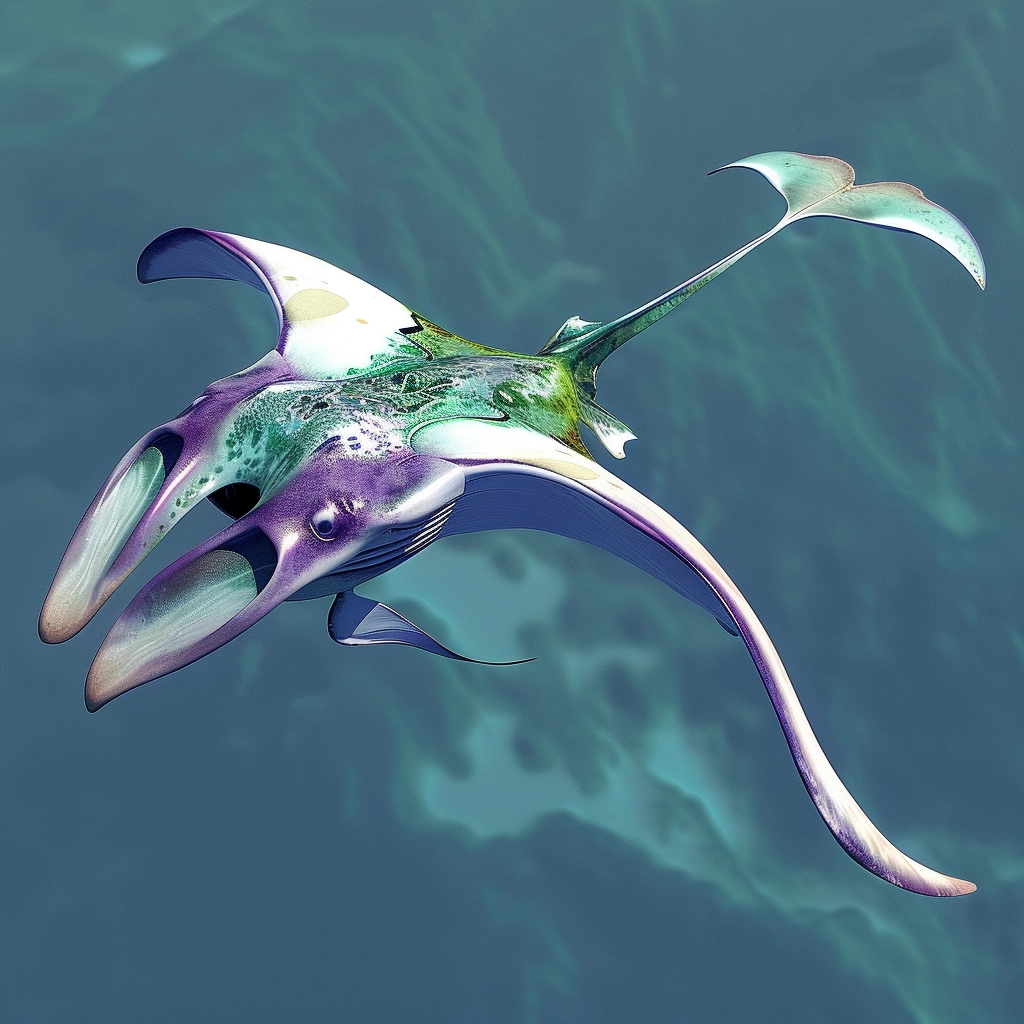
The brith is a majestic creature with the remarkable ability to swim through the air as if it were water. Its large pectoral fins undulate gracefully, propelling it forward in silent, flowing movements. The brith's skin is smooth and predominantly green with purple margins, signalling its presence among the rich grassy vistas of Dantooine. Its white ventral side often catches the sunlight, giving it an almost ethereal glow as it glides through the skies.
Inhabiting the vast, open expanses of Dantooine's grasslands, briths often congregate in loose flocks, their social structure more fluid than hierarchical. They communicate through subtle movements and changes in skin coloration, creating a visual symphony for those fortunate enough to observe them.
During the mating season, the air above Dantooine becomes a theatre for their elaborate courtship displays, where they showcase their colours and agility to potential mates. Briths are oviparous, laying their eggs in secluded, safe locations within the tall grasses, where they are camouflaged from predators.
Their behaviour is largely passive, and they are known to be gentle giants of the sky. However, when threatened, a brith can deliver powerful bites with its rectangular terminal mouth or sweeping blows with its thin, muscular tail.
| STR | DEX | CON | INT | WIS | CHA |
|---|---|---|---|---|---|
| 18 (+4) | 15 (+2) | 16 (+3) | 2 (-4) | 12 (+1) | 7 (-2) |
Flyby. The brith doesn't provoke opportunity attacks when it flies out of an enemy's reach.
Keen Sight. The brith has advantage on Wisdom (Perception) checks that rely on sight.
Bite. Melee Weapon Attack: +6 to hit, reach 5 ft., one target. Hit: 13 (2d8 + 4) piercing damage.
Tail Swipe. Melee Weapon Attack: +6 to hit, reach 10 ft., one creature. Hit: 15 (3d6 + 4) bludgeoning damage.

The C-8 saboteur droid is an advanced type of spy battle droid employed by the Confederacy of Independent Systems during the Clone Wars. Designed for stealth and disruption, this droid specializes in sabotage operations against enemy installations and equipment.
Standing at 1.7 meters tall, the C-8 is relatively shorter compared to other battle droids. Its design features matte-black plating and featureless faceplates, enhancing its stealth capabilities and allowing it to blend into its surroundings. This stealthy exterior is complemented by its humanoid frame, which is both agile and capable of handling various sabotage tools and weapons.
The manufacturer of the C-8 saboteur droid is not explicitly mentioned, but given its sophisticated design and purpose, it was likely produced by one of the Confederacy's primary droid manufacturers, known for creating specialized units for espionage and covert operations.
Tactically, the C-8 saboteur droid excels in infiltration and demolition missions. It is equipped with tools and programming to bypass security systems, plant explosives, and sabotage key infrastructure without drawing attention. Its operations are characterized by a hit-and-run approach, striking quickly and disappearing before the enemy can mount a response. This makes the C-8 an invaluable asset in weakening enemy defences and causing chaos behind the front lines, often leading to significant strategic advantages for the Separatist forces.
| STR | DEX | CON | INT | WIS | CHA |
|---|---|---|---|---|---|
| 8 (-1) | 18 (+4) | 10 (0) | 12 (+1) | 16 (+3) | 10 (0) |
Circuitry. The droid has disadvantage on saving throws against effects that would deal ion or lightning damage.
Nimble. The C-8 can take the Dash or Hide actions as a bonus action on its turn.
Keen Hearing and Sight. The C-8 has advantage on Wisdom (Perception) checks that rely on hearing or sight.
Explosives Expert. When the C-8 installs a breaching charge, it can do so in 30 seconds, instead of 1 minute.
Multiattack. The C-8 makes two weapon attacks with its strike or blaster arm.
Hidden Blade. Melee Weapon Attack: +5 to hit, Reach 5 ft., one target. Hit: 5(1d8+4) kinetic damage.
Wrist Blaster. Ranged Weapon Attack: +6 to hit, Range 60/240 ft., one target. Hit: 8 (2d6+4) energy damage
Wrist Blaster Volley (Recharge 6). The C-8 sprays a 10-foot-cube area within normal range with shots. Each creature in the area must make a DC 13 Dexterity saving throw, taking normal weapon damage on a failed save.

The C-B3 cortosis battle droid is an advanced model designed specifically to counter Jedi in combat. It is similar in appearance to the B2 super battle droid but features an outer shell made of cortosis, a rare material known for its ability to withstand lightsaber strikes. This makes the C-B3 a significant threat to lightsaber-wielding opponents.
Physically, the C-B3 cortosis battle droid is imposing and heavily armoured, with a black, formfitting cortosis shell that gives it a menacing appearance. Its design includes enhanced combat capabilities, allowing it to engage Jedi and other formidable adversaries effectively.
Manufactured by the Techno Union, the C-B3 was developed during the Clone Wars as part of the Confederacy of Independent Systems' ongoing efforts to create droid soldiers capable of challenging the Republic's Jedi. The use of cortosis in its construction was a strategic choice, aiming to leverage the material's lightsaber-resistant properties to gain an advantage in battles involving Jedi.
Tactically, the C-B3 cortosis battle droid is deployed in scenarios where Jedi are expected to be present. Its design allows it to engage in direct combat with the Jedi, using its cortosis armour to resist lightsaber attacks and force the Jedi to rely on alternative combat strategies. This droid is a high-value asset on the battlefield, capable of altering the dynamics of engagement with Jedi forces and requiring strategic planning to overcome its defences.
| STR | DEX | CON | INT | WIS | CHA |
|---|---|---|---|---|---|
| 15 (+2) | 15 (+2) | 15 (+2) | 14 (+2) | 12 (+1) | 11 (0) |
Circuitry. The Cortosis Battle Droid has disadvantage on saving throws against effects that would deal ion or lightning damage.
Cortosis Armor. The Cortosis Battle Droid can reduce damage taken from kinetic, energy, fire & cold attacks by 12 anytime it is damaged
Multiattack. The Cortosis Battle Droid makes four weapon attacks with its strike or wrist blasters
Strike. Melee Weapon Attack: +5 to hit, Reach 5 ft., one target. Hit: 5(1d4+2) kinetic damage.
Double Laser Cannon. Ranged Weapon Attack: +7 to hit, Range 60/240 ft., one target. Hit: 11 (2d6+4) energy damage
Blaster Volley. (Recharge 5-6). The Cortosis Battle Droid sprays a 10-foot-cube area within normal range with shots. Each creature in the area must make a DC 15 Dexterity saving throw, taking normal weapon damage on a failed save.
Parry. The Cortosis Battle Droid adds 3 to its AC against one lightweapon attack that would hit it. To do so, the droid must see the attacker and be wielding a lightweapon.

Cannoks are medium-sized, omnivorous creatures known for their insatiable appetite and adaptability. They possess stocky bodies covered in short, coarse fur, varying in color from dusky browns to dark greys, allowing them to blend into their surroundings. Their heads are characterized by a wide mouth filled with sharp teeth, suitable for consuming a variety of foods, and small, beady eyes that give them a keen sense of their environment. Cannoks have strong, muscular legs that end in clawed feet, adept for both grasping prey and scavenging.
Cannoks are primarily found on the moons of Dxun and Malachor V, thriving in diverse environments ranging from dense jungles to rugged, volcanic terrains. Their adaptability allows them to inhabit areas rich in flora and fauna, where they can easily find food and shelter. On Dxun, they prefer the dense jungle regions, utilizing the thick foliage for camouflage. On Malachor V, they are often found scavenging near the ruins, where the dark and desolate landscapes provide ample hiding spots.
Cannoks are opportunistic feeders, consuming anything from small creatures and carrion to plant matter and refuse left by other species. Their behaviour is primarily driven by their search for food, making them highly curious and sometimes aggressive when provoked or when food is scarce. They are solitary creatures but can be found in small groups when a food source is abundant. Cannoks are known for their cunning and have been observed using simple tools or tactics to access food or navigate their environment.
Cannoks have a simple mating system, where the males often compete for the attention of females through displays of strength or by offering food. Mating occurs once a year, during a specific season when food is most abundant, allowing the parents to provide for their offspring. Females typically give birth to a litter of 2-3 young, which are cared for in secluded dens. The young Cannoks grow quickly, reaching maturity in less than a year, and are taught to fend for themselves from an early age.
Cannoks play a vital role in the ecosystem as both scavengers and predators. By consuming carrion and waste, they help to keep their habitats clean. Additionally, their presence helps to control the populations of smaller creatures, maintaining a balance within their ecosystems. However, their opportunistic nature sometimes leads them to conflict with other species, including sentient beings, when they venture too close to settlements or camps in search of food.
| STR | DEX | CON | INT | WIS | CHA |
|---|---|---|---|---|---|
| 17 (+3) | 14 (+2) | 18 (+4) | 3 (-4) | 13 (+1) | 6 (-2) |
Keen Smell. The Cannok has advantage on Wisdom (Perception) checks that rely on smell.
Opportunistic Feeder. Once per day, the Cannok can regain 10 hit points as a bonus action by consuming organic material in its vicinity.
Multiattack. The Cannok makes two attacks: one with its bite and one with its claws.
Bite. Melee Weapon Attack: +6 to hit, reach 5 ft., one target. Hit: 10 (2d6 + 3) piercing damage.
Claws. Melee Weapon Attack: +6 to hit, reach 5 ft., one target. Hit: 12 (2d8 + 3) slashing damage.

The carrion spat, a native creature of Corellia, stands as a testament to the planet's diverse ecosystem. These flightless avian creatures boast a raptor-like beak and powerful legs, making them excellent mounts for traversing various terrains. Although they lack wings, they possess an elegant plumage that serves as a display for both mating and intimidation. Males and females share this feature, though the coloration may vary, presenting shades from verdant greens to earthy crimsons and browns.
Carrion spats typically inhabit open plains and can be found in small flocks, though they are also known to thrive on other worlds, such as Boz Pity, where they've been introduced. Their society is structured around a dominant pair leading the flock, often the most vibrant and powerful among them. Carrion spats are monogamous, and during the mating season, pairs perform intricate dances using their colourful plumage to attract each other.
Offspring are nurtured by both parents until they are strong enough to run and forage for themselves. In the wild, they exhibit a curious blend of skittish and aggressive behaviours, depending on whether they perceive an individual as part of their flock or an outsider. Domesticated carrion spats, however, are known for their speed and are often utilized as mounts in both civilian and military applications due to their remarkable mobility.
| STR | DEX | CON | INT | WIS | CHA |
|---|---|---|---|---|---|
| 16 (+3) | 14 (+2) | 16 (+3) | 2 (-4) | 12 (+1) | 5 (-3) |
Beast of Burden. The carrion spat is considered to be a Large animal for the purpose of determining its carrying capacity.
Sure-Footed. The carrion spat has advantage on Strength and Dexterity saving throws made against effects that would knock it prone.
Peck. Melee Weapon Attack: +5 to hit, reach 5 ft., one target. Hit: 9 (2d6 + 3) piercing damage.
Trample. Melee Weapon Attack: +5 to hit, reach 5 ft., one target. Hit: 11 (2d8 + 3) bludgeoning damage. If the target is a creature, it must succeed on a DC 14 Strength saving throw or be knocked prone.
Gallop. The carrion spat can use its action to move up to its speed. During this move, it can make one trample attack against any creature it moves over.

The Cavern Crawler is a creature of the deep, dwelling in the darkest corners of underground caves. Its body is covered in shiny, black chitin that serves as a natural armour against predators and the harsh environment of the caves. The chitin is segmented, allowing for flexibility and movement in the tight spaces of its subterranean home.
The creature is about the size of a large dog, but its long, slender limbs give it a deceptively larger appearance. Each limb ends in a set of sharp claws, which are not only used for combat but also for clinging to the walls and ceilings of the caves. This ability to move in all directions makes the Cavern Crawler a formidable hunter in its environment. Its eyes are large and compound, a necessary adaptation for life in complete darkness. These eyes give the Cavern Crawler excellent night vision, allowing it to spot prey and threats in the pitch-black caves. The Cavern Crawler's mouth is filled with sharp teeth, used for tearing apart its prey. It has a powerful jaw that can deliver a painful bite, one of its primary methods of attack.
One of the most unique abilities of the Cavern Crawler is its ability to burrow through the ground. This ability, combined with its natural stealth and agility, allows it to surprise its prey or escape from threats quickly. It can burrow at a speed of 20ft, disappearing into the ground and reappearing when least expected.
Despite its fearsome appearance and abilities, the Cavern Crawler is not particularly intelligent. It operates mainly on instinct, driven by the basic needs to feed, survive, and reproduce. However, its wisdom is not to be underestimated. It has a keen sense of its surroundings and a natural cunning that makes it a successful predator in its environment.
In the right light, the Cavern Crawler's chitin can give off a faint shimmer, a sight that is both beautiful and terrifying. This, combined with its eerie, silent movement, makes the Cavern Crawler a truly unforgettable creature of the underground world.
| STR | DEX | CON | INT | WIS | CHA |
|---|---|---|---|---|---|
| 14 (+2) | 18 (+4) | 16 (+3) | 4 (-3) | 10 (0) | 6 (-2) |
Wall Clinger. Cavern Crawlers can cling to walls and ceilings as easily as they move on the ground.
Darkvision. Cavern Crawlers can see in complete darkness.
Burrow. Cavern Crawlers have the ability to burrow through the ground at a speed of 20ft, allowing them to surprise their prey or escape from threats.
Multiattack. The Cavern Crawler makes two claw attacks and one bite attack each turn.
Claw Slash. Melee Weapon Attack: +4 to hit, range 5 ft., one target. Hit: 8 (1d8+4) kinetic damage.
Bite. Melee Weapon Attack: +4 to hit, range 5 ft., one target. Hit: 7 (1d6+4) kinetic damage.

The Cephalofin, a fascinating creature native to the planet Lwhekk in the remote Ssi'kaat system of the Ssi-ruuk Star Cluster, is a marvel of aquatic evolution. Residing in the deep oceans of Lwhekk, this sentient marine being boasts a captivating appearance and impressive cognitive capabilities.
Physically, the Cephalofin possesses a sleek and agile body that combines elements of a squid and a dolphin. Its form is perfectly adapted for swift swimming, allowing it to navigate the ocean depths with ease. Its body is elongated and streamlined, with a muscular torso enabling efficient propulsion through the water. The creature's skin is adorned in a vibrant shade of blue, radiating an ethereal beauty that harmonizes with its aquatic environment.
The most striking feature of the Cephalofin is its large, bulbous head, which houses a highly developed brain. This remarkable organ grants the creature intelligence on par with that of humans and fuels its insatiable curiosity. The head is perched atop a graceful neck, providing excellent mobility and granting the creature an elegant, almost regal appearance.
A distinguishing characteristic of the Cephalofin is the presence of multiple tentacles that emanate from its body. These tentacles are remarkably dexterous and serve a multitude of purposes. They can be utilized for precise manipulation of objects and intricate tasks, allowing the creature to interact with its environment in a sophisticated manner. Each tentacle possesses a remarkable level of flexibility and sensitivity, enabling the Cephalofin to explore its surroundings with a delicate touch.
The skin of the Cephalofin is adorned with bioluminescent spots, which add to its mesmerizing allure. These spots serve multiple functions, acting as a means of communication within its species, allowing for intricate patterns and signals to be displayed. Additionally, the creature can control the intensity and colour of its bioluminescent spots, utilizing them as a form of visual display to both attract prey and deter potential predators. This ability to manipulate its luminosity adds a touch of otherworldly beauty to the creature's already captivating appearance.
Within the depths of the oceans on Lwhekk, the Cephalofin thrives, utilizing its remarkable intellect and physical attributes to navigate the marine ecosystems and unravel the mysteries of its watery home. Its presence serves as a testament to the incredible diversity of life that exists within the Star Wars universe, showcasing the wonders that lie beyond the reaches of the known galaxy.
| STR | DEX | CON | INT | WIS | CHA |
|---|---|---|---|---|---|
| 16 (+3) | 14 (+2) | 16 (+3) | 10 (0) | 14 (+2) | 12 (+1) |
Force Sensitive. The Cephalofin is force sensitive and has the following innate force powers:
Tentacle Slam. Melee Weapon Attack: +6 to hit, reach 10 ft., one target. Hit: 13 (2d8 + 4) bludgeoning damage.
Ink Cloud (Recharges after a Short or Long Rest). A 20-foot-radius cloud of ink extends all around the Cephalofin if it is underwater. The area is heavily obscured for 1 minute, although a significant current can disperse the ink. After releasing the ink, the Cephalofin can use the Dash action as a bonus action.

The Arakyd Industries chameleon droid was a mine-laying sabotage probe droid used by the Confederacy of Independent Systems during the Clone Wars. Originally mining exploration droids known as Spelunker probe droids, they were outfitted with laser cannons, military-grade mines, and a holographic array for military service. The array worked by scanning the background and the angle of the viewer's sight, then projecting a hologram of the background behind the droid, camouflaging it.
The class four chameleon droid was two meters tall and had four articulated pincer legs for travelling, as well as a repulsor lift to further support the weight of its cylindrical body. The legs could generate traction fields, allowing it to walk vertically and even upside down. The droids, which were able to survive in a wide range of climates, were dispatched to planets via hyperspace pods.
The chameleon droid's primary job was not as a front-line combat unit but rather as a covert droid designed to sneak into enemy lines, lay mines, and assassinate or sabotage Republic targets. A common tactic used by them was to lay down a large number of mines around the intended target while invisible and then open fire, with the intent to herd the enemy targets into the mined area.
| STR | DEX | CON | INT | WIS | CHA |
|---|---|---|---|---|---|
| 12 (+1) | 18 (+4) | 14 (+2) | 13 (+1) | 16 (+3) | 7 (-2) |
Circuitry. The droid has disadvantage on saving throws against effects that would deal ion or lightning damage.
Holographic Cloak. As a bonus action, the droid becomes invisible. Anything the droid is carrying is invisible as long as it is on the droid. The droid may end the invisibility as a free action. The invisibility ends if the droid attacks.
Keen Hearing and Sight. The droid has advantage on Wisdom (Perception) checks that rely on hearing or sight.
Multiattack. The droid makes two weapon attacks and sets a mine.
Triple Laser Cannons. Ranged Weapon Attack: +7 to hit, range 60/240 ft., one target. Hit: 14 (3d6+4) energy damage.
Claw. Melee Weapon Attack: +7 to hit, reach 5 ft., one target. Hit: 4 (1d6+1) kinetic damage.
Mine Deployer (12/day). The droid sets a mine with an imperceptible laser line extending up to 15 feet. When the laser is tripped, the mine explodes, and each creature within 15 feet of it must make a DC 13 Dexterity saving throw. On a failed save, a creature takes 10 (3d6) kinetic damage, or half as much on a successful one.
Self-Destruct. When the droid is reduced to half of its hit point maximum, it attempts to self-destruct. Each creature within 20 feet of it must make a DC 14 Dexterity saving throw, taking 21 (6d6) fire damage on a failed save, or half as much on a successful one.

The Colicoid Infiltrator-series droid is an assassin droid model designed for stealth and efficiency in eliminating targets. These droids are known for their ability to operate undetected until they strike, making them feared among their adversaries.
Physically, the Infiltrator-series droid features a sleek, streamlined design optimized for covert operations. They are equipped with advanced cloaking technology, allowing them to blend into their surroundings and approach targets unnoticed. The droid's structure is humanoid, with appendages that are capable of precise and lethal movements, often armed with built-in weaponry such as blasters or blades.
Produced by the Colicoid Creation Nest, known for their menacing and efficient designs like the Droideka, the Infiltrator-series droid was used primarily by the Confederacy of Independent Systems during the Clone Wars. The Colicoids' expertise in creating droids that are both formidable in combat and capable of complex autonomous missions made the Infiltrator series a valuable asset in espionage and assassination operations.
In terms of tactics, the Infiltrator-series droids were deployed for missions requiring a high degree of stealth and precision. They were often used to eliminate key personnel or disrupt enemy operations from within, leveraging their ability to infiltrate secure locations undetected. Their programming allowed them to adapt to various environments and combat situations, making them versatile operatives capable of executing a wide range of directives to destabilize enemy forces effectively.
| STR | DEX | CON | INT | WIS | CHA |
|---|---|---|---|---|---|
| 18 (+4) | 20 (+5) | 13 (+1) | 18 (+4) | 12 (+1) | 8 (-1) |
Circuitry. The droid has disadvantage on saving throws against effects that would deal ion or lightning damage.
Spider Climb. The infiltrator droid can climb difficult surfaces, including upside down on ceilings, without needing to make an ability check.
Keen Hearing and Sight. The infiltrator droid has advantage on Wisdom (Perception) checks that rely on hearing or sight.
Techcasting. The infiltrator droid is a 4rd-level techcaster. Its techcasting ability is Intelligence (tech save DC 13, +12 to hit with tech powers). It has 18 tech points and knows the following tech powers:
Multiattack. The infiltrator Droid makes three weapon attacks with its vibroblades or its blaster rifle.
Vibroblades. Melee Weapon Attack: +5 to hit, Reach 5 ft., one target. Hit: 10(2d8+4) kinetic damage.
Blaster Rifle. Ranged Weapon Attack: +5 to hit, Range 40/160 ft., one target. Hit: 17 (3d6+4) energy damage.
Deflector Shield. The Colicoid Infiltrator-series droid adds 3 to its AC against one attack that would hit it. To do so, the droid must see the attacker.
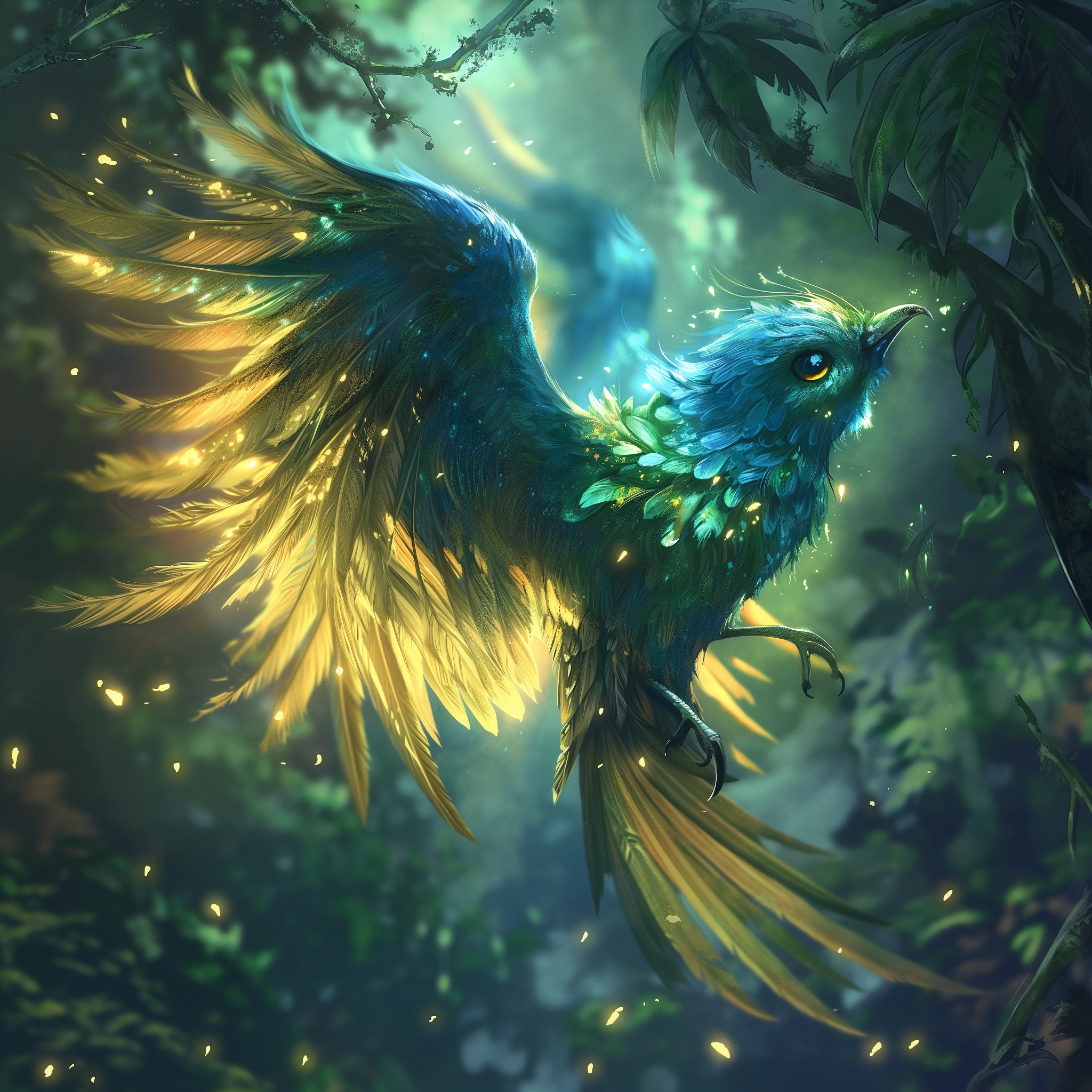
The Convor is not merely a bird; it's a spectral presence on the wings of the wind, often perceived as an omen or guide by those sensitive to the Force. These creatures exhibit an uncanny connection to the mystical energy field, appearing at moments of significant destiny or turmoil. In some cultures, the sighting of a Convor is considered a blessing, a sign that the Force is in motion, and guidance is near.
The Convor's plumage is its most striking feature, with each feather painted in bright hues that seem to glow under moonlight. These colours are not just for display; they serve as camouflage among the vibrant flora of their native worlds. Their eyes, large and luminous, allow them to see clearly even in low light, reflecting a world beyond our understanding. The agility of these birds is unparalleled, capable of executing turns and dives that defy their tiny stature.
Though primarily found in lush, verdant environments, Convors have adapted to a variety of ecosystems across the galaxy. From the misty canopies of Endor to the secluded cliffs of Ahch-To, these birds make their homes where the veil between the physical and the Force seems thinnest. Their nests, constructed from twigs and Force-sensitive materials, resonate with energy, often becoming places of pilgrimage for those seeking enlightenment.
Convors are loners by nature, but their impact on the galaxy's folklore is profound. Stories and legends depict them as messengers of the Force, carrying the spirits of fallen warriors or guiding lost souls to peace. The sight of a Convor circling overhead can inspire both awe and fear, for it is said they mark the presence of ancient powers and hidden truths waiting to be unveiled.
The breeding rituals of the Convor are shrouded in mystery, aligned with celestial events and strong Force currents. These events are rare, leading to the belief that Convors are eternal, their spirits reincarnating through the Force to continue their sacred vigil over the galaxy.
Beyond their mystical significance, Convors display extraordinary intelligence and curiosity. They have been known to interact with individuals strong in the Force, following them as if drawn by an invisible thread. Their calls, a complex melody of sounds, are believed to communicate not just with each other but with the Force itself, weaving a song that binds the galaxy together.
| STR | DEX | CON | INT | WIS | CHA |
|---|---|---|---|---|---|
| 3 (-4) | 15 (+2) | 10 (0) | 5 (-3) | 12 (+1) | 6 (-2) |
Keen Sight. The Convor has advantage on Wisdom (Perception) checks that rely on sight.
Mimicry. The Convor can mimic simple sounds it has heard, such as a person whispering or a door creaking. A creature that hears the sounds can tell they are imitations with a successful DC 10 Wisdom (Insight) check.
Talons. Melee Weapon Attack: +4 to hit, reach 5 ft., one target. Hit: 4 (1d4 + 2) slashing damage.

The Coruscani ogre was a large semi-sentient humanoid beast that lived in Coruscant sublevels, sewers, and dumps.
While most of these ogres demonstrated similar features such as sparse patches of hair, leathery skin, and large misshapen angular heads with wide mouths containing jagged teeth, it was interesting to note that no two of these beasts looked alike. Millennia of exposure to sewage, pollution, reactor radiation, poor diets, and destroyed ecosystems on Coruscant most likely contributed to the ogres' deformed, motley, mutated appearances. It is believed that these creatures were primates and closely related to Humans. However, like the Corridor ghoul, the true origins of this creature are unknown.
An operation needed to lobotomize an ogre and implant them with cybernetics was less expensive when compared to purchasing a new droid.
Ogres were observed using basic tools and weapons such as clubs, but so far it is unknown if an ogre could be taught to communicate. They also had been observed using rags and cloth to warm and cover their body, though this behaviour was extremely rare. Ogres were omnivorous scavengers and hunters, but preferred to avoid Human contact. However, an ogre was dangerous to sentient creatures if threatened, startled, scared, angry, or hungry.
| STR | DEX | CON | INT | WIS | CHA |
|---|---|---|---|---|---|
| 12 (+1) | 9 (-1) | 18 (+4) | 4 (-3) | 12 (+1) | 7 (-2) |
Disturbing Visage. Any creature other than an ogre that starts its turn or enters within 5 feet of the ogre for the first time on its turn must succeed on a DC 13 Constitution saving throw or be poisoned until the start of the creature's next turn. On a successful saving throw, the creature is immune to the visage of all ogres for 1 hour.
Reckless Attacks. The ogre has advantage on all melee weapon attack rolls, but attack rolls against it have advantage.
Multiattack. The ogre makes two mutated claw attacks.
Mutated Claw. Melee Weapon Attack: +3 to hit, range 10 ft., one target. Hit: 7 (1d12+1) kinetic damage.

The Crystal Reaver is a large, six-legged creature that stands about 8 feet tall at the shoulder. Its body is covered in a thick, white fur that has a unique crystalline sheen, allowing it to blend seamlessly into the grasslands of Crystal Nest. The fur is dense and provides excellent protection against both physical attacks and the harsh weather conditions of its home planet.
The creature’s most striking features are its long, curved tusks, which are made of a hard, crystal-like substance. These tusks are used both for defence and for asserting dominance during mating season. The Reaver’s six legs end in large paws equipped with sharp, retractable claws. These claws are not only deadly weapons but also help the creature gain traction on the slippery crystal grasslands.
Crystal Reavers are solitary creatures, each one claiming a large territory as its own and fiercely defending it from intruders. They are primarily nocturnal, hunting under the cover of darkness and sleeping during the day. Despite their size and fearsome appearance, Crystal Reavers are surprisingly stealthy, able to move silently through the grasslands and pounce on unsuspecting prey.
Crystal Reavers are carnivorous, feeding on the various fauna that inhabit the grasslands of Crystal Nest. They are capable hunters, using their speed, strength, and stealth to take down their prey. They are also known to scavenge when food is scarce.
During the mating season, male Crystal Reavers will engage in fierce battles, using their tusks and claws to inflict damage on their rivals. The victor earns the right to mate with the females in the area. After mating, the female will find a secluded spot to give birth and raise her young until they are strong enough to fend for themselves.
Crystal Reavers are formidable opponents in combat. Their Crystal Thrust attack can cause significant damage, and their Crystal Swipe can reach enemies that are slightly out of their immediate range. Their high constitution makes them resilient, and their strength makes their attacks particularly devastating. However, their low intelligence and charisma mean they are not particularly cunning or persuasive creatures.
| STR | DEX | CON | INT | WIS | CHA |
|---|---|---|---|---|---|
| 20 (+5) | 10 (0) | 18 (+4) | 4 (-3) | 12 (+1) | 6 (-2) |
Crystal Thrust (Tusk Thrust). Melee Weapon Attack: +5 to hit, reach 5 ft., one target. Hit: 11 (2d6 + 5) kinetic damage.
Crystal Swipe (Claw Swipe). Melee Weapon Attack: +5 to hit, reach 10 ft., one target. Hit: 9 (1d8 + 5) kinetic damage.

The Dark Lizard is a fearsome creature, stretching 10 feet in length with an obsidian hide that seems to consume light, radiating vile dark side energy. Its eyes glow a sinister coral, akin to a Dark Lord's, set above a maw filled with black stiletto teeth and a prehensile charcoal tongue, giving rise to its nickname, "Dark Tongue." Along its back, two rows of sharp spikes add to its predatory aura, while its limbs, ending in huge ivory claws, underscore its lethal nature. This ebony beast, glowing dimly with darkness and dripping tar-like drool, embodies the raw malice of the dark side, making it a symbol of fear and power among Sith cultists and crime lords alike.
The Dark Lizard thrives in shadowy, sinister environments that resonate with the dark side of the Force, such as the foreboding landscapes of Almas, a planet steeped in Sith history and dark energies. These creatures are found in the darkest recesses where the dark side is strongest, from ancient Sith temples submerged in darkness to the depths of twisted jungles where light barely penetrates. Their lairs are often littered with the remnants of their prey and are shrouded in an almost palpable aura of darkness, making them places few dare to tread.
Dark Lizards are solitary predators by nature, coming together only to mate or in rare circumstances where a powerful dark side user commands their allegiance. Despite their lack of a structured society, the influence of the dark side creates a rudimentary hierarchy among them, with the strongest, most malevolent individuals commanding respect and fear from their lesser kin.
The role of Dark Lizards in the cultures that revere or utilize them, particularly among Sith cultists like the Believers on Almas and power-mad crime lords across the galaxy, is multifaceted. They are symbols of power and control, living embodiments of the dark side that serve both as exotic, intimidating pets and as guardians of forbidden places. The Believers, in particular, see them as sacred creatures, perhaps even direct gifts from the dark side, to be used in rituals and as guardians of their most sacred sites.
The Dark Lizard is not just a creature of physical might; it is deeply intertwined with the dark side of the Force. It does not merely inhabit areas strong with the dark side; it draws strength from these places, with its own malevolent presence amplifying the ambient darkness. The beast's connection to the dark side is such that its mere presence can unsettle the weak-minded and those sensitive to the Force, making it an effective tool for Sith and dark-side practitioners to guard their domains or intimidate their enemies.
The dark side's influence is evident in every aspect of the Dark Lizard's being, from its glowing, coral eyes to its inky black drool. This connection manifests in their hunting behaviour as well; they are known to use the dark side to disorient or paralyze their prey before striking with their deadly claws and teeth.
Little is known about the reproduction of Dark Lizards, as their encounters are rare and shrouded in mystery. However, it is speculated that their mating rituals involve displays of power and dominance, with the dark side playing a role in attracting mates. The offspring are believed to be independent from birth, emerging from their eggs fully capable of harnessing the dark side to hunt and survive.
| STR | DEX | CON | INT | WIS | CHA |
|---|---|---|---|---|---|
| 19 (+4) | 14 (+2) | 17 (+3) | 5 (-3) | 14 (+2) | 8 (-1) |
Amphibious. The dark lizard can breathe air and water.
Keen Sight and Smell. The dark lizard has advantage on Wisdom (Perception) checks that rely on sight and smell.
Sith-born. Dark force casters and Sith (species) have advantage on Animal Handling checks against the dark lizard.
Pounce. If the dark lizard moves at least 20 ft. straight toward a creature and then hits it with a claw attack on the same turn, that target must succeed on a DC 14 Strength saving throw or be knocked prone. If the target is prone, the dark lizard can make one bite attack against it as a bonus action.
Multiattack. The dark lizard makes two claw and one bite attack or one claw and prehensile tongue attack.
Bite. Melee Weapon Attack: +6 to hit, range 5 ft., one target. Hit: 9 (1d10+4) kinetic damage.
Claw. Melee Weapon Attack: +6 to hit, range 5 ft., one target. Hit: 8 (1d8+4) kinetic damage.
Prehensile Tongue. Melee Weapon Attack: +6 to hit, range 10 ft., one target. Hit: If the target is medium or smaller, it must make a DC 14 Strength saving throw. On a failed save, the target is pulled into an unoccupied space within 5 feet of the dark lizard and the dark lizard can make a bite attack against it as a bonus action.

The Dark Lizard is a fearsome creature, stretching 10 feet in length with an obsidian hide that seems to consume light, radiating vile dark side energy. Its eyes glow a sinister coral, akin to a Dark Lord's, set above a maw filled with black stiletto teeth and a prehensile charcoal tongue, giving rise to its nickname, "Dark Tongue." Along its back, two rows of sharp spikes add to its predatory aura, while its limbs, ending in huge ivory claws, underscore its lethal nature. This ebony beast, glowing dimly with darkness and dripping tar-like drool, embodies the raw malice of the dark side, making it a symbol of fear and power among Sith cultists and crime lords alike.
The Dark Lizard thrives in shadowy, sinister environments that resonate with the dark side of the Force, such as the foreboding landscapes of Almas, a planet steeped in Sith history and dark energies. These creatures are found in the darkest recesses where the dark side is strongest, from ancient Sith temples submerged in darkness to the depths of twisted jungles where light barely penetrates. Their lairs are often littered with the remnants of their prey and are shrouded in an almost palpable aura of darkness, making them places few dare to tread.
Dark Lizards are solitary predators by nature, coming together only to mate or in rare circumstances where a powerful dark side user commands their allegiance. Despite their lack of a structured society, the influence of the dark side creates a rudimentary hierarchy among them, with the strongest, most malevolent individuals commanding respect and fear from their lesser kin.
The role of Dark Lizards in the cultures that revere or utilize them, particularly among Sith cultists like the Believers on Almas and power-mad crime lords across the galaxy, is multifaceted. They are symbols of power and control, living embodiments of the dark side that serve both as exotic, intimidating pets and as guardians of forbidden places. The Believers, in particular, see them as sacred creatures, perhaps even direct gifts from the dark side, to be used in rituals and as guardians of their most sacred sites.
The Dark Lizard is not just a creature of physical might; it is deeply intertwined with the dark side of the Force. It does not merely inhabit areas strong with the dark side; it draws strength from these places, with its own malevolent presence amplifying the ambient darkness. The beast's connection to the dark side is such that its mere presence can unsettle the weak-minded and those sensitive to the Force, making it an effective tool for Sith and dark-side practitioners to guard their domains or intimidate their enemies.
The dark side's influence is evident in every aspect of the Dark Lizard's being, from its glowing, coral eyes to its inky black drool. This connection manifests in their hunting behaviour as well; they are known to use the dark side to disorient or paralyze their prey before striking with their deadly claws and teeth.
Little is known about the reproduction of Dark Lizards, as their encounters are rare and shrouded in mystery. However, it is speculated that their mating rituals involve displays of power and dominance, with the dark side playing a role in attracting mates. The offspring are believed to be independent from birth, emerging from their eggs fully capable of harnessing the dark side to hunt and survive.
| STR | DEX | CON | INT | WIS | CHA |
|---|---|---|---|---|---|
| 19 (+4) | 14 (+2) | 17 (+3) | 5 (-3) | 14 (+2) | 8 (-1) |
Amphibious. The dark lizard can breathe air and water.
Keen Sight and Smell. The dark lizard has advantage on Wisdom (Perception) checks that rely on sight and smell.
Sith-born. Dark force casters and Sith (species) have advantage on Animal Handling checks against the dark lizard.
Pounce. If the dark lizard moves at least 20 ft. straight toward a creature and then hits it with a claw attack on the same turn, that target must succeed on a DC 14 Strength saving throw or be knocked prone. If the target is prone, the dark lizard can make one bite attack against it as a bonus action.
Multiattack. The dark lizard makes two claw and one bite attack or one claw and prehensile tongue attack.
Bite. Melee Weapon Attack: +6 to hit, range 5 ft., one target. Hit: 9 (1d10+4) kinetic damage.
Claw. Melee Weapon Attack: +6 to hit, range 5 ft., one target. Hit: 8 (1d8+4) kinetic damage.
Prehensile Tongue. Melee Weapon Attack: +6 to hit, range 10 ft., one target. Hit: If the target is medium or smaller, it must make a DC 14 Strength saving throw. On a failed save, the target is pulled into an unoccupied space within 5 feet of the dark lizard and the dark lizard can make a bite attack against it as a bonus action.
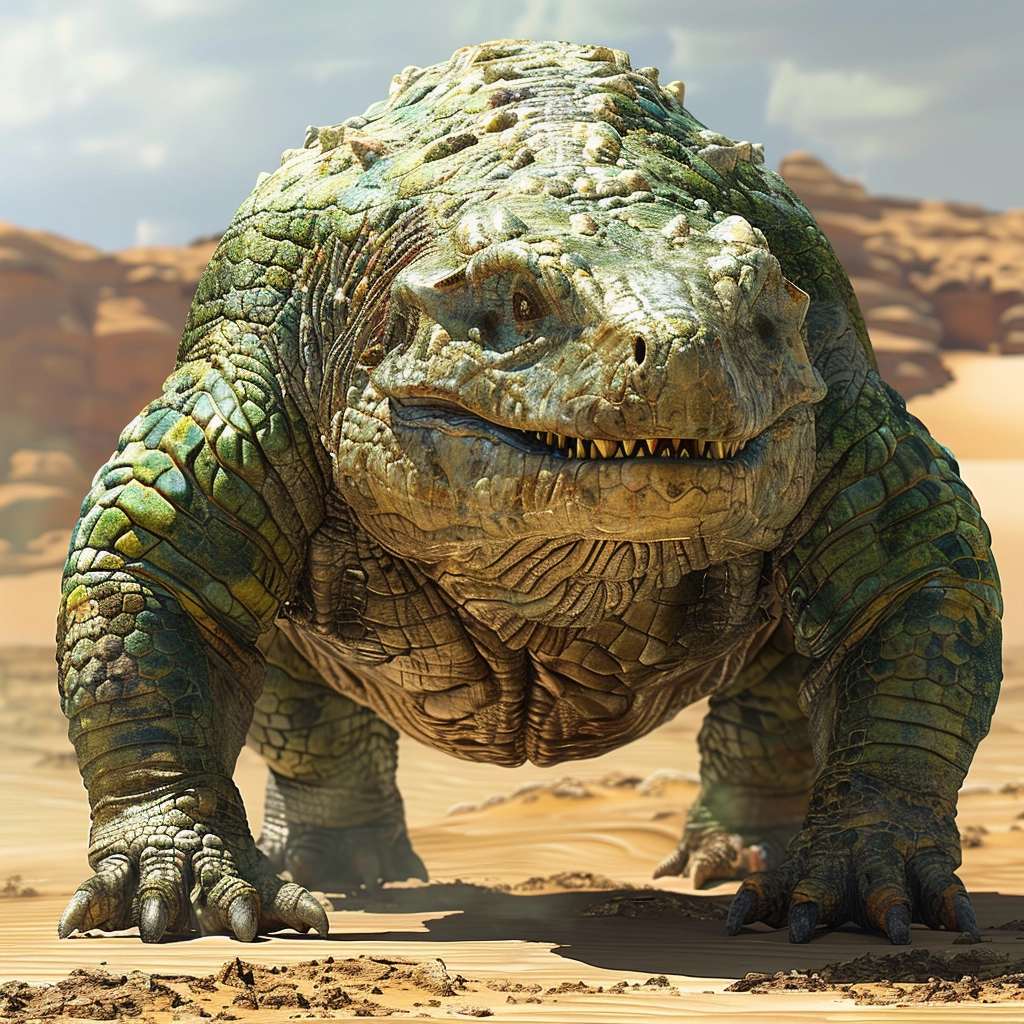
Dewbacks are formidable creatures, native to the harsh deserts of Tatooine. Their rugged, green scales blend seamlessly into the dunes, making them excellent mounts for patrols or heavy lifting in the unforgiving suns.
These reptiles stand between 1.3 to 2.1 meters tall and can stretch up to 3 meters long. Predominantly green, they can also exhibit red, brown, gray, and, rarely, blue scales, often in a camouflage pattern to deflect Tatooine’s twin suns and preserve moisture.
Dewbacks are well-suited to life in Tatooine’s Dune Sea, thriving in the extreme heat and capable of going days without water thanks to specialized scales that reduce glare and conserve fluids.
While not sociable creatures, Dewbacks can be domesticated and are often used by Tatooine’s settlers and the Imperial troops as sturdy mounts or pack animals due to their strength and resilience.
Information on their breeding habits is scarce, but like many reptiles, they likely lay eggs. The conditions on Tatooine suggest that their offspring must be hardy to survive the harsh environment from birth.
Dewbacks are mostly solitary but can be seen in small packs roaming the deserts in search of food and moisture. They huddle together at night to retain warmth and moisture collected as dew on their backs, which is both a vital water source and the origin of their name.
| STR | DEX | CON | INT | WIS | CHA |
|---|---|---|---|---|---|
| 20 (+5) | 10 (0) | 16 (+3) | 2 (-4) | 13 (+1) | 7 (-2) |
Keen Smell. The Dewback has advantage on Wisdom (Perception) checks that rely on smell.
Multiattack. The Dewback makes two attacks: one with its bite and one with its claws.
Bite. Melee Weapon Attack: +7 to hit, reach 5 ft., one target. Hit: 9 (1d8 + 5) kinetic damage.
Claw. Melee Weapon Attack: +7 to hit, reach 5 ft., one target. Hit: 12 (2d6 + 5) kinetic damage.

Dokmas are medium-sized creatures known for their agile movements and keen senses. Originating from the lush, forested world of Kashyyyk, they are often found in the towering wroshyr trees, navigating the canopy with ease. Despite their somewhat fearsome appearance, Dokmas are non-aggressive unless provoked or hunting.
Dokmas possess a lean, muscular build covered in short, coarse fur, ranging in colour from dark brown to black. They have sharp, elongated snouts and large, sensitive ears that pivot to catch the slightest sounds. Their eyes are large and luminous, adapted to their nocturnal lifestyle. Four powerful limbs end in sharp claws for climbing and grasping, while their long, bushy tails aid in balance.
Primarily arboreal, Dokmas thrive in dense, forested environments like those of Kashyyyk. They build nests in the crooks of trees and are rarely seen on the ground. Dokmas are solitary creatures, each claiming a vast territory as its own.
Dokmas have no discernible society or culture, being solitary animals. They communicate through a series of growls and chirps, especially during mating seasons or territorial disputes.
Dokma mating occurs once a year, with females giving birth to a litter of 2-3 young after a gestation period of several months. The young are cared for in the nest, learning to climb and hunt from their mother before leaving to find their own territories.
Dokmas are nocturnal, spending the day resting in their nests and becoming active at night to hunt. They primarily feed on smaller creatures and insects found in the trees but are known to occasionally descend to the forest floor for food.
| STR | DEX | CON | INT | WIS | CHA |
|---|---|---|---|---|---|
| 12 (+1) | 14 (+2) | 12 (+1) | 2 (-4) | 12 (+1) | 6 (-2) |
Keen Smell. The Dokma has advantage on Wisdom (Perception) checks that rely on smell.
Climber. The Dokma can climb difficult surfaces, including upside down on ceilings, without needing to make an ability check.
Bite. Melee Weapon Attack: +4 to hit, reach 5 ft., one target. Hit: 7 (2d4 + 2) piercing damage.

The droideka, also called the destroyer droid (destroyers for short), was a type of heavy battle droid used by the Trade Federation and the Confederacy of Independent Systems. It gained a reputation for deadliness over the course of the Clone Wars. Droid commanders, such as General Grievous, favoured the droideka for its resilience and firepower, as well as the fear it could instill in even the most powerful Jedi. They were also used for executions. They were deployed in many battles over the course of the Clone Wars, such as Muunilinst, usually in moderate numbers due to their cost, and were also used as guards in various Confederate installations. Trade Federation and Confederate Navy also utilized droidekas as security droids aboard their ships. After the Clone Wars, the remaining droidekas fell into the hands of a variety of factions such as smugglers and criminals.
| STR | DEX | CON | INT | WIS | CHA |
|---|---|---|---|---|---|
| 14 (+2) | 18 (+4) | 16 (+3) | 14 (+2) | 16 (+3) | 7 (-2) |
Explosives Vulnerability. While in attack form, the droideka has disadvantage on dexterity saving throws, and saving throws against grenades that detonate within its space.
Circuitry. The droideka has disadvantage on saving throws against effects that would deal ion or lightning damage.
Deflector Shield. As a bonus action while in attack form, the droideka can activate its deflector shield. The droideka gains +2 AC when the deflector shield is active. The deflector has 80 hit points. Whenever the droideka takes damage other than ion or lightning, the shield takes the damage instead. If this damage reduces the shield to 0 hit points, the droideka takes any remaining damage.
The droideka can deactivate the shield (no action required). When deactivated the shield regenerates 10 hit points at the end of the droideka's turn. Additionally, the shield shuts down when entering ball form.
Multiattack. The droideka makes two weapon attacks.
Twin Blaster Cannons. Ranged Weapon Attack: +7 to hit, range 80/320 ft., one target. Hit: 13 (2d8+4) energy damage.
Twin Blaster Cannons Burst (Recharge 4-6). The droideka sprays a 10-foot cube area within range. Each creature in the area must make a DC 15 Dexterity saving throw, taking 22 (4d8+4) energy damage on a failed save, or half as much on a successful one.
Ball Form. The droideka can transform into or out of ball form. While in ball form, the droideka has increased speed and no longer has disadvantage grenades, but it can't attack.
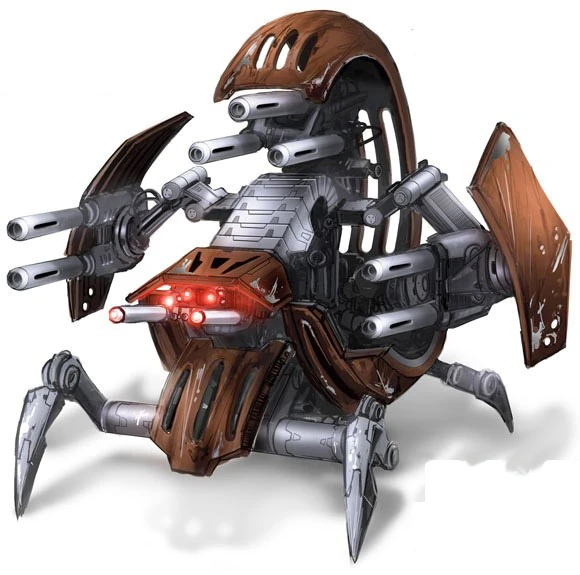
Like its predecessor, the Mark II was vulnerable when it was moving; however, when deployed, it was essentially a turret. This version of the droideka was different from previous types not only in appearance but also in capabilities, as they were capable of switching between blaster cannons and ion cannons, which allowed them to combat infantry or vehicles. Like the original droideka, they utilized a shield to protect themselves from harm when they were deployed.
| STR | DEX | CON | INT | WIS | CHA |
|---|---|---|---|---|---|
| 14 (+2) | 20 (+5) | 18 (+4) | 15 (+2) | 16 (+3) | 7 (-2) |
Circuitry. The droid has disadvantage on saving throws against effects that would deal ion or lightning damage.
Deflector Shield. As a bonus action while in attack form, the droideka can activate its deflector shield. The droideka gains +2 AC when the deflector shield is active. The deflector has 120 hit points. Whenever the droideka takes damage other than ion or lightning, the shield takes the damage instead. If this damage reduces the shield to 0 hit points, the droideka takes any remaining damage. The droideka can deactivate the shield (no action required). When deactivated the shield regenerates 20 hit points at the end of the droideka's turn. The shield shuts down and cannot be activated when in ball form.
Multiattack. The droideka makes two attacks with its twin blaster cannons and either one attack with its ion cannon or it uses its triple blaster cannon burst, if available.
Twin Blaster Cannons. Ranged Weapon Attack: +9 to hit, range 100/400 ft., one target. Hit: 16 (2d10+5) energy damage.
Triple Blaster Cannon Burst (Recharge 5-6). The droideka sprays a 10-foot cube area within range. Each creature in the area must make a DC 17 Dexterity saving throw, taking 21 (3d10+5) energy damage on a failed save, or half as much on a successful one.
Twin Ion Cannons. Ranged Weapon Attack: +9 to hit, range 80/320 ft., one target. Hit: 12 (2d6+5) ion damage.
Ball Form. The droideka can transform into or out of ball form. While in ball form, the droideka has increased speed, but it can't attack.

The DSD1 dwarf spider droid, known in Star Wars Legends, is a small, multi-legged combat droid used by the Confederacy of Independent Systems during the Clone Wars. These droids are recognized for their agility, durability, and combat effectiveness in various terrains and environments.
Physically, the DSD1 resembles a spider, with a central spherical body from which multiple articulated legs extend, allowing for rapid movement and stability on uneven surfaces. Its primary weapon is a centrally-mounted blaster cannon capable of rotating to track targets efficiently. The design emphasizes low profile and mobility, making it a challenging target in battle.
Manufactured by Baktoid Armor Workshop, the DSD1 dwarf spider droid was designed to support infantry forces, providing heavy firepower in a compact frame. Its role on the battlefield varied from direct assault to support and defence, capable of engaging both ground and low-flying targets.
In terms of tactics, the DSD1 was often used in swarms to overwhelm enemy forces, leveraging its mobility to flank and execute pincer movements. Its ability to traverse difficult terrain made it particularly effective in environments where larger vehicles would be impeded, such as dense forests or urban ruins. The droid's blaster cannon is effective against both personnel and light vehicles, making it a versatile asset in the Separatist droid army.
| STR | DEX | CON | INT | WIS | CHA |
|---|---|---|---|---|---|
| 15 (+2) | 16 (+3) | 14 (+2) | 10 (0) | 14 (+2) | 9 (-1) |
Circuitry. The spider droid has disadvantage on saving throws against effects that would deal ion or lightning damage.
Spider Climb. The spider droid can climb difficult surfaces, including upside down on ceilings, without needing to make an ability check.
Triangulation. The spider droid selects a target it can perceive and sends a digital signal to an OG-9 homing spider droid within 600 feet but more than 60 feet away. The OG-9 is made aware of the target's exact location, even if it cannot see it directly, and its next attack roll against that target is made with advantage, or the next saving throw that target must make against the OG-9's attack is made with disadvantage. Any effect that blocks communications, such as a comm jammer, can prevent this action from taking place. The dwarf spider droid will know if its signal is being blocked.
Multiattack. The spider droid makes three rapid-fire attacks.
Blaster Cannon. Ranged Weapon Attack: +5 to hit, range 150/600 ft., one target. Hit: 9 (1d12+3) energy damage. This attack is made with advantage against constructs. Hit or miss, the target and each creature within 5 feet must make a DC 13 Dexterity saving throw, taking 9 (1d12+3) energy damage on a failed save or half as much on a successful one.
Rapid-fire. Ranged Weapon Attack: +5 to hit, range 100/400 ft., one target. Hit: 8 (1d10+3) energy damage.
Claw. Melee Weapon Attack. +4 to hit, reach 5 ft., one target. Hit: 5 (1d6+2) kinetic damage.
Self-Destruct. When the spider droid is reduced to half of its hit point maximum and is within 20 feet of a hostile creature, it attempts to self-destruct. Each creature within 20 feet of it must make a DC 13 Dexterity saving throw, taking 8d6 fire damage on a failed save, or half as much on a successful one.

The E4 Baron Droid, used by the Trade Federation, represents an advancement over the standard B1-Series battle droid. These droids were developed by Baktoid Combat Automata as multi-functional security units. Physically, E4 Baron Droids are imposing, demonstrating significant strength and durability. They are encased in Arcetron metal armour, providing them with formidable protection.
In terms of armament, these droids are equipped with dual repeating blasters, making them effective in combat situations. Their design includes a heavy build, indicative of their role in providing robust security and combat capabilities. However, they lack personal shields, which can be a vulnerability in battle.
Tactically, E4 Baron Droids were likely deployed in situations requiring increased firepower and defence, acting as front-line units or guards in critical areas. Their robust construction and firepower made them a significant upgrade from the lighter B1 droids, although their effectiveness would still be constrained by their lack of shields and potential for strategic exploitation by enemies.
| STR | DEX | CON | INT | WIS | CHA |
|---|---|---|---|---|---|
| 13 (+1) | 16 (+3) | 16 (+3) | 11 (0) | 18 (+4) | 10 (0) |
Circuitry. The droid has disadvantage on saving throws against effects that would deal ion or lightning damage.
Spotlight. The E4 Baron Droid can radiate light in a 30-foot cone, the droid can toggle the light on or off as a bonus action.
Keen Hearing and Sight. The E4 Baron Droid has advantage on Wisdom (Perception) checks that rely on hearing or sight.
Multiattack. The Baron droid makes two weapon attacks with its strike or repeating blaster cannons
Strike. Melee Weapon Attack: +3 to hit, reach 5 ft., one target. Hit: 3 (1d4+1) kinetic damage
Repeating blaster cannon. Ranged Weapon Attack: +5 to hit, range 60/240 ft., one target. Hit: 10 (2d6+3) energy damage.
Repeating blaster cannon Volley (Recharge 6). The baron droid sprays a 10-foot-cube area within normal range with shots. Each creature in the area must make a DC 13 Dexterity saving throw, taking normal weapon damage on a failed save.

The EG-5 Jedi Hunter droid is a lethal droid model created specifically to hunt and eliminate Jedi. This droid was developed by the InterGalactic Banking Clan during the Clone Wars, underscoring its significant investment in the success of the Separatist cause.
Physically, the EG-5 droid resembles General Grievous with skeletal features and a humanoid shape, designed for agility and combat efficiency. It is equipped with advanced sensors for tracking Jedi and is armed with lightsabers, making it a formidable foe in lightsaber combat. Its body is often coated in a distinctive red colour, which makes it visually striking and intimidating on the battlefield.
In terms of tactics, the EG-5 Jedi Hunter droid uses its agility and combat skills to engage Jedi in close combat, exploiting its proficiency with lightsabers to challenge them directly. It is also capable of using various tactics and strategies to outmaneuver its opponents, making it a relentless and deadly adversary for any Jedi it encounters.
| STR | DEX | CON | INT | WIS | CHA |
|---|---|---|---|---|---|
| 16 (+3) | 21 (+5) | 18 (+4) | 18 (+4) | 16 (+3) | 12 (+1) |
Legendary Resistance (3/Day). If the EG-5 Jedi Hunter droid fails a saving throw, it can choose to succeed instead.
Circuitry. The droid has disadvantage on saving throws against effects that would deal ion or lightning damage.
Deflection. The EG-5 Jedi Hunter droid adds 1d6 to its AC against one attack of its choice until the start of its next turn.
Two Weapon Mastery. The EG-5 Jedi Hunter droid adds its ability modifier to two-weapon fighting damage. The droid can choose to forgo its proficiency bonus to make an additional two-weapon fighting attack, also without its proficiency bonus.
Agile Fighter. When the EG-5 Jedi Hunter droid takes the dodge or disengage action, it can make an attack as a bonus action.
Avoidance. If the EG-5 Jedi Hunter droid is subjected to an effect that allows it to make a saving throw to only take half damage, it instead takes no damage if it succeeds on the saving throw, and only half damage if it fails.
Surprise Attack (1/Day). If the EG-5 Jedi Hunter droid surprises a creature and hits it with an attack on the Droid's first turn, the attack deals an extra 2d6 damage.
Techcasting. The EG-5 Jedi Hunter droid is a 9th-level techcaster. Its techcasting ability is Intelligence (power save DC 16, +8 to hit with tech attacks) and it has 26 tech points. The EG-5 knows the following tech powers:
Frightful Presence. Each creature of the droid's choice that is within 120 feet of the droid and aware of it must succeed on a DC 16 Wisdom saving throw or become frightened for 1 minute. A creature can repeat the saving throw at the end of each of its turns, ending the effect on itself on a success. If a creature's saving throw is successful or the effect ends for it, the creature is immune to the droid's Frightful Presence for the next 24 hours.
Multiattack. The EG-5 Jedi Hunter droid makes three lightfoil attacks or two lightfoil attacks and two offhand lightfoil attacks.
Lightfoil. Melee Weapon Attack: +9 to hit, reach 5 ft., one target. Hit: 18 (3d8+5) energy damage.
Offhand Lightfoil. Melee Weapon Attack: +6 to hit, reach 5 ft., one target. Hit: 12 (2d8+5) energy damage.
Parry. The EG-5 Jedi Hunter droid adds 4 to their AC against one melee attack that would hit it. To do so, the droid must see the attacker and be wielding a melee weapon.
Moves. The EG-5 Jedi Hunter droid moves up to its speed without provoking attacks of opportunity.
At-will power. The EG-5 Jedi Hunter droid casts an at-will tech power.
Rapid Reconstruction (Costs 2 actions). The EG-5 Jedi Hunter droid regains 10 hit points.
Cast Tech Power (Costs 3 actions). The EG-5 Jedi Hunter droid casts a tech power of 1st-level or higher, expending tech points as normal.

The TaggeCo XK-V8 Excavation Droid, born from the ashes of the Clone Wars, represents a pivotal shift in droid technology, particularly for the reconstruction efforts on Cato Neimoidia. This droid, a product of the collaboration between the remnants of the Cato Neimoidian government and TaggeCo, showcases an ingenious design tailored for the unique architectural landscape of Cato Neimoidia's bridge cities.
Physically, the XK-V8 Excavation Droid draws inspiration from the natural world, resembling a massive arachnid. This design is not just for aesthetic purposes but serves a functional role in navigating the intricate structures of the bridge cities. Each of its appendages ends in a three-pronged claw, meticulously crafted for precision and strength. These claws are not just for gripping and climbing but also serve as multifunctional tools for excavation and construction tasks.
One of the most notable features of these droids is their magnetic feet, allowing them to traverse both the tops and undersides of the bridge cities with ease. This ability is crucial for repair and construction work in areas that would otherwise be inaccessible or hazardous for organic workers. The spiderlike structure of the droid, combined with its climbing and magnetic capabilities, makes it an ideal choice for the challenging terrain of Cato Neimoidia.
The underbelly of the XK-V8 is a testament to its purpose as an excavation and construction unit. It is equipped with an array of tools, including circular saws for cutting through debris and arc welders for joining metal structures. This arsenal of tools enables the droid to handle a variety of tasks, from demolishing damaged structures to aiding in the construction of new ones.
Atop the droid, several large visual sensors are strategically positioned. These sensors glow a faint blue and are designed to provide a wide field of vision, essential for navigation and operational accuracy in the complex environments of the bridge cities. The sensors also likely include advanced imaging technologies, such as infrared and 3D mapping, to assist in the droid's excavation and construction tasks.
Behaviourally, the XK-V8 Excavation Droid is programmed for efficiency and precision. It is capable of autonomous operation, guided by sophisticated algorithms that allow it to assess and respond to the varying needs of construction and excavation projects. The droid's programming likely includes safety protocols to ensure minimal risk to its surroundings and any organic workers in the area.
| STR | DEX | CON | INT | WIS | CHA |
|---|---|---|---|---|---|
| 14 (+2) | 12 (+1) | 16 (+3) | 10 (0) | 10 (0) | 7 (-2) |
Circuitry. The droid has disadvantage on saving throws against effects that would deal ion or lightning damage.
Leaping Strike (1/Rest). The droid can choose to deal double damage on a successful attack against one target provided it has climbed or jumped on its current turn.
Powerful Build. The droid counts as one size larger when determining its carrying capacity and the weight it can push, drag, or lift.
Excavation Tools. Melee Weapon Attack: +4, range 5ft, one target. Hit 5 (1d6+2) kinetic damage.

Fathiers, often referred to as the crowning jewels of the galaxy's fauna, epitomize the raw beauty and freedom that many worlds strive to preserve amidst the stars. These creatures, with their breathtaking speed and elegant form, are not merely animals; they are symbols of the untamable wild, the desire for freedom that burns in the heart of every being. In the high-stakes world of Fathier racing, they become the center of a vibrant yet shadowy subculture, where fortunes are won and lost on the strength and speed of these magnificent beasts. Yet, beyond the racetracks and the glamour, Fathiers share a profound, almost mystical bond with those few who seek to understand them, not as tools for sport, but as partners in the dance of life.
Standing at a majestic height of two to three meters at the shoulder, Fathiers combines the power and grace of terrestrial equines with unique alien elegance. Their bodies, muscular yet sleek, are built for bursts of high-speed gallops as well as enduring races across the varied terrains of countless worlds. A Fathier's head, noble and finely shaped, boasts a pair of large, intelligent eyes that seem to capture the depth of the creature's soul, reflecting a range of emotions from curiosity to fierce determination. Their mane, long and flowing, often sparkles with natural hues that can range from deep browns to radiant golds, enhancing their regal appearance. Their long, slender legs end in tough, hoof-like feet, designed to grip a multitude of surfaces firmly, from the softest soils of meadowlands to the synthetic tracks of racing arenas.
Fathiers are versatile creatures adaptable to a wide range of environments; however, they thrive in expansive, open areas that allow them to exercise their need for speed and exploration. Originally from planets with vast grasslands and rolling hills, they have been introduced to various ecosystems by beings who sought to domesticate or preserve them. Wild herds prefer areas where they can roam freely and have access to ample food and water sources, often migrating with the seasons to find the best grazing grounds.
While Fathiers do not possess a society or culture in a sentient sense, their impact on galactic culture and society is profound. On their native planets, they often play a crucial role in the ecosystem, acting as keystone species that help maintain the balance of their habitats. In societies where Fathiers are present, they are woven into the fabric of local traditions, celebrated in festivals, and revered in art and storytelling. The practice of Fathier racing, despite its controversies, is a testament to the creatures' significant cultural impact, blending the thrill of sport with deep-seated traditions of honour, skill, and the bond between rider and mount.
Fathiers mate for life, with a courtship that involves intricate displays of speed and agility, showcasing their strength and vitality. Females give birth to a single foal after a gestation period that can last up to a year, depending on environmental conditions. Foals are born with a soft, downy mane that thickens and lengthens as they mature. Parental Fathiers are fiercely protective and nurturing, teaching their young to run within hours of birth—a critical skill for survival in the wild.
Fathiers are inherently social creatures, forming tight-knit herds that offer protection and companionship. Their social structure is complex, with a clear hierarchy that is respected among herd members. Fathiers communicate through a series of vocalizations, body language, and even subtle changes in mane coloration, which can express mood or alert to danger. In the wild, their days are filled with foraging, grooming, and playful races, which strengthen bonds and keep their instincts sharp. When domesticated, Fathiers retain their social nature, often forming a bond with their caretakers or riders that is based on mutual respect and understanding. Their intelligence and sensitivity make them capable of remarkable feats of training, but they also require patience and a gentle hand to thrive.
| STR | DEX | CON | INT | WIS | CHA |
|---|---|---|---|---|---|
| 18 (+4) | 15 (+2) | 16 (+3) | 2 (-4) | 12 (+1) | 7 (-2) |
Sure-Footed. The Fathier has advantage on Strength and Dexterity saving throws made against effects that would knock it prone.
Run Like the Wind. Once per short or long rest, the Fathier can double its speed until the end of its turn.
Hooves. Melee Weapon Attack: +6 to hit, reach 5 ft., one target. Hit: 13 (2d8 + 4) bludgeoning damage.

Felucians are imposing, tall, bipedal beings. Their limbs, both arms, and legs, terminate in four large, webbed digits with suction-cup fingertips. A unique feature of the Felucians is the additional, shorter arm that extends from the underside of each forearm. These secondary arms end in three large, dexterous fingers. Their head is distinctively characterized by a dense cluster of long, flexible tendrils that possess illuminated tips, giving them an otherworldly glow in dim environments.
Felucians are deeply connected to their home world and maintain a harmonious relationship with its dense jungles and myriad creatures. Due to the planet's unique Force-sensitive nature, some Felucians exhibit Force sensitivity and may possess latent abilities. Their society values community and they often live in tight-knit groups, communicating through the bioluminescent signals of their tendrils.
| STR | DEX | CON | INT | WIS | CHA |
|---|---|---|---|---|---|
| 8 (-1) | 12 (+1) | 12 (+1) | 13 (+1) | 20 (+5) | 14 (+2) |
Amphibious. Felucians breathe air and water.
Mask of the Wild. Felucians may attempt to hide even when they are only lightly obscured by foliage, heavy rain, falling snow, mist, and other natural phenomena.
Force Powers. The Chief knows the following Force Powers: Affect Mind, Force Push/Pull, Give Life, Mind Trick, Spare the Dying, Disperse Force, Heal, Sense Emotion, Sense Force, Calm Emotions, Coerce Mind, Dissuade Mind, Sever Force, Share Life, Telekinesis
Skullblade. Melee Weapon Attack: +4 to hit, reach 5ft., one target. Hit 6 (1d8-1) kinetic damage.
Burst. The Felucian causes the earth to burst from beneath their feet. Each creature within 5 ft., other than them, must succeed on a DC 12 Dexterity saving throw or take 1d6 kinetic damage.
Beast Trick (1/Rest). This power lets the Chief distract a beast. Choose a beast that he can see within range. If the beast’s Intelligence is 4 or higher, the power fails. Otherwise, the beast must succeed on a DC 17 Wisdom saving throw or be charmed by the Chief for 24 hours. If the Chief or one of his companions harms the target, the power ends.
Plant Surge (1/Rest). If the Chief casts this power using 1 action, all normal plants in a 100-foot radius centred on a point become overgrown. Moving through the area spends 4 feet of movement for every 1 foot moved. He can exclude areas of any size within the power's area from being affected. If he casts this power over 8 hours, all plants in a half-mile radius centred on a point yield twice the normal amount of food when harvested for 1 year.
Felucians are imposing, tall, bipedal beings. Their limbs, both arms, and legs, terminate in four large, webbed digits with suction-cup fingertips. A unique feature of the Felucians is the additional, shorter arm that extends from the underside of each forearm. These secondary arms end in three large, dexterous fingers. Their head is distinctively characterized by a dense cluster of long, flexible tendrils that possess illuminated tips, giving them an otherworldly glow in dim environments.
Felucians are deeply connected to their home world and maintain a harmonious relationship with its dense jungles and myriad creatures. Due to the planet's unique Force-sensitive nature, some Felucians exhibit Force sensitivity and may possess latent abilities. Their society values community and they often live in tight-knit groups, communicating through the bioluminescent signals of their tendrils.
| STR | DEX | CON | INT | WIS | CHA |
|---|---|---|---|---|---|
| 14 (+2) | 13 (+1) | 14 (+2) | 8 (-1) | 15 (+2) | 8 (-1) |
Amphibious. Felucians breathe air and water.
Mask of the Wild. Felucians may attempt to hide even when they are only lightly obscured by foliage, heavy rain, falling snow, mist, and other natural phenomena.
Skullblade. Melee Weapon Attack: +4 to hit, reach 5ft., one target. Hit 6 (1d8+2) kinetic damage.
Mighty Swing. The Felucian can spend their bonus action to add an additional damage dice to their melee attack. This dice is doubled on a critical hit.
Burst. The Felucian causes the earth to burst from beneath their feet. Each creature within 5 ft., other than them, must succeed on a DC 12 Dexterity saving throw or take 1d6 kinetic damage.

Fyrnocks are silicon-based life forms unique to the Star Wars universe, notably found in the remnants of Fort Anaxes, a former military base utilized during the Clone Wars. These creatures thrive in darkness, their biology and behaviour intricately adapted to life away from sunlight. Fyrnocks possess a distinctive vulnerability to sunlight, which causes them physical harm and impairs their predatory capabilities, indicating a deep-rooted adaptation to nocturnal or dim environments. Intriguingly, artificial lights, unless mimicking solar properties, do not trigger the same vulnerability, showcasing their specialized adaptation against solar radiation.
Fyrnocks are medium-sized beasts, bearing an unaligned nature that highlights their primal instincts and survival-driven actions. With a natural armour class of 14 and hit points averaging at 16 (3d8 + 3), they exhibit notable resilience and endurance in their natural habitat. Their agility and strength are well-balanced, allowing for swift, powerful attacks against prey or threats. The creature's darkvision extends to an impressive 120 feet, a trait that underscores its dominion in the dark, allowing it to spot prey or intruders from afar without the need for light.
Adept at stealth, with a skill bonus of +5, Fyrnocks can approach unsuspecting targets with remarkable silence, making them formidable ambush predators. This stealth, combined with their natural weaponry, makes them a considerable challenge to unwary adventurers or explorers. Their ability to engage in multiattacks with their claws, dealing kinetic damage, further cementing their status as fearsome opponents in their darkened lairs.
Two unique aspects of their behaviour include their Recklessness and Sunlight Hypersensitivity. The former allows them to throw caution to the wind, attacking with heightened aggression at the risk of making themselves more vulnerable to counterattacks. The latter is a critical weakness, where exposure to sunlight inflicts fire damage and hampers their ability to fight and perceive, illustrating a significant ecological adaptation and potential strategy for dealing with them.
| STR | DEX | CON | INT | WIS | CHA |
|---|---|---|---|---|---|
| 14 (+2) | 15 (+2) | 14 (+2) | 3 (-4) | 12 (+1) | 6 (-2) |
Pack Tactics. The Fyrnock has advantage on an attack roll against a creature if at least one of the Fyrnock's allies is within 5 feet of the creature and the ally isn't incapacitated.
Darkness Dependent. In bright light or direct sunlight, the Fyrnock has disadvantage on attack rolls, as well as on Wisdom (Perception) checks that rely on sight.
Pounce. If the Fyrnock moves at least 20 feet straight toward a target and then hits it with a claw attack on the same turn, the target must succeed on a DC 12 Strength saving throw or be knocked prone. If the target is prone, the Fyrnock can make one bite attack against it as a bonus action.
Multiattack. The Fyrnock makes two attacks: one with its bite and one with its claws.
Bite. Melee Weapon Attack: +4 to hit, reach 5 ft., one target. Hit: 7 (1d10 + 2) piercing damage.
Claws. Melee Weapon Attack: +4 to hit, reach 5 ft., one target. Hit: 6 (1d8 + 2) slashing damage.

Gamorreans are bulky, brutish, and pig-like in appearance. They have thick green skin, broad flat snouts, sharp tusks, and small, beady eyes. Their bodies are large and heavily muscled, which contributes to their imposing presence. Typically, they stand about 1.8 meters tall.
The lack of horns in some Gamorreans can be attributed to genetic variations and individual differences. Gamorreans, a species of porcine humanoids native to the planet Gamorr, generally exhibit sexually dimorphic characteristics. Males, known as boars, traditionally have horns while females, known as sows, do not. However, some males might lack horns due to specific genetic traits, similar to how not all human males can grow a beard. It could also be the result of environmental factors or the consequence of injuries or disease. Cultural practices may also play a role; some Gamorrean societies might remove the horns of certain individuals as part of a rite of passage or punishment.
Gamorreans are usually seen in minimal clothing and armour, often including leather harnesses and metallic helmets, which is indicative of their cultural value placed on physical prowess and combat.
In combat, Gamorreans prefer to use melee weapons such as axes, clubs, or similar weapons that can take advantage of their significant strength. They are not often depicted using blasters or other more technologically advanced weaponry, further emphasizing their raw, physical style of combat.
| STR | DEX | CON | INT | WIS | CHA |
|---|---|---|---|---|---|
| 11 (0) | 12 (+1) | 12 (+1) | 10 (0) | 10 (0) | 8 (-1) |
Slugthrower. Ranged Weapon Attack: +3 to hit, range 30/120 ft., one target. Hit: 6 (2d4+1) energy damage
VibroAxe. Melee Weapon Attack: +2 to hit, reach 5 ft., one target. Hit: 6 (1d10+1) kinetic damage, or 6 (1d10+1) slashing damage if used with two hands.
Burst. The thug sprays a 10-foot-cube area within normal range of its slugthrower with shots. Each creature in the area must make a DC 11 Dexterity saving throw, taking normal weapon damage on a failed save.

The Geonosian hydra, a creature shrouded in the dust of legends, lurks in the shadowed recesses of Geonosis. Known to the native Geonosians as a formidable predator, this beast is whispered about in tales that blend the boundaries between myth and reality.
The Geonosian hydra is speculated to have multiple heads, each capable of independent thought and action, making it a deadly opponent in any confrontation. Its body is likely chitinous, reflecting the insectoid biology prevalent on Geonosis, with a tough exoskeleton that protects it from the harsh environmental conditions of its desert world. Its limbs, possibly numerous and spider-like, would enable it to navigate the rugged terrain with ease.
Given Geonosis's arid and rocky landscape, the hydra would be adapted to survive in such a climate, possibly dwelling in underground caverns or the few, scarce water bodies that exist on the planet. Its lair would be well-hidden, perhaps in the Ebon Sea's muddy depths or within the labyrinthine cave systems beneath the planet's surface.
While not much is known about the social structure of the Geonosian hydra, it is likely a solitary creature, given its predatory nature. In Geonosian culture, the hydra might be considered a creature of significant fear or respect, possibly even regarded as a guardian of ancient secrets or sacred sites.
Details of the hydra's reproductive habits remain a mystery. It might reproduce asexually, in line with the mythical hydras' ability to regrow heads or spawn new creatures from severed limbs, or it could have a unique lifecycle that is yet unknown to the broader galaxy.
The Geonosian hydra would be a formidable predator, using its multiple heads to hunt and capture prey, possibly attacking with surprising and sudden ferocity. It might be capable of burrowing or ambushing, striking swiftly from the cover of Geonosis’s rugged terrain to feed or defend its territory.
Due to the rarity and elusive nature of the Geonosian hydra, much of its existence remains steeped in mystery, intertwined with the lore and legend of Geonosis itself.
| STR | DEX | CON | INT | WIS | CHA |
|---|---|---|---|---|---|
| 20 (+5) | 15 (+2) | 20 (+5) | 2 (-4) | 10 (0) | 5 (-3) |
Amphibious. The hydra can breathe air and water.
Reactive Heads. For each head the hydra has beyond one, it gets an extra reaction that can be used only for opportunity attacks.
Three Heads. The hydra has three heads. While it has more than one head, the hydra has advantage on saving throws against being blinded, charmed, deafened, frightened, stunned, and knocked unconscious. Whenever the hydra takes 60 or more damage in a single turn, one of its heads dies. If all its heads die, the hydra dies.
Wakeful. While the hydra sleeps, at least one of its heads is awake.
Multiattack. The hydra makes as many bite attacks as it has heads.
Bite. Melee Weapon Attack: +9 to hit, reach 10 ft., one target. Hit: 18 (2d12+5) kinetic damage.

The Ghyrak Vexwing is native to the planet Dathomir, a planet renowned for its dark energy and connection to the Force, particularly the dark side.
The Ghyrak Vexwing is a chiropteran predator characterized by its gargantuan wingspan and formidable armoured exoskeleton. The creature's visage bears a menacing mien with piercing red eyes, indicative of its predatory nature. Its body is sculpted with sinewy, muscular contours, covered in a dark, leathery hide that blends seamlessly with the night skies of Dathomir.
These nightmarish beasts roost within the cavernous recesses of Dathomir's towering cliffs, often found in the gloom of the planet's most foreboding canyons. They prefer areas with dense fog and low visibility, which aid in their nocturnal hunts.
Ghyrak Vexwings are solitary hunters, emerging at dusk to utilize their echolocation abilities to navigate and locate prey. Despite their size, they are stealthy, utilizing the dark environment and their silent flight to ambush unsuspecting prey. Their diet primarily consists of the large fauna of Dathomir, though they are opportunistic and have been known to attack larger prey when hunting conditions are favourable.
The mating ritual of the Ghyrak Vexwing is a rare sight, characterized by a complex aerial dance where potential mates demonstrate their agility and control. The male will perform a series of elaborate flight patterns, showcasing his strength and stamina, while the female observes from a perch. If the male impresses her, she will join him in the sky, and they will interlock claws, spinning in a descent that tests the male's flying prowess.
As apex predators, Ghyrak Vexwings do not have a society in the traditional sense. However, they do exhibit a sort of territorial camaraderie during the birthing season, where they protect each other's nests from predators. This behaviour is not out of altruism but rather a mutual understanding to preserve their future lineage.
Given their origin on Dathomir, a subset of Ghyrak Vexwings has evolved an innate sensitivity to the dark side of the Force, which they use to augment their hunting capabilities. These rare individuals are often sought by the Nightsisters and other Dathomirian Force users to serve as companions or guardians.
| STR | DEX | CON | INT | WIS | CHA |
|---|---|---|---|---|---|
| 23 (+6) | 18 (+4) | 20 (+5) | 6 (-2) | 15 (+2) | 10 (0) |
Echolocation. The Ghyrak Vexwing can't use its blindsight while deafened.
Keen Sight. The Ghyrak Vexwing has advantage on Wisdom (Perception) checks that rely on sight.
Flyby. The Ghyrak Vexwing doesn't provoke an opportunity attack when it flies out of an enemy's reach.
Force Sensitive Predator. Once per day, the Ghyrak Vexwing can use the power fear, using Wisdom as its force ability (spell save DC 16). It can also cast darkness at will but only centered on itself.
Multiattack. The Ghyrak Vexwing makes three attacks: one with its bite and two with its claws.
Bite. Melee Weapon Attack: +10 to hit, reach 5 ft., one target. Hit: 17 (2d10 + 6) piercing damage.
Claws. Melee Weapon Attack: +10 to hit, reach 5 ft., one target. Hit: 13 (2d6 + 6) slashing damage.
Terrifying Screech (Recharge 5-6). The Ghyrak Vexwing emits a horrifying screech. Each creature within 60 feet of the Ghyrak Vexwing and able to hear it must succeed on a DC 16 Wisdom saving throw or be frightened for 1 minute. A creature can repeat the saving throw at the end of each of its turns, with a disadvantage if the Ghyrak Vexwing is within line of sight, ending the effect on itself on a success.

The Regular Gizka is a small lizard-like creature with a rounded body covered in rough, scaly skin. Its coloration varies from shades of green and brown to help it blend into its surroundings. Two large, round eyes peer out from the sides of its head, giving it a wide field of vision. Its short legs end in clawed digits that allow it to adeptly climb surfaces.
The Gizka's most distinctive feature is its tail, which is long and prehensile, aiding in its climbing and balance. The tail can also be used defensively, wrapping around its body to provide protection from predators.
Regular Gizka are often found in lush and temperate environments, such as forests, jungles, and swamps. They prefer to live in areas with ample vegetation and hiding spots, as their small size and natural camouflage help them avoid larger predators. These creatures are highly adaptable and can thrive in various ecosystems, making them a common sight across different worlds.
One of the most remarkable traits of the Gizka is its invasive reproduction strategy. During each long rest, a Gizka can lay an egg, and it can have up to three eggs at a time. These eggs are typically hidden in concealed locations where they remain safe until they hatch. The eggs take around 7 days to hatch, and the newborn Gizka emerges ready to explore its environment. Due to their rapid reproductive rate, Gizka populations can quickly grow out of control if not managed.
Regular Gizka are generally docile creatures, preferring to avoid confrontation when possible. They are herbivores, feeding on various plant materials such as leaves, fruits, and insects. Their small size and agility make them adept at escaping predators by climbing trees or hiding in foliage.
Despite their harmless appearance, Gizka can become a nuisance if left unchecked. They are known for infesting spaces like ships and buildings, causing damage to equipment and structures as they chew through materials.
Gizka are not typically aggressive toward sentient beings unless they feel threatened. Some individuals keep Gizka as pets due to their cute appearance, but they can quickly become overwhelming due to their rapid reproduction. The chirping sound they emit can be charming to some but annoying to others.
| STR | DEX | CON | INT | WIS | CHA |
|---|---|---|---|---|---|
| 10 (0) | 14 (+2) | 12 (+1) | 2 (-4) | 10 (0) | 3 (-4) |
Invasive Reproduction. At the end of each long rest, the Gizka can lay an egg. The Gizka can have up to 3 eggs at a time. An egg takes 7 days to hatch, and a newborn Gizka emerges.
Swarming Infestation. As a bonus action, the Gizka can release a swarm of hatchlings within a 10-foot square area cantered on itself. The swarm lasts for 1 minute or until the Gizka dismisses it as a bonus action. Any creature that starts its turn within the swarm's area must make a DC 11 Dexterity saving throw or take 1d4 piercing damage. A successful save negates the damage.
Bite. Melee Weapon Attack: +2 to hit, reach 5 ft., one target. Hit: 4 (1d6 + 1) piercing damage.
Chirp (Recharge 5-6). The Gizka emits a high-pitched chirp. Each creature within 20 feet of the Gizka that can hear it must succeed on a DC 11 Wisdom saving throw or be charmed until the end of the Gizka's next turn.

The Giant Gizka, larger and more imposing than its regular counterpart, stands about 5 feet tall. Its tough, scaly skin provides increased protection and allows it to thrive in various environments. Its strength, resilience, and more pronounced climbing abilities set it apart from the regular variant.
The Giant Gizka is a more powerful and versatile creature compared to its regular counterpart. Its increased size, strength, and defensive capabilities make it a formidable challenge for adventurers. The combination of enhanced abilities and its unique ability to lay eggs makes the Giant Gizka an even more intriguing and challenging encounter within the Star Wars 5e universe.
| STR | DEX | CON | INT | WIS | CHA |
|---|---|---|---|---|---|
| 16 (+3) | 14 (+2) | 18 (+4) | 2 (-4) | 10 (0) | 3 (-4) |
Invasive Reproduction. At the end of each long rest, the Giant Gizka can lay an egg. The Giant Gizka can have up to 3 eggs at a time. An egg takes 7 days to hatch, and a newborn Giant Gizka emerges.
Swarming Infestation. As a bonus action, the Giant Gizka can release a swarm of hatchlings within a 10-foot square area cantered on itself. The swarm lasts for 1 minute or until the Giant Gizka dismisses it as a bonus action. Any creature that starts its turn within the swarm's area must make a DC 14 Dexterity saving throw or take 2d4 piercing damage. A successful save negates the damage.
Multiattack. The Giant Gizka makes two bite attacks.
Bite. Melee Weapon Attack: +5 to hit, reach 5 ft., one target. Hit: 10 (2d6 + 3) piercing damage.
Chirp (Recharge 5-6). The Giant Gizka emits a high-pitched chirp. Each creature within 20 feet of the Giant Gizka that can hear it must succeed on a DC 13 Wisdom saving throw or be charmed until the end of the Giant Gizka's next turn.

The Gleamwing Etherdrake hails from the vibrant forests of Luminara, a planet bathed in the perpetual golden hue of its twin stars. The lush bioluminescent flora is a sight to behold, creating an ever-shifting mosaic of light and colour that provides the perfect environment for such a whimsical creature.
On Luminara, Gleamwing Etherdrakes are social creatures, forming tight-knit communities called "Twinkles." A Twinkle is led by the eldest and wisest Etherdrake known as the "Luminary." They communicate via a complex system of chitters, trills, and bioluminescent signals. Their culture celebrates artistry and magic, with each dragon often taking up a specific form of magical craft, be it weaving light, sculpting air, or composing melodies that can summon the rain.
| STR | DEX | CON | INT | WIS | CHA |
|---|---|---|---|---|---|
| 3 (-4) | 18 (+4) | 13 (+1) | 14 (+2) | 15 (+2) | 16 (+3) |
Innate Spellcasting. The Etherdrake's innate spellcasting ability is Charisma (save DC 13). It can innately cast the following force powers:
Euphoric Presence. Once per day, the Etherdrake can create a burst of joyous energy. Each creature within 15 feet must succeed on a DC 13 Wisdom saving throw or be charmed for 1 minute.
Bite. Melee Weapon Attack: +6 to hit, reach 5 ft., one target. Hit: 1 piercing damage plus 3 (1d6) poison damage.
Euphoria Breath (Recharge 5-6). The dragon exhales a puff of euphoria-inducing gas in a 15-foot cone. Each creature in that area must succeed on a DC 13 Wisdom saving throw or for 1 minute, the creature can't take reactions and must roll a d6 at the start of each turn to determine its behaviour for that turn.
Luminous Lash. The Gleamwing Etherdrake can channel the ambient energy of its home planet into a radiant whip of light. As an action, the Etherdrake can make a ranged force attack against a target within 30 feet, with a +6 to hit. On a successful hit, the target takes 2d6 radiant damage, and the next attack roll made against this target before the end of the Etherdrake's next turn has advantage, thanks to the mystical light marking the target.

Gorgodons were a species of large, furry, non-sentient reptile that lived in the snow-covered world of Ilum. They possessed blaster-proof hide, a strong bone structure, and three rows of sharp teeth, all of which made them dangerous foes in combat. Gorgodons had excellent senses of smell and hearing, which they relied upon due to poor vision. Despite being able to survive on eating just plants, gorgodons spent most of their time hunting live prey in groups. Travelling together in family groups of four to eight and using their senses of smell and hearing to locate other animals. When they attacked, they snapped their jaws and rolled their eyes, usually killing their prey by crushing or suffocating them in a hugging motion with their huge forelimbs, although they could use their claws, teeth, and tails to injure their opponents as well.
When they attacked or were injured, the creatures would roar or howl loudly, and if one of their number was killed, a pack would retreat upon picking up the scent of their fellow's death. Gorgodons could also use their claws to climb the frosted cliffs and mountains of Ilum, at which they were extremely skilled.
| STR | DEX | CON | INT | WIS | CHA |
|---|---|---|---|---|---|
| 22 (+6) | 14 (+2) | 18 (+4) | 6 (-2) | 14 (+2) | 8 (-1) |
Jaws of Hunger. The gorgodon has advantage on bite attacks it makes against a grappled or restrained creature.
Keen Hearing and Smell. The gorgodon has advantage on Wisdom (Perception) checks that rely on hearing or smell.
Pack Tactics. The gorgodon has advantage on an attack roll against a creature if at least one of the gorgodon's allies is within 5 feet of the creature and the ally isn't incapacitated.
Snow Camouflage. The gorgodon has advantage on Dexterity (Stealth) checks made to hide in snowy terrain.
Multiattack. The gorgodon makes two attacks with its claws. If it is grappling a creature, it can instead make one crush attack. It then makes one bite or tail attack.
Bite. Melee Weapon Attack: +9 to hit, reach 5 ft., one creature. Hit: 12 (1d12+6) kinetic damage.
Claw. Melee Weapon Attack: +9 to hit, reach 5 ft., one target. Hit: 13 (2d6+6) kinetic damage. If the gorgodon is not already grappling a creature, the target must succeed on a DC 16 Strength or Dexterity saving throw (the creature chooses the ability to use) or become grappled. Until the grapple ends, the creature is restrained.
Tail. Melee Weapon Attack: +9 to hit, reach 10 ft., one creature. Hit: 11 (1d10+6) kinetic damage.
Crush. The gorgodon makes one claw attack against a creature it is grappling. If the attack hits, the creature takes normal weapon damage and must succeed on a DC 16 Constitution saving throw or become stunned until the end of its next turn.

In the tapestry of galactic lore, few creatures inspire as much dread and awe as the Gundark. These formidable beasts are the stuff of nightmares, not merely for their brute strength but for their fearsome demeanour and predatory intelligence. To encounter a Gundark is to face one of the galaxy's most primal forces, a challenge that few can claim to have survived. Stories of Gundarks disassembling armoured transports with their bare hands or outmaneuvering seasoned hunters in dense forests circulate in hushed tones across star systems, often as warnings or tales of caution for those daring enough to explore the galaxy's wildest frontiers.
Standing at a daunting height of over 2.5 meters, Gundarks are a terrifying sight. Their muscular frame is not just for show; it's a testament to their predatory evolution, enabling them to overpower virtually any opponent. The Gundark's four arms serve distinct purposes - the upper pair, thick and veined, are capable of crushing bones with ease, while the lower pair, though smaller, are no less deadly, perfect for grappling prey or manipulating objects with surprising finesse. Their hide, a tapestry of scars and tough, leathery skin, speaks to a life of constant battles and survival against all odds. A Gundark's face is one of its most distinctive features, with large, bat-like ears that twitch and rotate independently, capturing even the slightest sound. Their eyes, small and deeply set, gleam with a predator's calculating gaze, and their wide, snarling mouth reveal rows of sharp teeth, ready to rend flesh from bone.
Gundarks are as versatile in their choice of habitat as they are in their methods of hunting. They are often found in the darkest, most foreboding caverns of rugged, untamed planets where daylight struggles to penetrate. These lairs are not just homes but strategic hunting grounds, offering ample cover and a plethora of ambush opportunities. From the dense jungles of Dathomir to the volcanic caves of Mustafar, Gundarks adapt to and dominate their chosen environment, making them apex predators wherever they roam.
Gundarks are creatures of instinct, driven by the need to hunt and dominate, yet their social interactions are intriguing. They are fiercely solitary, with a complex system of territory and dominance where disputes are settled through displays of strength and aggression. Mating season is the only time Gundarks seek out one another, a dangerous and tumultuous period marked by fierce battles and grudging alliances. Offspring are rare and are guarded jealously, with mothers teaching their young the skills needed to survive in a galaxy that fears and hunts them.
The birth of a Gundark is an event as rare as it is perilous. Females bear one to two offspring after a lengthy gestation, during which they become even more ferocious and territorial. Gundark infants are born remarkably developed, with keen senses and an instinctual understanding of their environment. However, they remain with their mother for extended periods, during which they learn to hunt and navigate their complex social hierarchy. This maternal bond is one of the few times Gundarks exhibit social behaviours, hinting at a complexity beyond mere predatory instinct.
Gundarks are the embodiment of primal ferocity, unmatched in their aggression when hunting or defending their territory. They employ a blend of raw power and cunning strategy, using their environment to their advantage and relying on their acute senses to track prey over long distances. However, they also possess a surprising level of restraint; Gundarks do not hunt without reason, preferring to conserve their energy for worthy challenges. They are creatures of paradoxes - solitary yet capable of complex social interactions, brutish yet intelligent, feared yet deeply respected by those who understand the true nature of the wilds they inhabit.
| STR | DEX | CON | INT | WIS | CHA |
|---|---|---|---|---|---|
| 20 (+5) | 14 (+2) | 18 (+4) | 3 (-4) | 12 (+1) | 7 (-2) |
Keen Hearing and Smell. The gundark has advantage on Wisdom (Perception) checks that rely on hearing or smell.
Multiattack. The gundark makes two attacks with its fists.
Fist. Melee Weapon Attack: +8 to hit, reach 5 ft., one target. Hit: 13 (2d8 + 4) bludgeoning damage.
Powerful Leap. The gundark can use its action to jump up to 30 feet to a creature it can see and make a fist attack against it.
Terrifying Roar (Recharge 5–6). The gundark emits a fearsome roar. Each creature within 30 feet of the gundark that can hear it and is not a gundark must succeed on a DC 14 Wisdom saving throw or be frightened for 1 minute. A creature can repeat the saving throw at the end of each of its turns, ending the effect on itself on a success.

Lurking in the shadows of Ryloth's rocky landscapes, the Gutkurr embodies the predatory spirit of this harsh world. Known for its viciousness and formidable hunting skills, this creature is both feared and respected by the native Twi'leks, often featuring in local lore and cautionary tales.
The Gutkurr is a large, insect-like creature with a menacing appearance. It typically stands taller than an average humanoid, with a set of sharp, curved claws and equally sharp teeth designed for tearing through flesh. Its body is likely covered in a thick, rugged exoskeleton, providing defence against both the predators and the harsh environment of Ryloth. The Gutkurr's physique is adapted for agility and strength, with multiple legs that allow it to traverse the rocky terrain swiftly and pounce on its prey with lethal accuracy.
Gutkurrs are native to the arid and rocky environments of Ryloth, thriving in the planet’s extreme conditions. They prefer the rugged landscapes, which offer ample hiding spots and vantage points for hunting, and the caves or crevices serve as their lairs.
While not much is known about the social structure of the Gutkurr, they are considered solitary predators, coming together only during mating seasons or in territories rich in food resources. In Ryloth’s culture, the Gutkurr is often seen as a symbol of nature's unyielding ferocity and is respected and feared in equal measure by the Twi'leks.
Details on the reproduction of Gutkurrs are sparse, but like many predatory species on Ryloth, they may lay eggs or have live births, with offspring that are likely independent of a very young age, quickly learning to hunt and survive in their perilous world.
Gutkurrs are apex predators, known for their aggressive and territorial nature. They hunt using ambush tactics, relying on their natural camouflage and the element of surprise to capture prey. Their diet likely consists of smaller creatures and perhaps even unwary travellers who venture too close to their domain. Gutkurrs have been known to be particularly relentless when provoked, defending their territory with fierce determination.
While the Gutkurr is a creature of legends on Ryloth, its presence adds a layer of danger and mystery to the planet’s already formidable reputation.
| STR | DEX | CON | INT | WIS | CHA |
|---|---|---|---|---|---|
| 16 (+3) | 14 (+2) | 15 (+2) | 2 (-4) | 8 (-1) | 5 (-3) |
Pounce. If the gutkurr moves at least 20 feet straight toward a creature and then hits it with a claw attack on the same turn, that target must succeed on a DC 13 Strength saving throw or be knocked prone. If the target is prone, the gutkurr can make one bite attack against it as a bonus action.
Wounded Fury. While it has 10 hit points or fewer, the gutkurr has advantage on attack rolls. In addition, it deals an extra 7 (2d6) damage to any target it hits with a melee attack.
Multiattack. The gutkuur can make two claw attacks.
Bite. Melee Weapon Attack: +5 to hit, reach 5ft., one target. Hit: 14 (2d10+3) kinetic damage.
Claw. Melee Weapon Attack: +5 to hit, reach 5ft., one target. Hit: 12 (2d8+3) kinetic damage.

The HKB-3 hunter-killer droid is a model of battle droid produced by Baktoid Combat Automata before the Invasion of Naboo. These droids were part of a line of easily modifiable hunter-killer units, characterized by their square heads and equipped with rapid-fire blasters, making them formidable in combat.
Physically, the HKB-3 has a more streamlined and angular design compared to other droid models, with its square head and body optimized for combat efficiency. This design includes integrated weaponry and sensory equipment, allowing for effective target acquisition and engagement.
Manufactured by Baktoid Combat Automata, a company known for producing various droid models for the Trade Federation and later the Confederacy of Independent Systems, the HKB-3 was designed to fulfill roles requiring aggressive combat tactics and high mobility.
In terms of tactics, the HKB-3 hunter-killer droid was used primarily for offensive operations, including assaults and territory defence. Its programming allowed for independent target tracking and engagement, making it a persistent and deadly adversary on the battlefield. Its rapid-fire blaster and durable construction enabled it to engage multiple enemies or provide suppressing fire, supporting other units in combat scenarios.
| STR | DEX | CON | INT | WIS | CHA |
|---|---|---|---|---|---|
| 10 (0) | 15 (+2) | 13 (+1) | 14 (+2) | 12 (+1) | 9 (-1) |
Circuitry. The droid has disadvantage on saving throws against effects that would deal ion or lightning damage.
Battle Droid Swarm. When an ally of the HKB-3 Hunter-Killer Droid hits a hostile creature that it can see with a weapon attack, the battle droid can use its reaction to make one weapon attack against that creature.
Strike. Melee Weapon Attack: +5 to hit, Reach 5 ft., one target. Hit: 5(1d4+2) kinetic damage.
Rapid-Fire Blaster Rifle. Ranged Weapon Attack: +6 to hit, Range 40/140 ft., one target. Hit: 8 (1d6+4) energy damage.

The Horned Kath Hound is a fearsome creature native to the grassy plains of Dantooine. Standing at around 7 feet tall and weighing approximately 600 pounds, these hounds possess a rugged and muscular build. Their most distinctive feature is the pair of large, curved horns that sprout from their heads, which they use for both offense and defence. Their fur ranges in colour from earthy browns to deep blacks, providing them with natural camouflage in their grassy habitat.
Horned Kath Hounds are known for their aggressive and territorial behaviour. They often travel in packs led by an alpha male or female. Their powerful legs allow them to sprint quickly across the plains, making them formidable hunters and defenders of their territory. They are scavengers as well, and they can often be found feeding on the remains of other creatures.
Horned Kath Hounds are commonly found in the grassy plains of Dantooine. They thrive in open spaces where they can utilize their speed and pack tactics to take down prey. The rolling hills and tall grasses of Dantooine provide ample cover for the hounds to hide and ambush their targets.
Adventurers on Dantooine must be cautious when traversing the plains, as encounters with Horned Kath Hounds can quickly become dangerous. The creatures are known to be territorial and will defend their territory and young with relentless aggression.
| STR | DEX | CON | INT | WIS | CHA |
|---|---|---|---|---|---|
| 18 (+4) | 14 (+2) | 16 (+3) | 2 (-4) | 12 (+1) | 6 (-2) |
Keen Smell. The kath hound has advantage on Wisdom (Perception) checks that rely on smell.
Pack Tactics. The kath hound has advantage on an attack roll against a creature if at least one of the kath hound's allies is within 5 feet of the creature and the ally isn't incapacitated.
Multiattack. The kath hound makes two bite attacks.
Bite. Melee Weapon Attack: +6 to hit, reach 5 ft., one target. Hit: 15 (2d8 + 4) piercing damage.
Gore (Recharge 5-6). The kath hound lowers its head and charges at a target within 30 feet. The target must make a DC 14 Strength saving throw or take 18 (3d8 + 4) bludgeoning damage and be knocked prone. On a successful save, the target takes half damage and isn't knocked prone. If the kath hound scores a critical hit on this attack, the target is also stunned until the end of its next turn.

The Hssiss, also known as dark-side dragons, are a formidable lizard species recognized for their ability to influence Force-sensitive beings around them. These creatures, originating from the harsh landscapes of Ambria, have carved out a niche in the galaxy, especially on worlds where the dark side of the Force is strong.
Hssiss are vicious reptiles measuring about three meters in length, adorned with a green scaly hide. Their length is further accentuated by a meter-long tail equipped with rows of spikes that extend from the tail over their backs and onto their necks.
These creatures are indigenous to Ambria, specifically thriving in and around Lake Natth. This area was known for dark side energies, which Jedi Master Thon had attempted to imprison, contributing to the Hssiss' dark nature.
Hssiss are largely solitary creatures but have been known to hunt in pairs. They are considered dark-side entities, having been influenced and possessed by the dark energies contained within Lake Natth on Ambria.
Details on their reproduction processes are scarce, but their ability to survive Ambria's devastation and spread across the galaxy suggests a robust mechanism for perpetuating their species.
These reptilian predators demonstrate remarkable hunting skills, utilizing their strong jaws and sharp claws to capture and devour prey. Their venomous bite and invisibility attribute--likely a manipulation of the Force--make them apex predators within their domain.
| STR | DEX | CON | INT | WIS | CHA |
|---|---|---|---|---|---|
| 19 (+4) | 14 (+2) | 17 (+3) | 9 (-1) | 12 (+1) | 8 (-1) |
Amphibious: Can breathe both air and water.
Sith-born: Dark forcecasters and Sith species have advantage on Animal Handling checks against Hssiss.
Invisibility: Can turn invisible until it attacks or concentration ends.
Multiattack. Makes three attacks: one with its bite and two with its claws.
Bite. Melee weapon attack. +6 to hit, reach 5 ft., one creature. Hit: 14 (3d8+4) kinetic damage. On a hit, the target must make a DC 17 Constitution saving throw or become poisoned, taking 6 (2d6) toxin damage per turn, and is grappled (escape DC 16).
Claws. Melee weapon attack. +6 to hit, reach 5 ft., one creature. Hit: 11 (3d6+4) kinetic damage. The target must succeed on a DC 15 Constitution saving throw or become poisoned, taking 6 (2d6) toxin damage per turn.

The IG-100 MagnaGuard was an advanced type of battle droid that was used during the Clone Wars as bodyguards of General Grievous as well as being specialized infantry on the battlefield. After the InterGalactic Banking Clan secured Grievous's services as an enforcer, they refused to hire his Kaleesh, and thus the general demanded a cadre of "more intelligent battle droids" to serve him.
General Grievous personally trained his IG-100 bodyguards in the seven classic styles of lightsaber combat so that they could effectively engage and then kill Jedi. For a harder and more cinematic fight, add the following lightsaber forms to the IG-100.
As a bonus action on each of its turns the IG-100 can adopt one of these forms, granting it a benefit determined by the form.
FORM I: SHII-SHO. The first time it hits a creature within 5 feet of it with a melee weapon attack before the start of its next turn, it can force the target to make a DC 15 Strength saving throw. On a failed save, the target is pushed back 5 feet, and the IG-100 can immediately move into the space it just vacated without provoking opportunity attacks.
FORM II: MAKASHI. Until the start of the IG-100's next turn, when a creature makes a melee weapon attack against it and misses, it can use its reaction to make one melee weapon attack against that creature.
FORM III: SORESU. The first time the IG-100 takes kinetic or energy damage from a weapon before the start of its next turn, that damage is reduced by half.
FORM IV: ATARU. As a part of the bonus action to adopt this form, the IG-100 can leap up to 15 feet to an unoccupied space it can see.
FORM V: SHIEN. Until the start of the IG-100's next turn, it can add +3 to the next ability check or attack roll it makes using Strength.
FORM VI: NIMAN. If the IG-100 hits with a melee weapon attack before the start of its next turn, it gains a +2 bonus to the damage roll of the next ranged weapon attack it makes against that target before the end of its next turn.
FORM VII: JUYO. Until the start of the IG-100's next turn, its weapon attacks score a critical hit on a roll of 19 or 20.
| STR | DEX | CON | INT | WIS | CHA |
|---|---|---|---|---|---|
| 14 (+2) | 19 (+4) | 16 (+3) | 15 (+2) | 15 (+2) | 9 (-1) |
Circuitry. The droid has disadvantage on saving throws against effects that would deal ion or lightning damage.
Grievous Training. The IG-100 deals one extra die of damage with its melee weapons (included).
Threatening. As a bonus action, the IG-100 can attempt to demoralize one humanoid it can see within 30 feet of it that can see and hear it. The IG-100 makes a Charisma (Intimidation) check contested by the target’s Wisdom (Insight) check. If the check succeeds, the target is frightened until the end of the IG-100's next turn. If the check fails, the target can’t be frightened by the IG-100 in this way for 1 hour.
Relentless Fortitude. If the IG-100 is reduced to 0 hit points, it rolls a d6, on a roll of a 5 or 6, the IG-100 is instead only reduced to 1. This feature is negated if the damage is from ion or lightning.
Tow cable. As a bonus action, the IG-100 makes a ranged weapon attack. +7 to hit, 30 ft., one target. Hit: 3 (1d6) On a hit, the target is pulled up to 25 feet closer to the IG-100. If it is a critical hit, the target is also knocked prone.
Multiattack. The IG-100 makes four attacks.
Electrostaff. Melee Weapon Attack: +7 to hit, reach 5 ft., one target. Hit: 11 (2d6+4) kinetic damage. The creature must make a DC 15 Dexterity saving throw or take an additional 5 (2d4) lightning damage and be shocked until the end of its next turn.
Bulldog RLR. Ranged Weapon Attack: +7 to hit, range 60/240 ft., one target. Hit: 7 (1d6+4) kinetic damage, and each creature within 5 feet must make a DC 15 Dexterity saving throw, taking 5 (1d10) fire damage on a failed save, or half as much on a successful save.
Parry. The IG-100 adds 4 to its AC against one melee attack that would hit it. The IG-100 must see the attacker and be wielding a melee weapon.

The IG-227 Hailfire-class droid tank, also known simply as the Hailfire droid, is a wheeled droid tank utilized by the Confederacy of Independent Systems during the Clone Wars. Notorious for its distinctive wheel-like locomotion system and aggressive combat presence, it played a significant role in various battles across the galaxy.
Physically, the Hailfire droid is characterized by its large, hoop-like wheels, which allow for rapid movement across the battlefield. Its main body is relatively slim, housing the droid's operational systems and an arsenal of weaponry, typically including rocket launchers capable of delivering a rapid barrage of missiles. This design not only makes it swift but also a formidable opponent in open terrain.
Manufactured by Haor Chall Engineering for the InterGalactic Banking Clan, the Hailfire droid was initially intended for use in fast assault and demolition operations. Its design reflects a focus on speed and firepower, enabling it to quickly breach enemy lines and unleash devastating attacks against both ground and air targets.
Tactically, the Hailfire-class droid tank excels in rapid assault and area saturation roles. It is commonly deployed to break through enemy fortifications, engage large groups of enemy troops, or target armoured vehicles and installations with its powerful missile volleys. Its speed allows it to reposition quickly on the battlefield, evading counterattacks and providing support where it's most needed. Despite its offensive capabilities, the Hailfire droid's relatively lighter armour compared to traditional tanks means it relies on its agility and long-range firepower to avoid direct confrontations with heavily fortified positions.
| STR | DEX | CON | INT | WIS | CHA |
|---|---|---|---|---|---|
| 20 (+5) | 18 (+4) | 19 (+4) | 10 (0) | 10 (0) | 1 (-5) |
Circuitry. The droid has disadvantage on saving throws against effects that would deal ion or lightning damage.
Nimble Escape. The droid can take the Disengage or Hide action as a bonus action on each of its turns.
Multiattack. The droid makes three medium laser cannon attacks.
Crushing Stride. The droid moves up to its speed in a straight line. During this move, it can enter Large or smaller creatures' spaces. A creature whose space the droid enters must make a DC 18 Dexterity saving throw. On a successful save, the creature is pushed to the nearest space out of the droid's path. On a failed save, the creature falls prone and takes 28 (8d6) kinetic damage. If the droid remains in the prone creature's space, the creature is also restrained until it's no longer in the same space as the droid. While restrained in this way, the creature, or another creature within 5 feet of it, can make a DC 18 Strength check. On a success, the creature is shunted to an unoccupied space of its choice within 5 feet of the droid and is no longer restrained.
Medium Laser Cannon. Ranged Weapon Attack: +9 to hit, 100/400, one target. Hit: 20 (3d10+4) energy damage.
Missile Launchers (10/Day). The droid launches three missiles at points within 240 feet of it that it can see. Each creature within a 10-foot radius sphere of each point must make a DC 18 Dexterity saving throw, taking 27 (6d8) fire and 27 (6d8) kinetic damage on a failed save, or half as much damage on a successful one. A creature in the area of more than one sphere is affected only once. Large and larger constructs and structures have disadvantage on the saving throw and suffer an additional 18 (4d8) fire and 18 (4d8) kinetic damage if they fail the save by 10 or more.

Iriaz are captivating creatures that inhabit the soaring forests of planets like Kashyyyk. Standing at an impressive 7 to 8 feet tall, their lithe and sinuous forms are covered in fur-like hair that ranges from deep greens to earthy browns, allowing them to blend seamlessly into the forest canopies they call home. Their wings, reminiscent of an insect's, are adorned with semi-translucent membranes that shimmer with an otherworldly iridescence when caught in the dappled sunlight of the forest.
Iriaz thrive amidst the vibrant tapestry of dense, ancient forests. These majestic creatures are often found perched high among the towering trees, using their agile limbs to navigate effortlessly through the interconnected branches and vines. The forest's natural abundance of fruits, leaves, and smaller creatures provides them with sustenance, while the thick canopy offers protection from predators and a serene place to rest.
Iriaz are known for their tranquil and contemplative behaviour. They move with a graceful elegance, their wings allowing them to glide soundlessly through the treetops. During the day, they bask in the gentle sunlight that filters through the leaves, often gathering in small groups known as "flutterclans." Within these groups, Iriaz share not only their territory but also a sense of community. They communicate through a series of melodious trills and soft chirps, establishing a harmonious connection with their fellow flutterclan members.
When threatened, Iriaz prefer to avoid confrontation. Their primary defence mechanism is their Flutterwing Gust, a powerful blast of wind created by their rapid wing flaps, capable of toppling would-be assailants or rivals. While they may occasionally defend their territory from interlopers, they rarely resort to outright aggression. Their inherent curiosity often leads them to investigate new phenomena within their forested realm.
Iriaz exhibit a remarkable sense of camaraderie within their flutterclans. Each clan consists of several Iriaz individuals, all of whom contribute to the well-being of the group. Sharing food sources, grooming one another, and participating in synchronized flights are all common activities that help strengthen the bonds within the flutterclan. When conflicts arise, disputes are often resolved through elaborate aerial displays rather than physical altercations.
| STR | DEX | CON | INT | WIS | CHA |
|---|---|---|---|---|---|
| 16 (+3) | 14 (+2) | 15 (+2) | 6 (-2) | 12 (+1) | 8 (-1) |
Keen Senses. The Iriaz has advantage on Wisdom (Perception) checks that rely on sight or hearing.
Forest Camouflage. When in natural forest environments, the Iriaz has advantage on Dexterity (Stealth) checks to hide.
Glide. The Iriaz can use its wings to glide, allowing it to descend 20 feet for every 5 feet it moves horizontally.
Talon Strike. Melee Weapon Attack, +5 to hit, reach 5 ft., one target. Hit: 10 (2d6 + 3) slashing damage.
Flutterwing Gust (Recharge 5-6). The Iriaz flaps its wings vigorously, creating a gust of wind in a 15-foot cone. Creatures in the cone must make a DC 12 Strength saving throw or be pushed 10 feet away from the Iriaz and knocked prone. On a successful save, the creature is not pushed or knocked prone.

Within the desolate expanses of arid worlds, where the sun beats down with relentless fury and the sands stretch beyond the horizon, the Joopa reigns as an unseen terror. This colossal, worm-like behemoth is a master of its domain, an embodiment of the harsh survival ethos that pervades the desert.
Joopas are monumental in size, with bodies that stretch up to 30 feet in length and segments as wide as a speeder bike. Their skin is a masterpiece of natural selection, a thick, leathery hide that is both armour against predators and insulation against the extremes of their environment. The coloration of this hide is a tapestry of earth tones, ranging from the pale beige of dry sand to the deep browns of wet soil, allowing the Joopa to blend seamlessly with its surroundings.
The creature's head is dominated by a wide, gaping maw, rimmed with rows upon rows of razor-sharp teeth designed to seize and rend flesh. These teeth are capable of shredding through armour and bone with ease, a testament to the Joopa's prowess as a predator. Above this fearsome orifice, small, beady eyes pierce the landscape, ever watchful for the telltale signs of prey.
Joopas are indigenous to the deserts, their very existence intertwined with the endless seas of sand. They have evolved to navigate this challenging landscape with a grace that belies their size, burrowing through the sand with a smooth, undulating motion that leaves little trace of their passage. The desert is both a shield and hunting ground for the Joopa, offering camouflage from predators and a rich hunting ground teeming with unsuspecting prey.
As solitary hunters, Joopas do not form societies or engage in any form of social behaviour. Theirs is a life of solitude, punctuated by the primal urges to hunt, feed, and reproduce. Despite this isolation, the Joopa has left a significant mark on the cultures of those who inhabit their desolate worlds. In some societies, the Joopa is revered as a powerful spirit of the desert, a symbol of strength and endurance. In others, it is feared as a merciless killer, a reminder of the ever-present danger lurking beneath the sands.
The reproductive habits of the Joopa are shrouded in mystery, their mating rituals and birthing practices hidden deep within the sands. What is known is that Joopas are oviparous, laying clutches of eggs in secluded burrows far beneath the surface. These eggs are left to incubate in the warmth of the sand, and the emerging young are left to fend for themselves in the harsh desert environment from the moment they hatch.
The Joopa is an apex predator, its behaviours honed by millions of years of evolution. It hunts by ambush, using its ability to sense vibrations through the sand to track the movements of its prey. Once detected, the Joopa will launch a sudden, devastating attack, bursting forth from the sand to seize its victim. Despite its fearsome nature, the Joopa is not indiscriminately aggressive; it hunts to feed, not for sport, and will often avoid confrontation with larger or more dangerous opponents.
In rare instances, Joopas have been tamed and used by the inhabitants of desert worlds for various purposes, including hunting, defence, and even sport. These domesticated Joopas are a testament to the adaptability and intelligence of these creatures, capable of forming bonds with those who understand and respect their primal nature.
| STR | DEX | CON | INT | WIS | CHA |
|---|---|---|---|---|---|
| 18 (+4) | 10 (0) | 18 (+4) | 2 (-4) | 12 (+1) | 5 (-3) |
Tunnelling. The Joopa can burrow through sand and dirt without leaving any trace of its passage.
Surprise Attack. On its first turn, the Joopa has advantage on attack rolls against any creature it surprised.
Bite. Melee Weapon Attack: +6 to hit, reach 5 ft., one target. Hit: 16 (2d10 + 5) piercing damage.
Swallow. The Joopa makes one bite attack against a Medium or smaller target it is grappling. If the attack hits, the target is swallowed, and the grapple ends. The swallowed target is blinded and restrained, it has total cover against attacks and other effects outside the Joopa, and it takes 21 (6d6) acid damage at the start of each of the Joopa's turns. The Joopa can have only one target swallowed at a time.

The K'kayeh dragon presents an awe-inspiring and terrifying visage, combining serpentine grace with draconic ferocity. Its body is covered in scales that shimmer with a sandy hue, blending seamlessly into the desolate landscapes of Almas' desert wastelands. These scales are not merely for show; they are as resilient as armour plating, capable of deflecting blaster fire and resisting the harsh environmental conditions of its native habitat. The dragon's physique is elongated and muscular, allowing for swift movement both on land and in water. Its maw is a horrifying sight, filled with steely, sharp teeth arranged in a manner that leaves no escape for its prey. Razor-sharp claws adorn its limbs, perfect for tearing into the flesh of the unfortunate or for digging into the terrain as it traverses its domain. The most distinctive feature of the K'kayeh dragon, however, is its snout, from which it can unleash devastating streams of Force lightning, a rare ability that marks it as a true abomination of the dark side.
As a creation of Sith alchemy, specifically by Darth Rivan, the K'kayeh dragon lacks a conventional society or culture. It is a solitary creature, with its existence cantered around serving the dark purposes of its Sith creators. However, the presence of a gigantic K'kayeh in the depths of the Almas Academy and the ability to spawn illusory clones, like the dreambeast created by Inquisitor Draco, suggests a level of significance in Sith lore and dark side rituals. These creatures are likely revered or feared as guardians of Sith secrets or as manifestations of the dark side's power, embodying the Sith's ability to bend life to their will and create weapons of terror.
The K'kayeh dragon thrives in the harsh desert wastelands of Almas, a testament to its resilience and adaptability. It is equally adept at navigating the open air, slithering across the sand with ease, and diving into the planet's hidden underground lakes. This amphibious nature allows the K'kayeh to exploit a wide range of environments, from the arid surface to the submerged caverns beneath. The presence of such a formidable predator in these areas suggests that it occupies the apex of the local food chain, facing few threats in its natural habitat.
The K'kayeh dragon's most notable ability is its mastery of Force lightning, an unnatural talent granted by its dark side origins. This power, typically reserved for the most skilled Sith practitioners, is weaponized through the creature's physiology, allowing it to project devastating energy attacks from its nostrils. In addition to its physical prowess and natural armour, the K'kayeh's Force sensitivity may grant it other unknown abilities, further cementing its status as a fearsome predator and a dark side entity.
The creation of the K'kayeh dragon by Darth Rivan and its use by other dark side users like Inquisitor Draco position it as a significant figure in Sith alchemy and the broader tapestry of dark side lore. Its existence is a testament to the Sith's relentless pursuit of power and their willingness to manipulate life itself to create instruments of war and guardians of their secrets. The K'kayeh dragon, especially in its dreambeast form, also serves as a symbol of the Sith's ability to inspire fear and exert control, not just through their actions but through the monstrous entities they bring forth from the shadows of the dark side.
| STR | DEX | CON | INT | WIS | CHA |
|---|---|---|---|---|---|
| 20 (+5) | 10 (0) | 19 (+4) | 12 (+1) | 11 (0) | 15 (+2) |
Amphibious. The K'kayeh Dreambeast can breathe air and water.
Multiattack. The K’kayeh Dreambeast can use its Frightful Roar. It then makes three attacks: one with its claws, and two with its bite. It can use it’s devour instead of its bite.
Bite. Melee Weapon Attack: +8 to hit, 15 ft., one target. Hit: 9 (1d8+5) psychic damage. If the target is large or smaller, the target is now grappled (escape DC 15). Until this grapple ends, the target is restrained and the K'kayeh Dreambeast can't bite another target.
Claw. Melee Weapon Attack: +8 to hit, 10 ft., one target. Hit: 9 (1d8+5) psychic damage.
Force Lightning Breath (Recharge 5-6). The K’kayeh Dreambeast exhales force lightning in a 90-foot-cone. Each creature in that cone must make a DC 15 Dexterity saving throw, taking 21 (6d6) lightning damage on a failed save, or half as much damage on a successful one.
Devour. The K’kayeh Dreambeast makes one bite attack against a large or smaller creature it is grappling. If the attack hits, the target takes the bite's damage, the target is swallowed, and the grapple ends. While swallowed, the creature is blinded and restrained, it has total cover against attacks and other effects outside the K’kayeh Dreambeast, and it takes 14 (4d6) psychic damage at the start of each of the K’kayeh Dreambeast’s turns. If the K’kayeh Dreambeast takes 25 damage or more on a single turn from a creature inside it, the K’kayeh Dreambeast must succeed on a DC 15 Constitution saving throw at the end of that turn or regurgitate all swallowed creatures, which fall prone in a space within 10 feet of the K’kayeh Dreambeast. If the K’kayeh Dreambeast dies, a swallowed creature appears within a space that the K'kayeh Dreambeast occupied as K'kayeh Dreambeast's body vanishes.
Frightful Roar. Each creature of the K’kayeh Dreambeast's choice within 90 feet of it must succeed a DC 15 Wisdom saving throw or become frightened for 1 minute. A creature can repeat the saving throw at the end of each of its turns, with disadvantage if the K’kayeh Dreambeast is within line of sight, ending the effect on itself on a success. If a creature's saving throw is successful or the effect ends for it, the creature is immune to the K’kayeh Dreambeast's Frightful Roar for the next 24 hours.

Kinrath are spider-like creatures known for their menacing presence and venomous attacks. Their physical appearance is characterized by a green and brown exoskeleton, sharp legs that allow for swift movement, and pincers used for attacking prey. These creatures vary greatly in size, ranging from as small as a small dog to as large as a large speeder, allowing them to dominate a variety of environments.
The preferred habitats of Kinrath include dark caves and dense forests, with a notable presence in the humid environments of planets such as Dantooine and Kashyyyk. In these locales, Kinrath weave large, intricate webs that serve as both homes and traps for unsuspecting prey. Their ability to adapt to and control their environment is a testament to their predatory nature.
Unlike sentient species, Kinrath do not possess a structured society or culture. Their behaviour is driven purely by instinct, with their lives centred around solitary existence or groupings formed around a nest. These creatures are fiercely territorial, aggressively defending their nests against any perceived threats. This territorial nature often leads to confrontations with other species that stumble upon their dwelling places.
Reproduction among Kinrath occurs through the laying of eggs in secluded areas of their nests. These eggs give rise to numerous offspring, which rapidly mature to their full size, ready to continue the cycle of life. Kinrath offspring are born with the instincts necessary for survival, quickly learning to navigate their environment and hunt.
The behaviours of Kinrath are primarily focused on predation. They utilize their venomous bite to subdue or kill prey, relying on the element of surprise for an effective attack. Their webs are not only homes but also strategic tools used to capture or disorient targets. Whether guarding their nests or hunting, Kinrath exhibit a combination of cunning and brute force that makes them formidable creatures within the ecosystems they inhabit.
| STR | DEX | CON | INT | WIS | CHA |
|---|---|---|---|---|---|
| 14 (+2) | 16 (+3) | 14 (+2) | 2 (-4) | 12 (+1) | 4 (-3) |
Web Walker: The Kinrath can move through webs of any kind without being slowed down or taking damage.
Venomous Bite: When the Kinrath hits with a melee attack, the target must make a DC 13 Constitution saving throw, taking 9 (2d8) poison damage on a failed save, or half as much damage on a successful one.
Multiattack: The Kinrath makes two attacks with its bite.
Bite: Melee Weapon Attack: +5 to hit, reach 5 ft., one target. Hit: 7 (1d8 + 3) piercing damage plus 9 (2d8) poison damage.

The Krayt Dragon looms as a legendary figure in the lore of Tatooine, a desert planet where survival is a day-to-day challenge for every creature. These dragons, embodying the very essence of primal might and terror, are subjects of many a tale told by the inhabitants of this harsh world. The Tusken Raiders, natives of Tatooine, hold a mix of reverence and fear for the Krayt Dragons. They see these creatures not only as ultimate tests of their warriors' strength and courage but also as sources of the highly prized krayt pearls, treasures formed within the beasts' gullets, believed to possess immense value and power.
The Krayt Dragon's immense size is its most striking feature, with adults often exceeding 100 feet in length. Its body, muscular and powerful, is perfectly adapted to life in the vast deserts of Tatooine. The dragon's skin is a tapestry of scales that range from light beige to deep ochre, mirroring the sands in which it dwells, allowing it to ambush prey with lethal efficiency. Its head, crowned with an array of sharp horns, houses a maw capable of unleashing devastating roars that can be heard for miles. The dragon's eyes, deep and intelligent, reflect a creature of cunning and dominance, a true master of its environment.
The Krayt Dragon makes its home in the vast, unforgiving deserts of Tatooine. It prefers the solitude and shelter of the deep desert, far from the prying eyes and disturbances of the planet's sparse settlements. Their lairs are often located within natural cave systems or burrowed beneath the sand's surface, where they can rest, away from the blistering sun, and protect their young and treasures.
As solitary creatures, Krayt Dragons do not form social bonds nor engage in communal activities. Their interactions are rare and usually driven by the need to defend their territory from intruders or to mate. The local sentient inhabitants of Tatooine, particularly the Tusken Raiders, have built a complex mythology around these dragons, incorporating them into their rites of passage and spiritual beliefs. To slay or even encounter a Krayt Dragon is considered a significant event, often celebrated or mourned with equal intensity.
The secretive nature of the Krayt Dragon extends to its reproductive habits. It is believed that these creatures lay eggs, which they fiercely guard in the deepest recesses of their lairs. The gestation of these eggs and the early life of a Krayt Dragon remain shrouded in mystery, observed by very few. What is known is that from the moment they hatch, young Krayt Dragons are formidable predators, ready to carve out their dominions in the harsh landscapes of Tatooine.
Krayt Dragons are apex predators, unparalleled in their domain. They primarily feed on large desert creatures, using their incredible strength, speed, and stealth to hunt banthas, dewbacks, and even the occasional unwary sandcrawler. Despite their fearsome nature, Krayt Dragons do not seek conflict and will usually avoid settlements unless provoked or driven by extreme hunger. They are highly territorial, and their roars serve as warnings to any that would dare encroach upon their domain.
| STR | DEX | CON | INT | WIS | CHA |
|---|---|---|---|---|---|
| 30 (+9) | 10 (0) | 25 (+7) | 2 (-4) | 12 (+1) | 10 (0) |
Ancient Wisdom. Despite its bestial nature, the Krayt Dragon possesses an innate understanding of the desert's secrets. It has advantage on Wisdom (Perception) checks that rely on hearing or smell.
Burrower. The Krayt Dragon can move through sand with ease, allowing it to surprise its prey from below. It can burrow through sand without leaving any tunnel or trace of its passage.
Legendary Resistance (3/Day). If the Krayt Dragon fails a saving throw, it can choose to succeed instead.
Sand Camouflage. The Krayt Dragon has advantage on Dexterity (Stealth) checks made to hide in sandy environments due to its scales that mimic the colors and textures of the desert.
Terrifying Presence. As an action, the Krayt Dragon can unleash a terrifying roar. Each creature of the dragon's choice within 120 feet and aware of it must succeed on a DC 18 Wisdom saving throw or become frightened for 1 minute. A frightened target can repeat the saving throw at the end of each of its turns, with disadvantage if the Krayt Dragon is within line of sight, ending the effect on itself on a success.
Multiattack. The Krayt Dragon makes three attacks: one with its bite and two with its claws.
Bite. Melee Weapon Attack: +15 to hit, reach 15 ft., one target. Hit: 36 (4d12 + 10) piercing damage.
Claw. Melee Weapon Attack: +15 to hit, reach 10 ft., one target. Hit: 28 (4d8 + 10) slashing damage.
Tail Swipe. Melee Weapon Attack: +15 to hit, reach 20 ft., one area. Hit: 33 (4d10 + 10) bludgeoning damage. Targets must make a DC 18 DEX saving throw or be knocked prone.
Sand Breath (Recharge 5-6). The Krayt Dragon exhales sandy blast in a 60-foot cone. Each creature in that area must make a DC 18 CON saving throw, taking 55 (10d10) bludgeoning damage on a failed save, or half as much damage on a successful one.
Detect. The Krayt Dragon makes a Wisdom (Perception) check.
Tail Swipe. The Krayt Dragon makes a tail swipe attack.
Move. The Krayt Dragon moves up to half its speed without provoking opportunity attacks.

Krykna Spiders are large, terrifying creatures native to the remote and desolate worlds of the Outer Rim. With a haunting presence, they embody the nightmares of those who dare traverse their domain. Covered in a thick exoskeleton and armed with deadly venom, these creatures are apex predators in their habitat.
Krykna Spiders stand at an imposing size, with eight long, spindly legs that allow for quick and agile movements across any terrain. Their bodies are covered in hard, chitinous armour, with a set of large, piercing eyes that glint with a predatory intelligence. Their mandibles are capable of delivering a venomous bite, a tool they use to immobilize their prey.
Krykna Spiders are commonly found in dark caves and deep canyons on desolate worlds. They prefer shadowy environments where they can use their natural camouflage to blend into the rocky surroundings.
Krykna Spiders are solitary hunters, with little to no social structure. Their interactions are primarily driven by territorial disputes or mating rituals.
Krykna Spiders lay clutches of eggs in secluded areas, often protected by intricate webs. The young are left to fend for themselves, ensuring only the strongest survive.
Predominantly nocturnal, Krykna Spiders emerge from their lairs to hunt under the cover of darkness. They are known to be highly territorial and aggressive towards intruders. Utilizing their webs to trap prey, they exhibit patience and cunning, waiting for the perfect moment to strike.
| STR | DEX | CON | INT | WIS | CHA |
|---|---|---|---|---|---|
| 16 (+3) | 14 (+2) | 17 (+3) | 2 (-4) | 12 (+1) | 4 (-3) |
Web Sense. The Krykna can sense vibrations in the webs it touches.
Web Walker. The Krykna ignores movement restrictions caused by webbing.
Multiattack. The Krykna makes two attacks: one with its bite and one with its web.
Bite. Melee Weapon Attack: +5 to hit, reach 5 ft., one creature. Hit: 9 (1d10 + 4) piercing damage plus 7 (2d6) poison damage.
Web (Recharge 5–6). Ranged Weapon Attack: +4 to hit, range 30/60 ft., one creature. The target is restrained by webbing. As an action, the restrained target can make a DC 14 Strength check, bursting the webbing on a success.

The Kybuck possesses a unique and striking physique, closely resembling a horse in overall structure but with several distinct features. The most prominent aspect of their appearance is their spiral horns, elegantly twisting from their heads, adding to their majestic presence. Their bodies are covered in a dense coat of brown fur, providing them with camouflage and protection in their forested habitats.
A notable characteristic of the Kybuck is their leg structure. Their rear legs are well-developed and of normal size, resembling those of a typical horse, designed for powerful and rapid movement. In stark contrast, their forelegs are much smaller and are not utilized for walking or running. This unique adaptation allows the Kybuck to move in a bipedal fashion, primarily using their hind legs for locomotion.
Kybucks are exceptionally agile and fast, capable of reaching speeds up to 100 kilometres per hour. This swift movement, combined with their forest-dwelling nature, makes them elusive and hard to catch. Despite their speed and wild appearance, Kybucks can be domesticated and are often used as riding animals, forming a close bond with their riders.
Kybucks hold a special place in the societies of the planets they inhabit, particularly on Kashyyyk and Shili. On Kashyyyk, the Wookiees regard them with a mix of respect and practical appreciation. The Wookiees, known for their deep connection with their forest home, see the Kybuck as a symbol of the untamed spirit of their world. They often use Kybucks as mounts, valuing their speed and agility in traversing the dense forests. Tales of legendary Wookiee warriors riding into battle on Kybucks are a staple of their folklore, inspiring awe and admiration.
On Shili, the Togruta have a more spiritual connection with the Kybuck. They see these creatures as part of the natural harmony of their world, embodying the balance and grace of the forests. Togruta hunters and gatherers often observe Kybucks to learn their paths and habits, which in turn guides them in understanding the rhythms of the forest. Young Togruta are taught to respect and coexist with Kybucks, viewing them as fellow inhabitants of their shared home rather than mere beasts of burden.
| STR | DEX | CON | INT | WIS | CHA |
|---|---|---|---|---|---|
| 12 (+1) | 16 (+3) | 8 (-1) | 2 (-4) | 13 (+1) | 12 (+1) |
Dash. Unlike many other beasts, kybucks can move at incredibly high speeds overland. They have a maximum velocity of 100 km/h.
Bite. Melee Weapon Attack: +3 to hit, reach 5ft., one target. Hit 5 (1d4+3)
Kick. Melee Weapon Attack: +3 to hit, reach 5ft., one target. Hit 4 (1d3+3)

In the damp caverns of Dantooine, a menacing chitter resounds through the shadows. This ominous sound heralds the Laigrek, a predatory insectoid whose hunger is as endless as the dark, sprawling tunnels it calls home. Rarely seen by sunlight, these creatures thrive in the murky underworld, their presence often a grim omen for explorers and settlers alike.
Laigreks possess a harrowing visage; their bodies are a testament to the harsh survival of subterranean life. Each Laigrek has six spindly legs, perfect for rapid movement in their dark environment. Their exoskeletons are tough, bearing a glossy black sheen with striking red and white patterns on their underside, which are seldom seen by those fortunate enough to escape their notice. The head of a Laigrek is crowned with two horn-like protrusions, and its face is dominated by bulbous red compound eyes that glow ominously in the dark.
Laigreks are native to the grassy plains of Dantooine but are primarily subterranean dwellers. They infest the labyrinthine caves and ruins, preferring areas that are dark and retain moisture.
As non-sentient beings, Laigreks do not have a society or culture in a traditional sense. However, they exhibit basic social behaviours, such as hunting in packs and responding to pheromonal signals, which govern their interaction and collective action, especially during feeding frenzies or when defending their nesting grounds.
Laigreks reproduce by laying clutches of eggs in secluded and damp areas of their subterranean homes. These eggs are fiercely guarded, and the creatures become highly aggressive if their nesting grounds are disturbed.
Laigreks are primarily nocturnal and are both predators and scavengers. They exhibit aggressive territorial behaviours and are known to attack anything that they perceive as a threat or potential food source. They use their horn-like appendages for both digging and combat. When hunting, they rely on their agility and the element of surprise, often ambushing unsuspecting prey.
| STR | DEX | CON | INT | WIS | CHA |
|---|---|---|---|---|---|
| 14 (+2) | 12 (+1) | 14 (+2) | 2 (-4) | 12 (+1) | 8 (-1) |
Multiattack. The laigrek makes two attacks with its claws.
Bite. Melee Weapon Attack: +4 to hit, reach 5 ft., one target. Hit: 13 (2d10+2) kinetic damage.
Claws. Melee Weapon Attack: +4 to hit, reach 5 ft., one target. Hit: 5 (1d6+2) kinetic damage.

Lakemites are small, predatory creatures native to the aquatic environments of certain planets in the Star Wars universe. They are characterized by their nimble movements in water and their aggressive hunting behaviour in swarms.
Lakemites possess sleek, streamlined bodies that allow for swift movement through the water. Their skin is typically dark, with shades varying from murky greens to deep blues, camouflaging them within their aquatic habitats.
These creatures are found in the lakes and rivers of planets with abundant freshwater ecosystems. They prefer murky waters where they can ambush prey undetected.
Lakemites do not have a society or culture in the traditional sense. They operate on instinct, living in swarms for more effective hunting and protection from larger predators.
Lakemites reproduce by laying clutches of eggs in hidden underwater locations. These eggs hatch into swarms of tiny, voracious predators ready to take on small aquatic organisms.
Lakemites are known for their aggressive swarm behaviour, attacking anything that enters their territory. They communicate through simple chirps and clicks, coordinating attacks on intruders or potential prey. Their diet primarily consists of smaller fish, insects, and occasionally small mammals or birds that venture too close to the water's edge.
| STR | DEX | CON | INT | WIS | CHA |
|---|---|---|---|---|---|
| 3 (-4) | 16 (+3) | 10 (0) | 1 (-5) | 12 (+1) | 4 (-3) |
Water Breathing: Lakemites can breathe only underwater.
Swarm Tactics: Lakemites are more dangerous in large numbers, gaining advantage on attack rolls when within 5 feet of another Lakemite.
Bite: Melee Weapon Attack: +5 to hit, reach 5 ft., one target. Hit: 4 (1d4 + 2) piercing damage.

| STR | DEX | CON | INT | WIS | CHA |
|---|---|---|---|---|---|
| 15 (+2) | 24 (+7) | 18 (+4) | 18 (+4) | 20 (+5) | 14 (+2) |
Aggressive. As a bonus action, the Mandalorian can move up to its speed toward a hostile creature that it can see.
Close Quarters Shooter. When the Mandalorian attacks, it can choose to make ranged weapon attacks without its proficiency bonus, it can then use a bonus action to make an additional ranged weapon attack, also without its proficiency bonus.
Enhanced Tech. The Mandalorian deals one extra die of damage with its weapons and equipment and saving throws with explosives have an additional +2 to the DC (included in the attack).
Jetpack (10 minutes/day). Activating or deactivating the jetpack requires a bonus action and, while active, the Mandalorian has a flying speed of 40 feet.
Keen Hearing and Sight. The Mandalorian has advantage on Wisdom (Perception) checks that rely on hearing or sight.
Moderately Armoured. While wearing medium armour, the captain adds +1 to its AC (included).
Ranger's Quarry. The Mandalorian chooses a creature that it can see within 90 feet and marks it as their quarry. For the next 10 minutes, once per round, it deals 4 (1d8) additional damage to its quarry. Additionally, the Mandalorian has advantage on any Wisdom (Perception) or Wisdom (Survival) check made to find its quarry while it’s on the same planet.
Legendary Resistance (3/Day). If the Mandalorian fails a saving throw, he can choose to succeed instead.
Multiattack. The Mandalorian makes three carbine rifle attacks and uses either its thermal detonator, wrist flamer, or wrist missile, if available.
Carbine Rifle. One target within range must succeed on a Dexterity saving throw (DC 21) or take 20 (3d8+7) energy damage.
Jetpack Rocket (1/Day). Ranged Weapon Attack: +13 to hit, range 80/320 ft., one target. Hit: 17 (3d6+7) kinetic damage, and each creature within 10 feet must make a DC 15 Dexterity saving throw, taking 10 (3d6) kinetic damage on a failed save, or half on a successful save.
Thermal detonator (4/Day). The Mandalorian throws a grenade at a point within 40 ft. Each creature within 10 feet must make a DC 15 Dexterity saving throw. A creature takes 10 (3d6) fire and 10 (3d6) kinetic damage on a failed save, or half as much as on a successful one.
Wrist Flamer (3/Day). Each creature in a 15-foot cone or a 30-foot line must make a Dexterity saving throw (DC 15). A creature takes 14 (4d6) fire damage on a failed save, or half as much on a successful one. Any flammable objects in the area that aren't being worn or carried are ignited.
Wrist Missile (3/Day). Ranged Weapon Attack: +12 to hit, range 30/120 ft., one target. Hit: 14 (2d6+7) kinetic damage, and each creature within 5 feet must make a DC 15 Dexterity saving throw, taking 7 (2d6) kinetic damage on a failed save, or half on a successful save.
Uncanny Dodge. The Mandalorian halves the damage that it takes from an attack that hits it.
Move. The Mandalorian can move up to his speed without provoking opportunity attacks.
Carbine Rifle. The Mandalorian makes one carbine rifle attack.
Wire Restraint. Ranged Weapon Attack: +12 to hit, range 30 ft., one target. Hit: The target is grappled. On the target's turn, it can use an action to make a Strength saving throw (DC 15) to attempt to break the wire.

Living nightmares are ethereal entities, born from the dark side of the Force, embodying the very essence of fear and horror. They possess no fixed shape or form, instead constantly shifting between the most terrifying visages imaginable, drawn from the deepest recesses of their targets' memories. These apparitions may appear translucent or semi-solid, giving the eerie impression that they are not entirely part of the physical realm. Their appearances are tailored to invoke the utmost dread in those who behold them, morphing into the most fearsome creatures or beings an individual has ever encountered or imagined. As they drift through the air, their movements are unnervingly silent, enhancing their ghostly and nightmarish presence.
As manifestations of Force energy, living nightmares do not participate in or form societies or cultures. They are singular in their purpose: to terrorize and attack the minds of their opponents. Created by entities like the K'kayeh dreambeast, living nightmares are tools of psychological warfare, deployed to weaken or incapacitate enemies through fear. Their existence is a dark reflection of the power of the Force, showcasing its ability to affect not just the physical world but the minds and spirits of individuals.
Living nightmares are not bound to any one habitat, as they are not creatures of flesh and blood. However, they are often encountered in places strong with the dark side of the Force, such as the ruins of the Almas Academy, where the dark energy suffusing the remains can give rise to these terrifying manifestations. Their presence is usually an indicator of a significant dark side influence, marking areas of great danger and corruption.
The primary ability of living nightmares is their attack on the psyche, using fear as a weapon to paralyze, confuse, or control their targets. They exploit the personal fears and traumatic memories of individuals, making each encounter uniquely horrifying. Given their ethereal nature, they may be immune to physical attacks, requiring the use of the Force or specific countermeasures to dispel or destroy them. Their ability to shift forms also makes them unpredictable, capable of adapting their appearance to overcome the defences of their opponents.
Living nightmares are a manifestation of the dark side's ability to corrupt and manipulate, serving as a testament to the Sith's mastery over fear and the mind. They are often used to guard sacred or important sites, such as the remnants of the Almas Academy, preventing the unwary or the unprepared from uncovering dark side secrets. In a broader sense, their existence underscores the psychological aspect of the Sith's power, demonstrating that domination can be achieved not just through physical strength but through control over the mind and spirit.
| STR | DEX | CON | INT | WIS | CHA |
|---|---|---|---|---|---|
| 6 (-2) | 17 (+3) | 10 (0) | 5 (-3) | 15 (+2) | 16 (+3) |
Attack the Mind. The Living Nightmare strikes a single creature within 5 ft of it with psychic energy forcing the target to make a DC 13 Intelligence saving throw. On a failed save the target takes 9 (2d8) psychic damage. On a successful save the target takes half damage.

The LM-432 crab droid, known as the "Muckraker," is a mechanical terror utilized primarily by the Confederacy of Independent Systems during the Clone Wars. Its design is inspired by the natural form of a crab, featuring multiple legs that provide stability and mobility across varied terrains, including marshlands where it earned its nickname.
This droid is equipped with a central body that houses its weapon systems, typically blaster cannons or missiles. Its legs, besides supporting movement, can also be used as weapons in close combat, crushing and slicing through enemy forces and obstacles.
Manufactured by the Techno Union, the crab droid's design focuses on versatility and adaptability, allowing it to serve in multiple roles on the battlefield, from front-line assault to support and flanking maneuvers.
Tactically, the LM-432 crab droid is employed to exploit its all-terrain capability, making it effective in environments where traditional vehicles might struggle. Its ability to traverse difficult landscapes quickly and its considerable firepower makes it a valuable asset in disrupting enemy lines and supporting larger Separatist offensives.
| STR | DEX | CON | INT | WIS | CHA |
|---|---|---|---|---|---|
| 21 (+5) | 8 (-1) | 18 (+4) | 16 (+3) | 14 (+2) | 8 (-1) |
Blindspot. The crab droid's actions and traits are incapable of targeting any creature or space directly above it.
Circuitry. The crab droid has disadvantage on saving throws against effects that would deal ion or lightning damage.
Duranium Stabilizers. The crab droid can dig its claws into difficult surfaces, like sheer bedrock, to climb them without needing to make an ability check. It is also not slowed by muddy or swamplike difficult terrain.
Pin. The crab droid can use a bonus action to attempt to grapple a prone target within 10 feet.
Techcasting. The crab droid's innate tech casting ability is Intelligence (tech save DC 16, +8 to hit with tech powers). It can innately cast the following tech powers:
Multiattack. The crab droid makes four blaster attacks.
Blaster Cannon. Ranged Weapon Attack: +2 to hit, range 100/400 ft., one target. Hit: 5 (1d12-1) energy damage.
Claw. Melee Weapon Attack: +8 to hit, reach 10 ft., one target. Hit: 24 (3d12+5) kinetic damage. If the target is a Large or smaller creature, it must make a DC 16 Strength saving throw or be knocked prone.

Loth-cats are small, feline creatures native to the grasslands of Lothal, a planet in the Outer Rim Territories. Known for their playful yet ferocious demeanour, these creatures are deeply connected to the Living Force, often displaying an uncanny sense of perception.
Loth-cats are small, nimble creatures covered in soft fur, ranging in colour from sandy browns to vibrant oranges, often with stripes or spots. They possess sharp teeth and claws, large, expressive eyes, and tufted ears, which give them an acute sense of hearing.
They thrive in the grassy plains of Lothal, preferring areas with ample cover and abundant prey. However, they can adapt to a variety of environments, including urban areas where they can become quite the pest.
Loth-cats are solitary creatures but have been known to form small packs when advantageous. They are territorial and will defend their chosen domain fiercely from intruders. Despite their generally wild nature, Loth-cats can form strong bonds with individuals they deem as part of their "pack," including other species.
Loth-cats mate once a year, with litters ranging from 2-4 kittens. These kittens are raised by the mother in hidden dens until they are capable of fending for themselves, typically around 8 weeks old.
Loth-cats are curious, cunning hunters that prey on smaller animals. They are known for their playful behaviour, often seen chasing each other or playing with small objects. However, they can become aggressive if threatened or cornered. Their connection to the Force sometimes manifests in unusual behaviours, such as being drawn to strong Force users or significant events in the Force.
| STR | DEX | CON | INT | WIS | CHA |
|---|---|---|---|---|---|
| 6 (-2) | 15 (+2) | 10 (0) | 3 (-4) | 12 (+1) | 7 (-2) |
Pounce. If the Loth-cat moves at least 20 ft. straight toward a creature and then hits it with a claw attack on the same turn, that target must succeed on a DC 10 Strength saving throw or be knocked prone. If the target is prone, the Loth-cat can make one bite attack against it as a bonus action.
Keen Smell. The Loth-cat has advantage on Wisdom (Perception) checks that rely on smell.
Bite. Melee Weapon Attack: +4 to hit, reach 5 ft., one target. Hit: 5 (1d6 + 2) piercing damage.
Claw. Melee Weapon Attack: +4 to hit, reach 5 ft., one target. Hit: 4 (1d4 + 2) slashing damage.
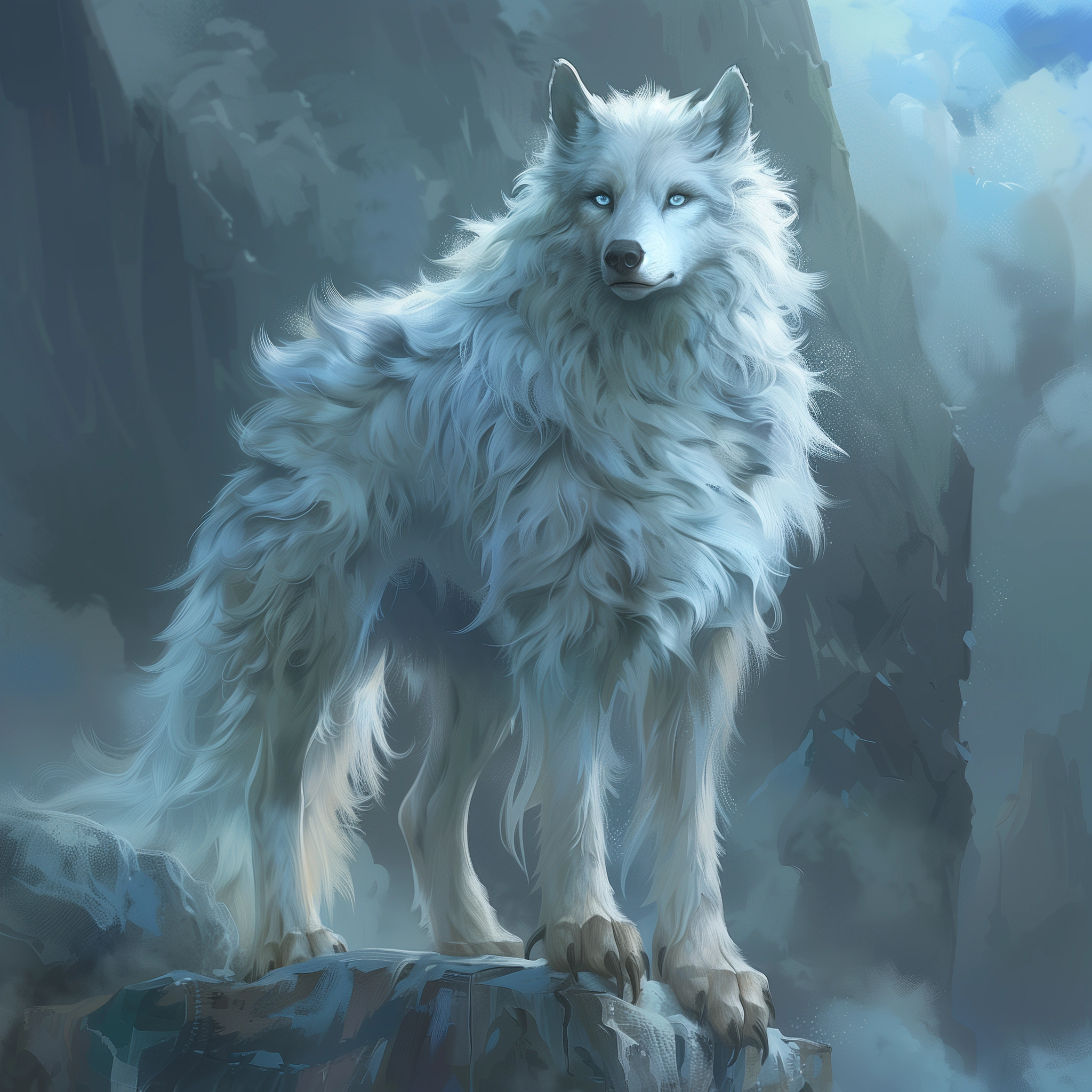
Loth-wolves are majestic and mysterious creatures native to the planet Lothal. They are deeply connected to the Force and are considered to be guardians of the planet's natural world. These wolves are not only powerful predators but also intelligent beings capable of understanding complex emotions and communicating through the Force.
Loth-wolves are large canines, standing at about 3 feet at the shoulder with a length of nearly 8 feet from nose to tail. They possess a thick coat of white fur with distinctive markings of grey or black that seem to shimmer with subtle energy. Their eyes glow with an ethereal blue, indicating their deep connection to the Force.
Loth-wolves are found in the varied terrains of Lothal, from grassy plains to dense forests. They prefer secluded areas away from the hustle and bustle of civilization, thriving in the planet's untouched natural environments.
Loth-wolves are solitary creatures but come together in packs for hunting and protection. They share a unique bond, communicating through a combination of vocalizations and the Force. The wolves exhibit a strong sense of loyalty to their pack and to the planet of Lothal itself, often intervening to protect it from harm.
Little is known about the reproduction of Loth-wolves. It is believed they mate for life, with a gestation period lasting several months, after which one or two pups are born. These pups are incredibly rare and are fiercely protected by their parents and the pack.
Loth-wolves are elusive, preferring to avoid contact with outsiders. They are, however, fiercely protective of their territory and will defend it from intruders. Their deep connection to the Force allows them to sense intentions, making them more likely to assist those who mean no harm or those in need of guidance. They are known to guide or transport individuals through the Force, appearing and disappearing in a mystical manner.
| STR | DEX | CON | INT | WIS | CHA |
|---|---|---|---|---|---|
| 18 (+4) | 15 (+2) | 15 (+2) | 12 (+1) | 18 (+4) | 12 (+1) |
Keen Hearing and Smell. The Loth-wolf has advantage on Wisdom (Perception) checks that rely on hearing or smell.
Force Sensitivity. The Loth-wolf has a number of Force Points equal to 5 + its Wisdom modifier. It knows the Force powers Force Stasis, Force Jump, and Force Empathy.
Pack Tactics. The Loth-wolf has advantage on an attack roll against a creature if at least one of the wolf's allies is within 5 feet of the creature and the ally isn't incapacitated.
Bite. Melee Weapon Attack: +6 to hit, reach 5 ft., one target. Hit: (2d6 + 4) piercing damage. If the target is a creature, it must succeed on a DC 15 Strength saving throw or be knocked prone.

The LR-57 combat/retail droid, often referred to simply as the retail droid, is a versatile battle droid designed for both commercial protection and frontline combat. These droids were utilized extensively by the Retail Caucus and the Confederacy of Independent Systems during the Clone Wars.
Physically, the LR-57 has a tall, thin structure with long, spindly legs that give it a spider-like appearance. Its main body houses the droid's central processing unit and primary weapon systems, typically a pair of blaster cannons. The design allows for a 360-degree field of vision, enabling the droid to track and engage targets from various angles.
Manufactured by the Retail Caucus, a member of the Confederacy of Independent Systems, the LR-57 was designed to be deployed in both commercial settings for asset protection and on the battlefield against enemy forces. The droid's adaptability in various environments made it a valuable asset in the Separatist droid army.
In terms of tactics, the LR-57 combat/retail droid excelled in stationary defence roles, using its height and range of sensors to detect and engage threats at a distance. Its long legs allowed it to traverse a variety of terrains, making it effective in both urban and rugged environments. The LR-57 was often deployed to guard strategic locations, where its formidable firepower and extensive field of view could be used to maximum effect in deterring enemy advances.
| STR | DEX | CON | INT | WIS | CHA |
|---|---|---|---|---|---|
| 12 (+1) | 15 (+2) | 13 (+1) | 10 (0) | 12 (+1) | 9 (-1) |
Circuitry. The droid has disadvantage on saving throws against effects that would deal ion or lightning damage.
Tunneler. The combat droid can burrow through solid rock at half its burrowing speed and leaves a 5-foot-wide, 8-foot-high tunnel in its wake.
Sentry Mode. The combat droid can use it's action to conceal itself in the ground out of sight. Creatures must make a Perception check (DC-13) to spot the antennae sticking out of the ground unless disguised or hidden. Creatures must pass a Stealth check (DC-18) without activating the droids. Any creature entering the same 5-foot radius of the combat droid activates it, the radius increases with each droid concealed in the same area.
Multiattack. The Combat Droid makes two weapon attacks with its strike or blaster cannons.
Strike. Melee Weapon Attack: +5 to hit, Reach 5 ft., one target. Hit: 5(1d4+2) kinetic damage.
Blaster Cannons. Ranged Weapon Attack: +5 to hit, Range 60/160 ft., one target. Hit: 10 (2d6+4) energy damage.

The Mephout Ironleafs are unique creatures native to the verdant forests of Mephout, a planet located in the Wild Space sector known as the Mephout Dominion. They are small, quadrupedal beings, standing about 3 feet tall when fully grown. Their bodies are covered in a vibrant green fur that resembles the leaves of the dense ironwood trees they inhabit, providing them with excellent camouflage. This fur is not just for show; it's thick and tough, offering the Ironleafs some protection against predators.
Their limbs are long and slender, ending in dexterous paws that they use for climbing and crafting. Their eyes are large and expressive, glowing a soft blue in the dark forest undergrowth. These creatures are known for their unique ability to craft and use weapons made from the dense ironwood trees of Mephout. They carve these clubs with their sharp teeth and strong jaws, creating a simple but effective weapon.
Mephout Ironleafs feed primarily on tree sap, which they extract using their sharp incisors. They have a symbiotic relationship with the forest, often helping to pollinate the towering trees of Mephout as they move from tree to tree in search of food.
Despite their cute and somewhat cuddly appearance, Mephout Ironleafs can defend themselves when threatened, especially when wielding their ironwood clubs. They are surprisingly strong for their size, and their clubs can deliver a powerful blow.
| STR | DEX | CON | INT | WIS | CHA |
|---|---|---|---|---|---|
| 12 (+1) | 16 (+3) | 14 (+2) | 6 (-2) | 12 (+1) | 10 (0) |
Force Sensitive. The Mephout Ironleaf is force-sensitive and has the following innate force powers:
Ironwood Club. Melee Weapon Attack: +5 to hit, reach 5 ft., one target. Hit: 6 (1d6 + 3) kinetic damage.
Leafy Buffet. The Mephout Ironleaf can also use its leaf-like fur to create a gust of wind, buffeting enemies in a 15 ft. cone. Creatures caught in the gust of wind must make a dexterity saving throw DC14. This attack deals 1d4 + 3 bludgeoning damage, save for half damage.

The Moon Lurker is a large, monstrous creature that stands on four powerful, clawed legs. Its sleek, metallic-grey hide mirrors the lunar landscapes it calls home, providing it with excellent camouflage amidst Jamiron’s rocky terrains and shadowy crevices.
Its hulking body is low and wide, an adaptation for better stability in the lesser gravity. It possesses a formidable set of jaws lined with razor-sharp teeth, capable of crushing stones and metal alike, a reflection of its harsh and unforgiving home.
Two long, forward-curving horns protrude from the top of its head, looking like grim scythes in the moonlight. They are not merely for show; they act as natural sensors, picking up vibrations from the ground to compensate for the creature’s lack of hearing in the airless environment.
The Moon Lurker’s eyes are its most fascinating feature - deep, luminous blue orbs that glow with an ethereal light in the dark, capable of seeing across a wide spectrum, and evolved to penetrate the absolute darkness of Jamiron’s moon’s cavernous interiors.
The Moon Lurker is a cunning and patient predator. It’s known to wait motionless for hours, blending seamlessly with its surroundings, ambushing its prey when they least expect it. In the absence of a rich ecosystem, the creature has developed a slow metabolic rate and can survive extended periods without food, making it an even more terrifying presence in the barren landscapes.
Despite Jamiron’s barren surface, the Moon Lurker thrives in the planet’s porous crust and labyrinthine hydroponic facilities. Here, it feeds off the nutrient-rich algae and other hardy lifeforms nurtured by the Chiss. Its presence is a constant threat to the hydroponic farmers, who must always be on guard for the lurker’s chilling breath and sudden attacks.
The Chiss Ascendancy on Jamiron have a complex relationship with these creatures. While they are a constant menace to their agricultural facilities, the Chiss respect the Moon Lurkers’ resilience and adaptability. Some even view them as a symbol of their own survival in the harsh Unknown Regions. Attempts have been made to remove or exterminate the Moon Lurkers, but they have proven to be resilient, further deepening the respect and fear the Chiss hold for these formidable creatures.
| STR | DEX | CON | INT | WIS | CHA |
|---|---|---|---|---|---|
| 18 (+4) | 14 (+2) | 15 (+2) | 6 (-2) | 12 (+1) | 8 (-1) |
Vacuum Adaptation. The Moon Lurker can survive without air. It’s also adapted to the cold and low-pressure environment of space.
Ambusher. The Moon Lurker has advantage on attack rolls against any creature it has surprised.
Multiattack. The Moon Lurker makes two claw attacks. If both attacks hit a Medium or smaller target, the target is grappled (escape DC 15), and the Moon Lurker uses its Crush on it.
Claw. Melee Weapon Attack: +7 to hit, reach 5 ft., one target. Hit: 13 (2d8 + 4) slashing damage.
Crush. Melee Weapon Attack: +7 to hit, reach 0 ft., one creature grappled by the Moon Lurker. Hit: 15 (2d10 + 4) bludgeoning damage.
Chilling Breath (Recharge 5-6). The Moon Lurker exhales a blast of chilling air in a 15-foot cone. Each creature in that area must make a DC 14 Constitution saving throw, taking 18 (4d8) cold damage on a failed save, or half as much damage on a successful one.

Within the vast expanses of the galaxy lies the Mudhorn, a creature embodying the raw ferocity and indomitable will of nature. Encounters with these behemoths are rare, leaving lasting impressions on those who survive. The tale of the Mudhorn that crossed paths with the Mandalorian and The Child on Arvala-7 has become a legendary story, echoing the Mudhorn's significance in the lore of the galaxy. Its solitary figure, standing defiant in the murky wilderness, symbolizes the untamed wilderness that persists amidst the stars.
The Mudhorn is a sight to behold, a testament to evolutionary prowess. Standing towering above most beings, its frame is sheathed in a thick coat of fur, coloured in shades of earth and stone, allowing it to merge seamlessly with its preferred swampy abodes. The spiralled horn, rising majestically from its skull, serves as both a natural weapon and a symbol of its strength. Its eyes, small and piercing, scan its surroundings with keen awareness, always alert to potential threats or intruders into its domain.
Mudhorns are masters of their domains, selecting environments that offer natural defences and advantages. Their habitats are often difficult for most creatures to navigate, with deep mud, thick vegetation, and water bodies providing both camouflage and protection. These environments also support the Mudhorn's diet, which is as varied as the ecosystems they inhabit, ranging from plants and roots to smaller creatures that share their habitat.
As solitary creatures, Mudhorns lack a traditional society or culture. Their interactions are limited to occasional encounters during mating seasons or territorial disputes. However, these interactions follow a complex set of behaviours and rituals that could be considered the foundations of a rudimentary social structure. These include displays of strength, territory marking, and non-lethal combat intended to establish dominance rather than to kill.
The reproductive cycle of the Mudhorn is a rare event, shrouded in mystery. Females lay a single large egg in a carefully constructed nest, often hidden away in the most inaccessible parts of their territory. The maternal instinct of a Mudhorn is fierce; they will defend their nest against all comers with a relentless ferocity that is awe-inspiring. Once hatched, the young Mudhorn grows rapidly, fueled by an insatiable appetite as it prepares to claim a territory of its own.
The behaviour of the Mudhorn is a fascinating blend of aggression and intelligence. While they may seem to act on instinct, there's a cunning behind their actions, an understanding of their environment and how to use it to their advantage. Mudhorns prefer to avoid unnecessary conflict but will not hesitate to engage when threatened. They are known to use the terrain to their advantage, lying in wait for the opportune moment to strike. Their lives are spent in a constant balance between the calm of solitude and the explosive violence of their wrath.
| STR | DEX | CON | INT | WIS | CHA |
|---|---|---|---|---|---|
| 18 (+4) | 10 (0) | 18 (+4) | 2 (-4) | 12 (+1) | 5 (-3) |
Charge. If the Mudhorn moves at least 20 feet straight toward a target and then hits it with a horn attack on the same turn, the target takes an extra 9 (2d8) piercing damage. If the target is a creature, it must succeed on a DC 14 Strength saving throw or be knocked prone.
Relentless. If the Mudhorn takes 14 damage or less that would reduce it to 0 hit points, it is reduced to 1 hit point instead.
Mud Camouflage. The Mudhorn has advantage on Stealth checks made to hide in muddy environments.
Horn Attack. Melee Weapon Attack: +7 to hit, reach 5 ft., one target. Hit: 16 (2d10 + 5) piercing damage.
Stomp. Melee Weapon Attack: +7 to hit, reach 5 ft., one prone creature. Hit: 18 (2d12 + 5) bludgeoning damage.
Mud Spray (Recharge 5-6). The Mudhorn can fling mud from its body in a 15-foot cone. Each creature in that area must make a DC 14 Dexterity saving throw, becoming blinded until the end of the Mudhorn's next turn on a failed save, or half as much damage on a successful one. The mud also makes the ground in the area difficult terrain until it dries.

Mynocks are unique creatures possessing several distinctive characteristics that set them apart as both fascinating and troublesome to space travellers. Physically, Mynocks are characterized by their leathery wings and a somewhat bat-like appearance. They have a distinctive mouth that is capable of latching onto surfaces, an adaptation that is particularly suited to their notorious behaviour of chewing on power cables and energy conductors of starships. This habit not only signifies their preference for electrical energy but also makes them a considerable nuisance aboard spacecraft.
In terms of habitat, Mynocks are space-dwelling entities, able to survive and thrive in the vacuum of space, a trait that is quite rare among living creatures. This silicon-based lifeform is often found clinging to the hulls of starships or within cargo holds, where they feed on the electrical systems. Their ability to survive in space allows them to latch onto ships traveling through hyperspace, leading to sudden and unexpected infestations.
Furthermore, Mynocks are known for their rapid reproduction rate, which can quickly turn a small problem into a significant infestation if not promptly dealt with. Their resilience and quick breeding make them a persistent problem in the galaxy, especially on ships that travel long distances through uncharted or less frequented hyperspace routes. Despite their small size, the cumulative effect of a Mynock infestation can lead to severe damage to a spacecraft's electrical systems, making them a creature that is often dreaded by pilots and space-farers across the galaxy.
| STR | DEX | CON | INT | WIS | CHA |
|---|---|---|---|---|---|
| 10 (0) | 16 (+3) | 12 (+1) | 4 (-3) | 14 (+2) | 6 (-2) |
Dive Attack. If the Neimoidian Kreehawk is flying and dives at least 30 ft. straight toward a target and then hits it with a talon attack, the attack deals an extra 2 (1d4) damage to the target.
Flyby. The Neimoidian Kreehawk doesn't provoke opportunity attacks when it flies out of an enemy's reach.
Keen Sight. The Neimoidian Kreehawk has advantage on Wisdom (Perception) checks that rely on sight.
Talons. Melee Weapon Attack: +5, range 5ft, one target. Hit 6 (1d6+3) kinetic damage.

Among the hazy annals of Mandalorian lore, the Mythosaur stands supreme – a creature so colossal and formidable that its very name has become synonymous with strength and legend within Mandalorian culture. These titans of Mandalore, around which many a tale of valour has been spun, are as deeply ingrained in the planet's history as the iron will of the people who tamed them.
The Mythosaur is a gargantuan beast, dwarfing even the largest of Mandalore's native creatures. Towering over the landscape on thick, muscular legs, the Mythosaur is a sight to behold, with a long, sinuous neck supporting a head filled with razor-sharp teeth capable of rending durasteel. Their massive tails could demolish buildings with a single swipe, and their hide was thick enough to withstand blaster fire.
The Mythosaur once roamed the expanses of Mandalore, dominating every terrain from the craggy mountains to the sweeping plains. However, over time, as Mandalore's environment became more inhospitable due to wars and ecological damage, the Mythosaurs retreated to become legends, spoken of but seldom seen.
The Mythosaurs did not have a society or culture as sentient beings might, but they played a significant role in the society and culture of the Mandalorians. The Mandalorians viewed the Mythosaurs as both a challenge to be conquered and as respected creatures of power, embodying the qualities that Mandalorians themselves admired.
While detailed records of the Mythosaurs' reproduction are scant, it is likely that these creatures laid eggs, as do many reptilian species. The laying of a Mythosaur egg would have been an event of great significance, possibly giving rise to new myths and quests for glory among the Mandalorians.
Mythosaurs were apex predators, commanding their environment with sheer size and power. They were territorial and solitary, except during mating seasons. Their roars were said to echo across the valleys of Mandalore, instilling fear and awe in equal measure.
| STR | DEX | CON | INT | WIS | CHA |
|---|---|---|---|---|---|
| 25 (+7) | 10 (0) | 20 (+5) | 4 (-3) | 12 (+1) | 12 (+1) |
Hold Breath. The mythosaur can hold its breath for 1 hour.
Keen Striking. The mythosaur scores a critical hit on a roll of 19 or 20. If at least one of the mythosaur's allies is within 5 feet of its target and the ally isn't incapacitated, the mythosaur instead scores a critical hit on a roll of 18-20.
Multiattack. The mythosaur makes three attacks: one with its bite and two with its claws. It can make one tail attack in place of its two claw attacks.
Bite. Melee Weapon Attack: +13 to hit, reach 15 ft., one target. Hit: 26 (3d12+7) kinetic damage.
Claw. Melee Weapon Attack: +13 to hit, reach 10 ft., one target. Hit: 16 (2d8+7) kinetic damage.
Tail. Melee Weapon Attack: +13 to hit, reach 15 ft., one target. Hit: 26 (3d12+7) kinetic damage. If the target is a creature, it must succeed on a DC 20 Strength saving throw or be pushed up to 10 feet away from the mythosaur and knocked prone.
Primal Roar (Recharge 5-6). The mythosaur's roar shatters the air in a 60-foot cone. Each creature in that area must make a DC 18 Constitution saving throw, taking 52 (15d6) sonic damage on a failed save, or half as much damage on a successful one. The roar is audible out to 10 miles, and other mythosaurs automatically succeed on the saving throw.

The Neimoidian Kreehawk is a most formidable creature from the verdant forests of Cato Neimoidia. This avian species, distinguished by its lustrous black plumage, is a remarkable example of predatory efficiency. The Kreehawk, with its elegantly sloping cranial structure and large, reflective ocular sensors, is superbly adapted for low-light vision, a feature most advantageous for nocturnal hunting.
Its talons, sharp as a vibroblade, are a testament to its predatory prowess, making the Kreehawk a fearsome hunter amidst the dense foliage of its native habitat. Furthermore, the creature exhibits an exceptional degree of agility and velocity, capable of navigating the forest canopies with astonishing speed and grace. This combination of stealth, vision, and speed renders the Neimoidian Kreehawk a master of its environment.
Beyond its biological attributes, the Kreehawk holds a place of ecological significance on Cato Neimoidia. The planet, steeped in rich history within the galactic tapestry, is further enriched by the presence of such a unique species. The Neimoidian Kreehawk, thus, is not merely a creature but a vital part of the complex and vibrant ecosystem that contributes to the cultural and natural diversity of this world, a fact most intriguing and worthy of study in the grand narrative of the galaxy.
| STR | DEX | CON | INT | WIS | CHA |
|---|---|---|---|---|---|
| 10 (0) | 16 (+3) | 12 (+1) | 4 (-3) | 14 (+2) | 6 (-2) |
Dive Attack. If the Neimoidian Kreehawk is flying and dives at least 30 ft. straight toward a target and then hits it with a talon attack, the attack deals an extra 2 (1d4) damage to the target.
Flyby. The Neimoidian Kreehawk doesn't provoke opportunity attacks when it flies out of an enemy's reach.
Keen Sight. The Neimoidian Kreehawk has advantage on Wisdom (Perception) checks that rely on sight.
Talons. Melee Weapon Attack: +5, range 5ft, one target. Hit 6 (1d6+3) kinetic damage.

The Nexu is a fierce and agile predator known throughout the galaxy for its ferocity and hunting prowess. Encountered on planets both wild and civilized, Nexu are as adaptable as they are deadly. Often employed in arena combat for their terrifying appearance and vicious nature, these creatures command both fear and respect.
A Nexu stands about the size of a large terrestrial feline but bears a more menacing presence with its four eyes and sharp, spiky ridges along its back. Its mouth is filled with razor-sharp teeth, and its tail is long and whip-like, aiding in balance. The Nexu's most distinctive feature might be its two sets of eyes - the primary pair for diurnal vision and a secondary set adapted for nocturnal environments.
Nexus are adaptable creatures found in a variety of environments, from dense jungles to barren wastelands. They prefer territories where they can use their climbing abilities and agility to hunt prey.
Nexu are solitary hunters, coming together only to mate. They do not form packs or societies and exhibit highly territorial behaviour.
Nexu reproduces via live birth, with litters typically consisting of two to three cubs. The mother raises the cubs until they are capable of hunting independently, teaching them essential survival skills during this period.
Nexu are primarily nocturnal, using their excellent night vision to stalk prey. They are ambush predators, relying on stealth and their pouncing ability to surprise and quickly overcome their targets. While they are not inherently aggressive towards creatures other than their prey, they will ferociously defend their territory against intruders.
| STR | DEX | CON | INT | WIS | CHA |
|---|---|---|---|---|---|
| 16 (+3) | 14 (+2) | 14 (+2) | 3 (-4) | 12 (+1) | 7 (-2) |
Keen Smell. The Nexu has advantage on Wisdom (Perception) checks that rely on smell. This trait underscores its role as an apex predator, capable of tracking its prey over great distances or while hidden.
Terrifying Roar. Once per short rest, the Nexu can unleash a terrifying roar as an action. All creatures within 20 feet that can hear and see the Nexu must succeed on a DC 14 Wisdom saving throw or be frightened for 1 minute. A creature can repeat the saving throw at the end of each of its turns, ending the effect on itself on a success.
Agile Predator. The Nexu has advantage on Dexterity (Stealth) checks made in natural terrain. This reflects its ability to move silently through its environment, surprising its prey.
Pack Tactics. The Nexu has advantage on an attack roll against a creature if at least one of the Nexu's allies is within 5 feet of the creature and the ally isn't incapacitated.
Multiattack. The Nexu makes two attacks: one with its bite and one with its claws.
Bite. Melee Weapon Attack: +5 to hit, reach 5 ft., one target. ?Hit: 8 (1d10 + 3) piercing damage.
Claw. Melee Weapon Attack: +5 to hit, reach 5 ft., one target. Hit: 6 (1d6 + 3) slashing damage.
Pounce. If the Nexu moves at least 20 ft. straight toward a target and then hits it with a claw attack on the same turn, the target must succeed on a DC 13 Strength saving throw or be knocked prone. If the target is prone, the Nexu can make one bite attack against it as a bonus action.

The OG-9 homing spider droid, known in Star Wars Legends, is a large droid model used by the Confederacy of Independent Systems during the Clone Wars. Its distinctive feature is its spider-like design, equipped with long, slender legs that allow it to traverse various terrains and provide a stable platform for its heavy weaponry.
Physically, the OG-9 homing spider droid has a central body from which several articulated legs extend, giving it the appearance of a giant arachnid. This central body houses the droid's main weapon, typically a large, powerful cannon capable of firing at both ground and aerial targets, along with secondary armaments like smaller blaster cannons or missile launchers.
Manufactured by the Commerce Guild, one of the corporate backers of the Separatist Alliance, the OG-9 was designed for heavy assault, anti-vehicle operations, and long-range engagement. Its role was to provide heavy fire support, disrupt enemy formations, and engage fortifications and vehicles with its powerful armaments.
Tactically, the OG-9 homing spider droid was deployed in situations where its long-range firepower and high vantage point could be utilized effectively. Its towering presence allowed it to support ground forces by engaging enemy targets over obstacles and from a distance, while its mobility enabled it to reposition quickly in response to changing battlefield conditions. Despite its size, the OG-9 was vulnerable to concentrated attacks, especially to its legs and undercarriage, requiring it to be used in conjunction with other units for protection and to maximize its combat effectiveness.
| STR | DEX | CON | INT | WIS | CHA |
|---|---|---|---|---|---|
| 18 (+4) | 16 (+3) | 18 (+4) | 10 (0) | 8 (-1) | 6 (-2) |
Circuitry. The spider droid has disadvantage on saving throws against effects that would deal ion or lightning damage.
Towering. Creatures of Medium size or smaller can stand in the spider droid's space.
Vulnerable Legs. When the spider droid is reduced to half of its hit point maximum, one of its legs falls off, reducing its speed to 0 feet, and will remain so even if the spider droid is healed to above half its maximum.
Multiattack. The spider droid makes two laser cannon attacks.
Homing Laser. The spider droid saturates an area in a 60-foot cone with laser fire. All enemies within the area must make a DC 15 saving throw. On a failure, targets take 26 (4d12) energy damage, half as much on a success, or no damage on a success while behind at least half cover.
Laser Cannon. Ranged Weapon Attack: +7 to hit, range 100/400 ft., one target. Hit: 14 (2d10+3) energy damage.
Sustained Beam. A beam of energy flashes out from the droid's circular dish in a 5-foot-wide, 300-foot-long line. Each creature in the line must make a DC 18 Dexterity saving throw. On a failed save, a creature takes 28 (8d6) energy damage. On a successful save, it takes half as much damage. The Sustained Beam is maintained until the spider droid moves, is rendered unable to use actions, or loses one of its legs. The spider droid must use its action to maintain the beam at the start of each of its turns, dealing its damage to any structures touching the beam immediately. A creature that moves through or begins its turn in the beam's area must make a DC 14 Dexterity saving throw. On a failed save, it takes 8d6 energy damage. Because the circular dish that fires the beam is 10 feet off the ground, some creatures may be able to pass safely underneath it, at the DM's discretion.

OOM Command Battle Droids, often referred to simply as Command Droids, embody the relentless efficiency and unwavering loyalty characteristic of the Separatist Alliance. These droids are the backbone of the Separatist Droid Army, executing commands with robotic precision and showing no mercy to their adversaries. Their cold, calculating nature makes them formidable opponents on the battlefield, where they follow orders without hesitation, ensuring the success of Separatist military campaigns.
Standing at a towering height of 1.9 meters, OOM Command Battle Droids are instantly recognizable by their sleek, angular design and the iconic Trade Federation colour scheme of blue and gray. They are equipped with a formidable blaster rifle, designed for long-range engagements, and feature various sensors and antennae that enhance their tactical awareness. Their metallic frames are reinforced with durable armour plating, providing protection against enemy fire and physical assaults. These droids exude a sense of menace with their imposing presence, instilling fear in their opponents on the battlefield.
OOM Command Battle Droids are mass-produced in sprawling factories located across Separatist-controlled star systems, including key locations such as Geonosis and Mustafar. These factories churn out legions of droids to bolster the ranks of the Separatist Droid Army, fulfilling the demands of the ongoing galactic conflict. Each Command Droid is programmed with advanced combat algorithms and communication protocols, allowing it to operate autonomously or under the direction of higher-ranking droid officers. They are a testament to the industrial might and technological prowess of the Separatist Alliance, showcasing their commitment to droid warfare.
In combat, OOM Command Battle Droids showcase their strategic acumen and battlefield adaptability. They employ a range of tactics to outmaneuver and overwhelm enemy forces, including coordinated suppressive fire, flanking maneuvers, and strategic use of cover. These droids prioritize targets based on tactical analysis, targeting high-value assets or vulnerable points in enemy formations. They excel in adapting to changing battlefield conditions, adjusting their strategies on the fly to exploit weaknesses and capitalize on opportunities. Whether leading droid squads or supporting larger assault forces, OOM Command Battle Droids are relentless in their pursuit of victory for the Separatist cause.
| STR | DEX | CON | INT | WIS | CHA |
|---|---|---|---|---|---|
| 11 (0) | 16 (+3) | 12 (+1) | 18 (+4) | 12 (+1) | 10 (0) |
Circuitry. The droid has disadvantage on saving throws against effects that would deal ion or lightning damage.
Innate Tech-casting. The OOM Command Battle Droid can innately cast the following tech powers (tech save DC 14):
Blaster Rifle. Ranged Weapon Attack: +5 to hit, range 40/160 ft., one target. Hit: 6 (1d6+3) energy damage.
Command Ally. The OOM Command Battle Droid targets one ally within 30 feet of it. If the target can hear the droid, the target can make one weapon attack as a reaction and gains advantage on the attack roll.
Redirect Attack. When a creature the OOM Command Battle Droid can see targets it with an attack, the droid chooses another droid within 5 feet of it. The two droids swap places, and the chosen droid becomes the target instead.

Emerging silently from the dark depths of Naboo's oceans, the Opee Sea Killer is a formidable predator. Its bioluminescent body cuts through the murky waters as it searches for its next meal, utilizing both its crab-like claws and sharp teeth to ensnare unsuspecting prey.
The Opee Sea Killer combines the traits of several aquatic predators into one terrifying form. It has a long, eel-like body, armoured with natural plating. At the front, it boasts a massive maw capable of swallowing a Gungan whole, flanked by strong, crab-like claws used for grappling.
These creatures are native to the planet Naboo, specifically dwelling in the planet's vast oceans. They prefer the dark, pressure-intense depths but will venture into shallower waters when hunting.
Opee Sea Killers are solitary creatures, coming together only during mating seasons. They do not form social bonds and are highly territorial.
Little is known about their mating rituals, but they are presumed to lay eggs in the ocean's depths, where the young are left to fend for themselves from the moment they hatch.
Opee Sea Killers are apex predators within their environment, preying on anything smaller than themselves. They use a combination of stealth and raw power to hunt, often ambushing their prey from below.
| STR | DEX | CON | INT | WIS | CHA |
|---|---|---|---|---|---|
| 18 (+4) | 14 (+2) | 15 (+2) | 2 (-4) | 12 (+1) | 5 (-3) |
Amphibious. The Opee Sea Killer can breathe air and water.
Keen Sight and Smell. The Opee Sea Killer has advantage on Wisdom (Perception) checks that rely on sight or smell.
Multiattack. The Opee Sea Killer makes two attacks: one with its bite and one with its tail.
Bite. Melee Weapon Attack: +7 to hit, reach 5 ft., one target. Hit: 18 (3d8 + 4) piercing damage.
Tail Swipe. Melee Weapon Attack: +7 to hit, reach 10 ft., one target. Hit: 15 (3d6 + 4) bludgeoning damage. If the target is a creature, it must succeed on a DC 15 Strength saving throw or be knocked prone.
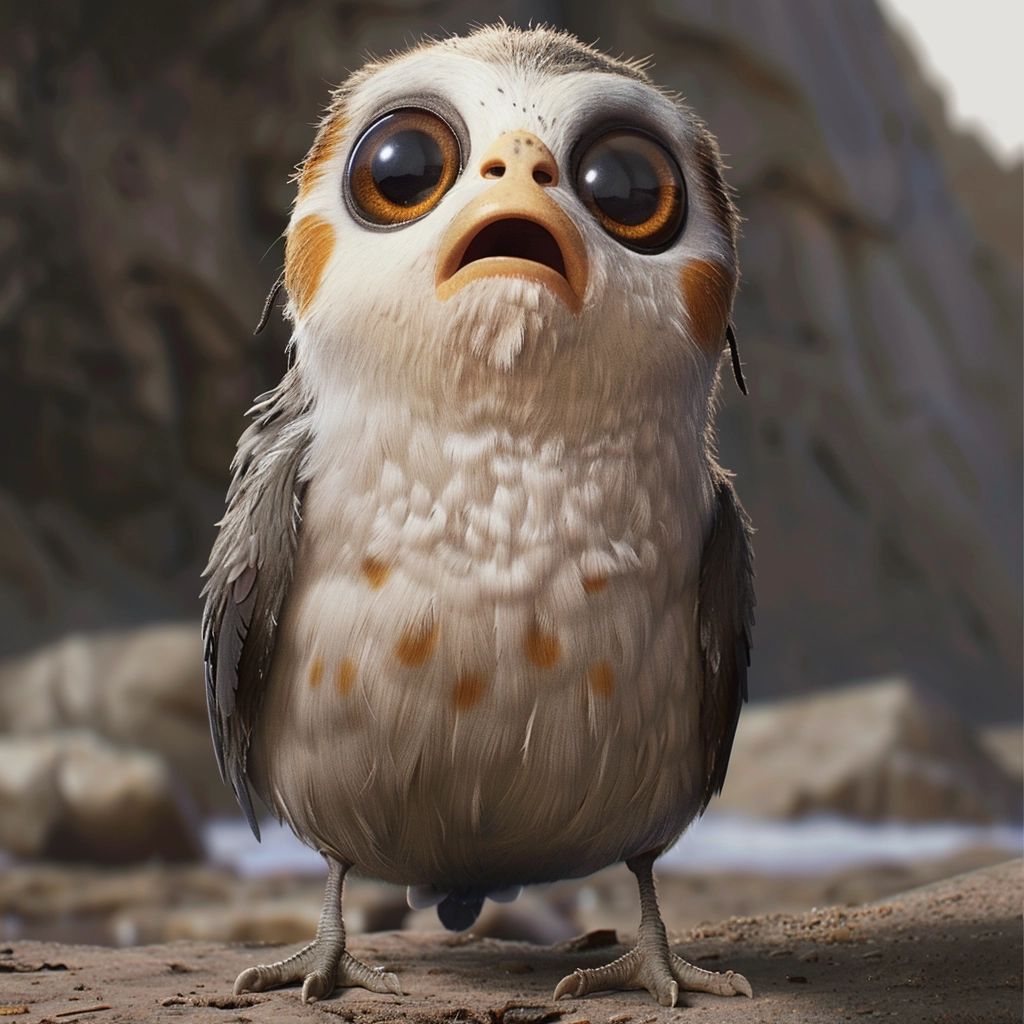
The porg is a small, curious seabird native to the remote planet Ahch-To. These creatures are known for their inquisitive nature, often approaching visitors with little fear. Porgs have become a common sight around the island's ancient Jedi temples, filling the air with their distinctive calls.
Porgs are tiny birds with fluffy feathers, big round eyes, and a wide mouth that gives them a perpetually surprised expression. Their plumage is primarily brown and white, with varying patterns across individuals. They possess stubby wings that are surprisingly powerful, allowing them to dart quickly through the air.
Porgs are primarily found along the rocky cliffs and shores of Ahch-To, where they nest in crevices and caves. They thrive in this isolated environment, away from natural predators.
Porgs live in large colonies, exhibiting complex social behaviours. They communicate through an array of chirps and squawks, which serve both as a means of social interaction and as a way to alert others to dangers. While not possessing a culture in a human sense, porgs do show signs of communal living, such as collective feeding and communal care for their young.
Porgs mate for life, with pairs often seen nurturing their offspring together. They lay eggs in nests built within the safety of their cliffside communities. Porg chicks are precocial, born with their eyes open and a soft down, ready to explore their surroundings under the watchful eyes of their parents.
Porgs are highly curious and sometimes mischievous, often attracted to shiny objects or unfamiliar visitors. They are skilled fliers, capable of maneuvering with agility to snatch fish from the sea, their primary food source. Despite their playful demeanour, porgs can be fiercely protective of their young and their territory.
| STR | DEX | CON | INT | WIS | CHA |
|---|---|---|---|---|---|
| 3 (-4) | 15 (+2) | 12 (+1) | 2 (-4) | 12 (+1) | 6 (-2) |
Flyby. The porg doesn't provoke opportunity attacks when it flies out of an enemy's reach.
Keen Sight. The porg has advantage on Wisdom (Perception) checks that rely on sight.
Peck. Melee Weapon Attack: +4 to hit, reach 5 ft., one target. Hit: 1 piercing damage.

Legends whisper of the Purrgil as the original navigators of the cosmos, creatures that understood the pathways of the stars long before the galaxy's myriad civilizations took their first steps into hyperspace. These beings, resembling leviathans of the void, possess an innate connection to the Force, enabling them to traverse the galaxy in a way that mystifies even the most scholarly of Jedi historians.
Purrgil are titanic, ethereal beings whose bodies are adapted perfectly to the vacuum of space. Their skin shimmers with a pearlescent sheen that seems to reflect the very nebulae they glide through. Bioluminescent spots dot their hides, pulsing gently, adding to their mystical appearance. Their eyes, vast and wise, gaze eternally into the infinite, seeing paths that remain hidden from all others.
While these creatures roam the vast expanses of space, they are most often encountered near gas giants rich in Clouzon-36. These areas serve not only as feeding grounds but also as the starting points for their incredible journeys across the stars, leaping from one system to another in a display of natural hyperspace travel that predates technological advancements.
Purrgil society remains largely a mystery. However, their movements across the galaxy hint at complex social structures and perhaps even a form of collective consciousness that guides their migrations. Scholars speculate that their gatherings in the depths of space, which are rare and awe-inspiring, might be linked to social rituals or even a form of celestial navigation unknown to modern science.
The process by which Purrgil reproduce is a closely guarded secret of the universe. Observations suggest that they gather in the heart of nebulae to birth their young, enveloped in the cosmic nursery's protective embrace. These nebulae serve as cradles for the young Purrgil, who emerge with an intrinsic understanding of the cosmos and the pathways that lace it.
The Purrgil are serene, navigating the galaxy with a purpose that is their own. They exhibit curiosity towards spacecraft, often approaching them in a display of gentle intelligence. Despite their peaceful nature, they can defend themselves if threatened, though they prefer to avoid conflict. Their migrations, which sometimes intersect with populated space lanes, have led to myths of omens and portents among spacefarers.
| STR | DEX | CON | INT | WIS | CHA |
|---|---|---|---|---|---|
| 24 (+7) | 10 (0) | 22 (+6) | 2 (-4) | 12 (+1) | 10 (0) |
Hyperspace Dive. Once per day, the Purrgil can enter hyperspace without the need for a hyperdrive, travelling to a predetermined location as if using the astrogate ability.
Oxygen Creation. Purrgil can survive in the vacuum of space due to their ability to internally create oxygen. Creatures within 5 feet of the Purrgil can also breathe normally.
Space Whales' Grace. Despite their size, Purrgil are incredibly graceful, granting them advantage on Dexterity saving throws against effects that they can see while flying in space.
Multiattack. The Purrgil makes two attacks: one with its bite and one with its tail.
Bite. Melee Weapon Attack: +11 to hit, reach 10 ft., one target. Hit: 28 (4d10 + 6) piercing damage.
Tail Swipe: Melee Weapon Attack: +11 to hit, reach 15 ft., one target. Hit: 24 (3d12 + 5) bludgeoning damage.

The Rakghouls are a horrific manifestation of primal fear and predatory instinct, brought to life through the sinister machinations of Sith alchemy. These creatures are the unfortunate end products of the Rakghoul Plague, a disease that spares no quarter in its ruthless efficiency to twist and defile the humanoid form into something grotesque and unrecognizable. The physical transformation is both rapid and agonizing, stripping away not just the physical human likeness but also eroding the very essence of sentience and individuality. The victims' skin loses all pigmentation, turning a deathly white, and their bodies bleed from every conceivable pore, rendering them a nightmarish vision of animated death. Eyes, now devoid of any spark of intelligence or emotion, gleam with a feral hunger, and their limbs contort into weapons of natural predation.
These abominations are not bound to any one specific locale but are rather the product of their contagion's reach. They often form packs, indicative of their remaining vestigial instinct to hunt in numbers, ranging from four to eight, though larger congregations are not unheard of, especially in the dark corners of the galaxy where the plague runs rampant. These packs are devoid of any societal structure or culture, driven purely by an insatiable hunger. They roam the abandoned catacombs, derelict spaceships, and forgotten worlds, places where shadows reign supreme, and the light of civilization has long since dimmed. Their presence is often a death knell for unprepared explorers or colonists seeking to reclaim such forsaken places.
Despite their seemingly mindless hunger, there exists among them a peculiar hierarchy, though not one born of social structure or mutual cooperation. Certain Rakghouls, referred to as "fiends," exhibit glimmers of their past intelligence, wielding crude weapons or exhibiting basic strategic thinking, hinting at the terrifying possibility that the plague does not wholly eradicate the host's personality or memories but instead buries them under layers of aggression and primal instinct. These fiends are capable of exerting a form of dominance or influence over their lesser kin, though whether this is due to any recognized leadership or sheer force is a matter of speculation.
The plague serves as the ghastly method of reproduction for these creatures, spreading through bites and scratches, each victim doomed to join the horde of their aggressor. This relentless cycle of transmission ensures their persistence in the galaxy, a dark reminder of the Sith's legacy and the constant threat lurking in the shadows, ready to consume the unwary or the unfortunate. The Rakghoul's existence is a testament to the dark side's corrupting influence, transforming victims into monsters that embody the very essence of fear and despair.
| STR | DEX | CON | INT | WIS | CHA |
|---|---|---|---|---|---|
| 14 (+2) | 15 (+2) | 12 (+1) | 4 (-3) | 10 (0) | 6 (-2) |
Rakghoul Plague: Contact may afflict creatures with a virulent disease transforming them into a rakghoul over the next 24 hours. Only effective against humanoids. Humanoid creatures hit by a Rakghoul's bite or claw attack must succeed on a DC 12 Constitution saving throw or become infected with the Rakghoul Plague​​. The plague transforms the infected creature into a Rakghoul over the next 24 hours (7d6 hours)​​. The infection's manifestation is generally a rapid and painful experience. The victim's body becomes twisted, skin pigmentation drains leading to a whitened, corpse-like state, and victims also bleed from pores in the skin and from orifices such as the eyes​​.
Savage Leap: Can knock targets prone with a claw attack after moving 20 feet towards them, allowing for a bite attack as a bonus action if the target is prone.
Bite. Melee Weapon Attack: +4 to hit, reach 5 ft., one target. Hit: 9 (2d6+2) Kinetic damage. Can infect humanoids with the Rakghoul Plague.
Claws. Melee Weapon Attack: +4 to hit, reach 5 ft., one target. Hit: 7 (2d4+2) Kinetic damage. Can infect humanoids with the Rakghoul Plague​​.

The Rancor, a name that evokes fear and awe across the galaxy, holds a special place in the mythos of Star Wars. These creatures are not just apex predators; they are living legends, often woven into the tales of daring escapades and narrow escapes. Originating from the murky depths of Dathomir, a planet steeped in dark side energy and witchcraft, Rancors have been spread throughout the galaxy by traders and conquerors who used them as ultimate tests for warriors or as execution beasts to instill fear.
Rancors are towering monstrosities, with adults standing up to 5 meters tall. Their bodies are a marvel of predatory evolution, featuring powerful, muscled limbs that can crush durasteel, and skin tough enough to withstand blaster fire. Their heads, crowned with a ridge of small horns, house a maw capable of opening wide enough to swallow a human whole. Despite their bulk, Rancors move with surprising speed, their large, clawed hands ready to snatch up prey or smash through obstacles.
While native to the shadowy world of Dathomir, Rancors have adapted to a myriad of environments across the galaxy. From the dank pits of Tatooine to the lush jungles of Felucia, these creatures prove both versatile and resilient. However, they are most commonly found in the service of crime lords and in the arenas of the galaxy's underbelly, where they serve as the centrepiece of gladiatorial combat.
In the wild, Rancors are solitary hunters, coming together only to mate and occasionally share large kills. Intriguingly, despite their fearsome demeanour, Rancors have shown the capacity for emotional depth. They can form strong bonds with their handlers, a trait exploited by those who seek to use these creatures for their own ends. Tales of Rancors protecting their handlers or mourning their loss add a complex layer to the creature's brutish image.
Rancors lay eggs, which are fiercely protected by the mother until they hatch. Rancor young, or "pups," grow rapidly, reaching full size in a few years, though they are born with the instincts and ability to hunt from the moment they can walk. The lifecycle of a Rancor in the wild is largely a mystery, as their solitary nature and dangerous reputation make them difficult subjects of study.
Rancors are not mindless beasts; they employ cunning and strategy in their hunting. They prefer to ambush their prey, using their environment to their advantage to compensate for their size, which can make stealth a challenge. In combat, a Rancor will use its sheer strength to overpower foes, but it also exhibits a surprising level of problem-solving ability, using objects in its environment as weapons or creating obstacles for its prey.
To the galaxy at large, Rancors are symbols of unstoppable force and raw power. They are creatures of horror and wonder, a reminder of the wildness that exists in the heart of civilization. Stories of Rancors defeating squads of soldiers, surviving direct hits from spacecraft, or showing gentleness to those they bond with circulate in hushed tones, contributing to the legend of these formidable creatures.
| STR | DEX | CON | INT | WIS | CHA |
|---|---|---|---|---|---|
| 24 (+7) | 14 (+2) | 22 (+6) | 3 (-4) | 10 (0) | 7 (-2) |
Keen Smell. The Rancor has advantage on Wisdom (Perception) checks that rely on smell.
Terrifying Presence. Once per day, the Rancor can unleash a fearsome roar. Each creature of the Rancor's choice within 120 feet of it and aware of it must succeed on a DC 15 Wisdom saving throw or become frightened for 1 minute. A creature can repeat the saving throw at the end of each of its turns, with disadvantage if the Rancor is within line of sight, ending the effect on itself on a success.
Thick Hide. The Rancor's thick skin gives it resistance to bludgeoning, piercing, and slashing damage from nonmagical attacks not made with lightsabers or force-imbued weapons.
Siege Monster. The Rancor deals double damage to objects and structures.
Multiattack. The Rancor makes two attacks: one with its bite and one with its claws.
Bite. Melee Weapon Attack: +12 to hit, reach 5 ft., one target. Hit: 32 (4d10 + 7) piercing damage.
Claw. Melee Weapon Attack: +12 to hit, reach 10 ft., one target. Hit: 28 (4d8 + 7) slashing damage.
Swallow. The Rancor makes one bite attack against a Medium or smaller target it is grappling. If the attack hits, the target is swallowed, and the grapple ends. The swallowed target is blinded and restrained, it has total cover against attacks and other effects outside the Rancor, and it takes 21 (6d6) acid damage at the start of each of the Rancor's turns.

Rathtars are the stuff of spacefarer nightmares, a dark blend of myth and too many lost ships to count. These creatures are a grotesque testament to nature's capacity for creating perfect predators. The galaxy's fringe worlds whisper tales of shadowed ships drifting aimlessly, their crews gone, with only the echoing silence and the faint marks of tentacles wrapped around bulkheads as evidence of what transpired. The Rathtar is not just a predator; it is an apex terror, a being that hunts not just for sustenance but as an embodiment of primordial fear.
The Rathtar is an amalgam of terror incarnate, its spherical body easily the size of a small skiff. The creature's hide is a patchwork of scars, each telling tales of battles fought, survived, and won. Its skin is a deep, mottled red, tough as durasteel armour, capable of deflecting blaster fire and resisting the cold vacuum of space. The Rathtar's numerous tentacles, some thick as tree trunks, others thinner and more dexterous, undulate with a life of their own. They are covered in suckers, with razor-sharp barbs at their tips, perfect for gripping onto prey or the hulls of starships. At its core lies its maw, a gaping abyss lined with rows upon rows of needle-like teeth, capable of shredding duraplast and flesh alike.
Rathtars are believed to have originated from the Unknown Regions, thriving in the dark, between the stars themselves. These creatures adapt to virtually any environment, from the cold vacuum of space to the atmospheric pressures of gas giants, making them unpredictable and even harder to track. They are often found aboard derelict ships or hidden within asteroid fields, lying in wait for unwary travellers.
Rathtars lead solitary lives, driven by an insatiable hunger. There is no known social structure among them; they are lone predators, each a master of its domain. On the rare occasion that they do come together, it is a temporary alliance for the sake of a particularly large or difficult hunt, after which they quickly part ways.
The mysteries of Rathtar reproduction remain largely unsolved. They are rarely encountered in pairs, and juveniles have never been documented. Some theories suggest a form of asexual reproduction, possibly related to their incredible resilience and adaptability. Others speculate that their birthplace in the Unknown Regions holds the key to understanding their propagation.
Rathtars exhibit extreme aggression towards all forms of life, viewing them as potential meals. Their hunting strategy is straightforward yet terrifyingly effective: use their tentacles to immobilize or kill their prey before consuming it whole. Rathtars are known to attack without provocation, driven by hunger and a primal urge to dominate. They possess cunning intelligence, allowing them to manipulate their environment to their advantage, using stealth and surprise to ambush their victims. Once a Rathtar has marked its quarry, escape is nearly impossible. Their notorious persistence is matched only by their ferocity, making an encounter with a Rathtar a dire predicament indeed.
| STR | DEX | CON | INT | WIS | CHA |
|---|---|---|---|---|---|
| 18 (+4) | 14 (+2) | 20 (+5) | 2 (-4) | 12 (+1) | 5 (-3) |
Ambusher. The Rathtar has advantage on attack rolls against any creature it has surprised.
Keen Smell. The Rathtar has advantage on Wisdom (Perception) checks that rely on smell.
Pack Hunter. Rathtars are more commonly solitary but can occasionally be found hunting in small groups. A Rathtar has advantage on an attack roll against a creature if at least one of the Rathtar’s allies is within 5 feet of the creature and the ally isn't incapacitated.
Tentacle Drag. After hitting a creature with its tentacle slam attack, the Rathtar can attempt to pull the creature up to 10 feet closer to it.
Terrifying Presence. As an action, the Rathtar can unleash a fearsome roar. Each creature of the Rathtar's choice within 30 feet of it and aware of it must succeed on a DC 14 Wisdom saving throw or become frightened for 1 minute. A frightened target can repeat the saving throw at the end of each of its turns, with disadvantage if the Rathtar is within line of sight, ending the effect on itself on a success. Once a creature succeeds on this saving throw or the effect ends for it, the creature is immune to the Rathtar's Terrifying Presence for the next 24 hours.
Multiattack. The Rathtar can make two attacks: one with its bite and one with its tentacles.
Bite. Melee Weapon Attack: +7 to hit, reach 5 ft., one target. Hit: 22 (3d10 + 6) piercing damage.
Tentacle Slam. Melee Weapon Attack: +7 to hit, reach 10 ft., one target. Hit: 15 (2d8 + 6) bludgeoning damage. If the target is a creature, it must succeed on a DC 16 Strength saving throw or be grappled (escape DC 16). Until this grapple ends, the target is restrained, and the Rathtar can't use its tentacles on another target.
Swallow. The Rathtar makes one bite attack against a Medium or smaller target it is grappling. If the attack hits, the target is swallowed, and the grapple ends. The swallowed target is blinded and restrained, it has total cover against attacks and other effects outside the Rathtar, and it takes 21 (6d6) acid damage at the start of each of the Rathtar's turns. If the Rathtar dies, a swallowed creature is no longer restrained by it and can escape from the corpse using 15 feet of movement, exiting prone.

The Red Fury Pirates are a notorious and fearsome group known throughout the Outer Rim. They have made a name for themselves by raiding cargo ships, smuggling illegal goods, and occasionally dabbling in the slave trade. Their operations are mainly concentrated in less patrolled sectors, taking advantage of the sparse Imperial presence.
The group is led by a charismatic and ruthless leader, known only as Captain Vrax. Vrax is a cunning strategist and a skilled pilot, feared by both his crew and his enemies. His leadership has elevated the Red Fury Pirates from a ragtag group of outlaws to a well-organized and formidable pirate organization.
The crew consists of various species from across the galaxy, each bringing their own unique skills to the group. They are united by their loyalty to Captain Vrax and their desire for wealth and infamy. The Red Fury Pirates are known for their aggressive recruitment tactics, often pressuring or enticing skilled individuals to join their ranks.
The Red Fury Pirates are equipped with a small fleet of modified starships, each outfitted for fast strikes and quick getaways. They specialize in hit-and-run tactics, using their speed and manoeuvrability to outrun larger ships. Their primary targets are cargo vessels, but they have been known to attack small outposts and settlements when the opportunity arises.
In the galaxy, the Red Fury Pirates have a reputation for being ruthless and relentless. They are feared by traders and small-time merchants but have also garnered respect from other pirate groups for their successful and daring raids. The Imperial authorities have placed bounties on many of their members, but their elusive nature makes them difficult to capture.
| STR | DEX | CON | INT | WIS | CHA |
|---|---|---|---|---|---|
| 12 (+1) | 16 (+3) | 12 (+1) | 14 (+2) | 16 (+3) | 11 (0) |
Aggressive. As a bonus action, the pirate can move up to its speed toward a hostile creature that it can see.
Multiattack. The pirate makes two weapon attacks and throws an electrostun grenade, if available.
Heavy Blaster Pistol. Ranged Weapon Attack: +5 to hit, range 40/160 ft., one target. Hit: 7 (1d8+3) energy damage.
Vibroblade. Melee Weapon Attack: +3 to hit, range 5 ft., one target. Hit: 5 (1d8+1) kinetic damage.
Electrostun Grenade (3/Day). The pirate throws a grenade, choosing a point within 35 ft. Each creature within 10 feet must make a DC 13 Dexterity saving throw. A creature takes 3 (1d6) lightning damage on a failed save, or half as much as on a successful one. Additionally, on a failed save, the creature is stunned until the end of its next turn.

The Red Fury Pirates are a notorious and fearsome group known throughout the Outer Rim. They have made a name for themselves by raiding cargo ships, smuggling illegal goods, and occasionally dabbling in the slave trade. Their operations are mainly concentrated in less patrolled sectors, taking advantage of the sparse Imperial presence.
The group is led by a charismatic and ruthless leader, known only as Captain Vrax. Vrax is a cunning strategist and a skilled pilot, feared by both his crew and his enemies. His leadership has elevated the Red Fury Pirates from a ragtag group of outlaws to a well-organized and formidable pirate organization.
The crew consists of various species from across the galaxy, each bringing their own unique skills to the group. They are united by their loyalty to Captain Vrax and their desire for wealth and infamy. The Red Fury Pirates are known for their aggressive recruitment tactics, often pressuring or enticing skilled individuals to join their ranks.
The Red Fury Pirates are equipped with a small fleet of modified starships, each outfitted for fast strikes and quick getaways. They specialize in hit-and-run tactics, using their speed and manoeuvrability to outrun larger ships. Their primary targets are cargo vessels, but they have been known to attack small outposts and settlements when the opportunity arises.
In the galaxy, the Red Fury Pirates have a reputation for being ruthless and relentless. They are feared by traders and small-time merchants but have also garnered respect from other pirate groups for their successful and daring raids. The Imperial authorities have placed bounties on many of their members, but their elusive nature makes them difficult to capture.
| STR | DEX | CON | INT | WIS | CHA |
|---|---|---|---|---|---|
| 13 (+1) | 18 (+4) | 14 (+2) | 14 (+2) | 16 (+3) | 11 (0) |
Aggressive. As a bonus action, the pirate can move up to its speed toward a hostile creature that it can see.
Experimental Tech. The pirate deals one extra die of damage with its weapons (included).
Multiattack. The pirate makes three weapon attacks and throws an electrostun grenade, if available.
Heavy Slugpistol. Ranged Weapon Attack: +7 to hit, range 40/160 ft., one target. Hit: 13 (2d8+4) energy damage.
Vibrorapier. Melee Weapon Attack: +7 to hit, range 5 ft., one target. Hit: 13 (2d8+4) kinetic damage.

The Reek, a titanic beast of raw strength and aggression, roams the expansive grasslands of Ylesia and other planets, a testament to the wild and untamed spirit that characterizes the galaxy's most formidable creatures. Captured and transported across the stars, these beasts often find themselves in the gladiatorial arenas where they fight for their survival against other fearsome creatures and skilled combatants. Despite their fearsome reputation, there's an unmistakable grace in their charge, a natural power that resonates with the primal forces of life itself.
The physique of a Reek is a marvel of natural evolution, perfectly adapted for both the serene moments of grazing in vast, sunlit meadows and the explosive bursts of speed required to fend off attackers or to assert dominance within the herd. Standing at a height that can intimidate even the bravest of souls, a Reek's body is covered in a thick hide that ranges from dark browns to subtle ochres, offering protection from both physical threats and the harsh climates of their native worlds. The three horns that adorn their heads are not just weapons but symbols of their might, growing throughout their lives and telling the story of their survival and battles.
Reeks are creatures of the open plains, thriving in environments where the horizon stretches endlessly in all directions. These habitats offer them the vast expanses they require for their grazing habits and the open spaces necessary for the full display of their charging prowess. While originally from Ylesia, their adaptability has allowed them to survive and even thrive in a variety of ecosystems, from the cultivated fields of agrarian worlds to the rugged terrains of frontier planets.
While the concept of society and culture as understood by sentient beings does not apply to the Reek, their social structures and interactions hint at complex behaviours and social hierarchies. Herds of Reeks display a dynamic social order, where challenges for dominance are common yet governed by an instinctual set of rules aimed at preserving the herd's overall well-being. Observers have noted the subtle communication cues Reeks use to interact with one another, suggesting a level of social intelligence not immediately apparent to the casual observer.
The Cycle of Life for a Reek is a fascinating study of the balance of nature. Mating rituals, rarely observed by outsiders, involve displays of strength and endurance, with males charging across fields to demonstrate their fitness as potential sires. The birth of a calf is a momentous event, with the newborn standing and running within the hour - a necessary adaptation to life in the open, where predators are never far away.
In their natural habitat, Reeks exhibit a range of behaviours from the idyllic peace of a herd grazing under the twin suns of a distant world to the ferocity of a charge, whether in defence of the herd or as part of their mating rituals. Despite their often violent encounters in the arenas, Reeks are not inherently aggressive creatures. However, when cornered or threatened, their response is immediate and devastating, leveraging their formidable mass and strength in a charge that can break through nearly any defence.
In captivity, Reeks can show signs of distress, as the confinement clashes with their inherent need for wide-open spaces and social interactions with their kind. Yet, some individuals adapt, forming bonds with their keepers or becoming attuned to the rhythms of life beyond the wild.
| STR | DEX | CON | INT | WIS | CHA |
|---|---|---|---|---|---|
| 18 (+4) | 1 (-5) | 16 (+3) | 2 (-4) | 12 (+1) | 5 (-3) |
Charge. If the Reek moves at least 20 feet straight toward a target and then hits it with a gore attack on the same turn, the target takes an extra 9 (2d8) piercing damage.
Trampling Charge. If the Reek moves at least 20 feet straight toward a creature and then hits it with a gore attack on the same turn, that target must succeed on a DC 14 Strength saving throw or be knocked prone. If the target is prone, the Reek can make one stomp attack against it as a bonus action.
Gore. Melee Weapon Attack: +6 to hit, reach 5 ft., one target. Hit: 15 (2d10 + 4) piercing damage.
Stomp. Melee Weapon Attack: +6 to hit, reach 5 ft., one prone creature. Hit: 17 (2d12 + 4) bludgeoning damage.

The Pam’ba Rockhorn is a majestic creature native to the high mountain ranges of Pam’ba, a planet located in the galaxy’s Mid Rim. Despite the planet’s predominant marshlands, these massive creatures have found a home in the rocky heights, adapting to the unique challenges of their lofty habitat.
Covered in thick, shaggy fur that ranges from white to grey to brown, the Rockhorn is well insulated against the chill of the mountain air. Beneath this fur lies a hide so dense and tough that it can resist the effects of Force powers. This hide also provides excellent camouflage among the rocky outcrops and phosphate deposits scattered across the mountains.
The Rockhorn’s most striking feature is its large, curved horns, a unique blend of bone and rock. These formidable horns are not only a means of defense against predators but also a versatile tool for navigating the rugged mountain terrain and hunting for food.
Despite their formidable appearance, Rockhorns are solitary creatures with a fiercely territorial nature. They are a testament to the resilience and adaptability of life on Pam’ba, a planet that has seen its share of change and hardship.
| STR | DEX | CON | INT | WIS | CHA |
|---|---|---|---|---|---|
| 22 (+6) | 8 (-1) | 20 (+5) | 2 (-4) | 10 (0) | 6 (-2) |
Force Resistance. The Rockhorn’s extremely thick hide gives it advantage on saving throws against Force powers.
Rampage. When the Rockhorn is engaged in combat, it enters a state of rampage. During this state, it adds an additional 2 damage to its attacks each round.
Multiattack. The Rockhorn can make 3 attacks per turn, 2 horn attacks and 1 stomp attack.
Horn Attack. Melee Attack: +6 to hit, range 5 ft., one target. Hit: 11 (2d10+6) kinetic damage.
Stomp. Melee Attack: +6 to hit, range 5 ft., one target. Hit: 14 (2d8+6). A successful hit with a stomp will knock a creature prone unless it is successful on a DC 15 Dexterity Saving Throw.

The Sando Aqua Monster, a leviathan of legends, casts a shadow over the lore of Naboo. Its existence is a chilling reminder of the planet's ancient and untamed wilderness, where colossal creatures rule the depths beyond the reach of civilization. Tales of its might and ferocity circulate among the inhabitants of Naboo, often serving as a warning to those who dare to explore the planet's mysterious oceans. It embodies the primal force of nature, untamed and unfathomable, lurking in the silent, dark waters where it reigns supreme.
Majestic and terrifying, the Sando Aqua Monster's massive body stretches nearly 200 feet, making it one of the largest predators in Naboo's waters. Its skin is a thick, rubbery hide, a mottled tapestry of blues and greens that camouflages it within the aquatic depths. This natural armour is nearly impervious to conventional weapons, allowing it to shrug off attacks from most predators and prey alike. The creature's head, resembling an ancient sea dragon, houses a maw capable of a bone-crushing grip, designed to engulf and digest its unfortunate targets whole. Despite its size, the Sando moves with surprising grace, propelled by powerful muscle contractions that send ripples through the water.
The Sando Aqua Monster favours the abyssal trenches and deep caves of Naboo's oceans, environments as harsh and unforgiving as the creature itself. These depths are a world apart from the sunlit waters above, a realm of eternal darkness where pressure crushes anything unadapted to its intensity. Here, in these secluded depths, the Sando Aqua Monster thrives, far from the reach of most lifeforms, in a domain where silence and solitude reign.
As a solitary behemoth, the Sando Aqua Monster has no need for society or culture. Its life is a solitary journey, with interactions limited to the brief, tumultuous moments of predation. There are no alliances or kinships in its world—only the ceaseless pursuit of sustenance and the defence of its territory. This isolation highlights the Sando's role as an apex predator, an entity for whom companionship is replaced by dominion over the dark waters it calls home.
The reproductive process of the Sando Aqua Monster is shrouded in mystery, observed by none and understood by fewer. It is believed that they lay eggs in the most secluded and inaccessible underwater caves, places untouched by external threats. The offspring are born into the darkness of the deep sea, emerging into a life of solitude and survival, embodying the fierce independence of their species from the very beginning.
The Sando Aqua Monster is the embodiment of an apex predator's patience and power. It waits in the shadows, using the terrain of the ocean floor to camouflage its immense form. With an innate understanding of the deep, it uses the element of surprise to ambush its prey, striking with devastating speed and precision. Its diet is as varied as the ocean is deep, including giant squids, colossal fish, and even the unfortunate aquatic vehicle that wanders too close. Despite its predatory nature, the Sando Aqua Monster avoids unnecessary conflict, displaying a preference for the serenity of its dark, quiet domain over the chaos of battle.
| STR | DEX | CON | INT | WIS | CHA |
|---|---|---|---|---|---|
| 26 (+8) | 14 (+2) | 21 (+5) | 2 (-4) | 12 (+1) | 7 (-2) |
Aquatic Ambush. The first attack roll against a creature surprised by the Sando Aqua Monster has advantage.
Deep Sea Camouflage. The Sando Aqua Monster has evolved to blend seamlessly into the dark depths of its underwater environment. It can use its action to become invisible as long as it is fully submerged in water. This trait allows it to ambush prey or hide from potential threats, making it a formidable predator of the deep.
Pressure Resistance. Living in the extreme pressures of Naboo's deepest trenches has granted the Sando Aqua Monster resilience against high-pressure environments. It is immune to damage from pressure changes and can move through high-pressure zones without any reduction in speed, making it nearly unstoppable in its natural habitat.
Territorial Surge. When the Sando Aqua Monster detects an intruder within its designated territory, it gains a surge of aggressive energy. Once per day, when it first engages in combat within its territory, it can take an additional action on its first turn. This represents its heightened state of aggression and the immediate threat it poses to invaders.
Leviathan's Grasp. The muscular tail and limbs of the Sando Aqua Monster are not just for show; they are powerful tools for ensnaring prey. It has advantage on grapple checks and can grapple creatures up to two sizes larger than itself. Once a creature is grappled, the Sando Aqua Monster can drag it underwater at half its swimming speed.
Sonic Roar: As a means of communication and a weapon, the Sando Aqua Monster can emit a powerful, low-frequency roar that travels far underwater. This roar can be used once every 24 hours. All creatures within a 300-foot radius must make a DC 18 Constitution saving throw or be stunned for 1 round and take 2d8 thunder damage. Allies of the Sando Aqua Monster are immune to this effect, assuming any such allies exist or are magically compelled to fight alongside it.
Oceanic Recovery. The Sando Aqua Monster heals rapidly in its aquatic environment. When fully submerged, it regains 20 hit points at the start of its turn if it has at least 1 hit point. This trait does not activate if the Sando Aqua Monster has taken radiant or fire damage since its last turn.
Apex Predator. The Sando Aqua Monster is the undisputed ruler of its domain. It has advantage on all Perception checks that rely on smell or hearing and on all Survival checks made to track other creatures in its aquatic environment.
Multiattack. The Sando Aqua Monster can make two attacks: one with its bite and one with its slam, or it can use its Swallow whole.
Bite. Melee Weapon Attack: +13 to hit, reach 15 ft., one target. Hit: 36 (4d12 + 8) piercing damage.
Slam. Melee Weapon Attack: +13 to hit, reach 10 ft., one target. Hit: 28 (4d10 + 8) bludgeoning damage.
Swallow. The Sando Aqua Monster makes one bite attack against a Large or smaller target it is grappling. If the attack hits, the target is swallowed, and the grapple ends. The swallowed target is blinded and restrained, it has total cover against attacks and other effects outside the Sando Aqua Monster, and it takes 42 (12d6) acid damage at the start of each of the Sando Aqua Monster’s turns. If the Sando Aqua Monster takes 30 damage or more on a single turn from the swallowed creature, the Sando Aqua Monster must succeed on a DC 21 Constitution saving throw at the end of that turn or regurgitate the creature, which falls prone in a space within 10 feet of the Sando Aqua Monster.

Whispered tales among spacers and settlers of the Outer Rim speak of the sarlacc, a lurking death hidden beneath the deceptive calm of desert worlds. These creatures are the subject of both fear and fascination - ancient, insatiable entities whose very presence reshapes the ecology and myths of their home planets. The sarlacc does not simply kill; it condemns its prey to a millennium of torment, digesting them slowly as they are kept alive by its inexplicable biology, making it a creature of nightmares and dark stories.
Imagine a creature so vast that its body extends far beneath the surface, unseen and unfathomable. The sarlacc's visible portion is but a fraction of its total self, with a gaping maw that opens like a hellish pit to the underworld. This mouth, capable of expanding to several meters wide, is ringed with layers of needle-like teeth, each set designed to grip and pull prey into its digestive abyss. Above this maw, tentacles stretch out like the arms of a starved deity, searching for food. These tentacles are covered in barbs and sensory organs, capable of detecting the vibrations of potential meals from afar. The creature's skin is tough and leathery, a mosaic of scars from battles with the few who dared fight it, and its coloration blends perfectly with the sandy environment, making it nearly invisible until it strikes.
Sarlaccs choose desolate, uninhabited regions to make their home, favouring large, open deserts where sandstorms and the harsh sun conceal their presence. They dig themselves into the ground, creating vast pits that are nearly impossible to escape once fallen into. Over centuries, these pits become filled with the bones of countless victims, a grim testament to the sarlacc's lethality.
As solitary beings, sarlaccs have no society or culture in a traditional sense. However, the impact they have on the planets they inhabit creates a culture of fear and respect around them. Indigenous peoples and settlers tell tales of the sarlacc, anthropomorphizing it with god-like qualities and incorporating it into their rituals and stories as a symbol of death and the inescapability of fate.
The reproduction of sarlaccs is shrouded in mystery, with few ever witnessing such an event. It is theorized that sarlaccs can release spores into the air to drift to new locations, where they grow into new sarlaccs over the course of centuries. Another theory suggests that sarlaccs may reproduce when a piece of their body is severed, growing into a new sarlacc if it lands in an environment conducive to their survival.
A sarlacc spends most of its life in patient stillness, its entire being focused on the moment when prey wanders too close to its pit. It can sense the vibrations through the sand and will wait until the perfect moment to strike, using its tentacles to snatch up the unsuspecting victim and drag it into its mouth. Once a creature is captured, the sarlacc's digestive system takes over, injecting the prey with enzymes that keep it alive while it is slowly digested. This process is not just for sustenance but seems to be a fundamental aspect of the sarlacc's horrifying nature.
| STR | DEX | CON | INT | WIS | CHA |
|---|---|---|---|---|---|
| 24 (+7) | 10 (0) | 20 (+5) | 2 (-4) | 14 (+2) | 5 (-3) |
Engulf. The sarlacc can engulf any creature it hits with its bite attack. Engulfed creatures are restrained, blind, and at risk of being swallowed.
Swallow. The sarlacc swallows a creature grappled by it. A swallowed creature is blinded, restrained, and takes 42 (12d6) acid damage at the start of each of the sarlacc’s turns. If the sarlacc dies, a swallowed creature is no longer restrained by it and can escape from the corpse using 30 feet of movement, exiting prone.
Bite. Melee Weapon Attack: +11 to hit, reach 10 ft., one target. Hit: (3d10 + 7) piercing damage.
Detect. The sarlacc makes a Wisdom (Perception) check.
Engulf. The sarlacc makes one bite attack against a target it can sense with its tremorsense.

The Scorpenek annihilator droid, a part of Star Wars Legends, is a large, formidable droid used by the Confederacy of Independent Systems during the Clone Wars. It represents an advanced evolution of the droideka design, offering superior firepower, armour, and size.
The Scorpenek droid stands much larger than a human, often towering over most battlefield units. Its design includes four spider-like legs for mobility, a central body housing its primary weapon systems, and a head with advanced sensor arrays. It features two dual rapid-fire laser cannons and is heavily armoured, making it resistant to small arms fire and capable of withstanding direct hits from heavier weapons.
Manufactured by the Colicoid Creation Nest, the same entity responsible for the droideka, the Scorpenek was designed to be the pinnacle of droid warfare technology. Its construction was a direct response to the need for more powerful and intimidating droid units capable of breaking enemy lines and causing havoc on the battlefield.
Tactically, the Scorpenek annihilator droid was used as a heavy assault unit, capable of engaging multiple targets with its powerful weapons and enduring significant damage. Its role was to spearhead attacks, breach fortifications, and provide a formidable presence that could demoralize enemy troops. The Scorpenek's combination of firepower, armour, and mobility made it a dreaded adversary on the battlefield, capable of altering the course of engagements through sheer force and resilience.
| STR | DEX | CON | INT | WIS | CHA |
|---|---|---|---|---|---|
| 15 (+2) | 18 (+4) | 21 (+5) | 14 (+2) | 17 (+3) | 12 (+1) |
Legendary Resistance (3/Day). If the Scorpenek Annihilator Droid fails a saving throw, it can choose to succeed instead.
Circuitry. The droid has disadvantage on saving throws against effects that would deal ion or lightning damage.
Keen Hearing and Sight. The Scorpenek Annihilator Droid has advantage on Wisdom (Perception) checks that rely on hearing or sight.
Innate Tech Casting. The Scorpenek Annihilator Droid can innately cast the following tech powers (tech save DC 14):
Multiattack. The Annihilator Droid makes four weapon attacks
Rapid Fire Laser Cannons. Ranged Weapon Attack. +8 to hit, 120/240 ft., one target. Hit: 30 (5d10+5) energy damage.
Slam. Melee Weapon Attack: +5 to hit, reach 10 ft., one target. Hit: 13 (2d8+4) kinetic damage.
Blaster Volley (Recharge 5-6). The Scorpenek Annihilator Droid sprays a 10-foot-cube area within normal range with shots. Each creature in the area must make a DC 18 Dexterity saving throw, taking normal weapon damage on a failed save.
Frightful Presence. Each creature of the droid's choice that is within 120 feet of the droid and aware of it must succeed on a DC 16 Wisdom saving throw or become frightened for 1 minute. A creature can repeat the saving throw at the end of each of its turns, ending the effect on itself on a success. If a creature's saving throw is successful or the effect ends for it, the creature is immune to the droid's Frightful Presence for the next 24 hours.
Deflector Shield. The Scorpenek Annihilator Droid adds 3 to its AC against one attack that would hit it. To do so, the droid must see the attacker.
Rapid Fire Laser Cannon. The Scorpenek Annihilator Droid makes one Rapid Fire Laser Cannon attack.
Detect. The Scorpenek Annihilator Droid makes a Wisdom (Perception) check.
Rapid Reconstruction (Costs 2 actions). The droid regains 15 hit points.

A Commission for the Preservation of the New Order (COMPNOR) security guard is a physically imposing figure, donned in an imposing black uniform. The suit, designed for intimidation and practicality, is tailored from high-quality, durable material. The uniform consists of a form-fitting jacket, combat trousers, and sturdy black boots.
A variety of tools and weapons rest at their disposal, including a standard-issue blaster pistol holstered on one side, stun baton on the other, and a communicator device embedded in their wrist guard. The blaster and baton signify their readiness to maintain order, while the communicator keeps them connected with central command.
Their helmets are designed to induce fear, a semi-gloss black with only a slim visor that glows a menacing red when active, concealing their faces and anonymizing them, increasing their intimidation factor. The helmet is equipped with advanced communication and night vision technology to deal with any situation, and a built-in rebreather for hostile environments.
Their demeanour is stern, disciplined, and uncompromising, reflecting the totalitarian nature of COMPNOR. Trained to follow orders without question, these guards represent the oppressive hand of the Empire, tasked with preserving the New Order and stifling any dissent. They are a constant reminder of the Empire's reach and the price of defying its will.
| STR | DEX | CON | INT | WIS | CHA |
|---|---|---|---|---|---|
| 12 (+1) | 11 (0) | 11 (0) | 10 (0) | 10 (0) | 10 (0) |
Blaster Carbine. Ranged Weapon Attack: +2 to hit, range 60/240 ft., one target. Hit 3 (1d6) energy damage. Reload 16.
Suppress. The security officer sprays a 10-foot-cube area within normal range of its carbine with shots. A creature in the area takes the weapon’s normal damage, or half damage on a successful DC 10 Dexterity saving throw. This action consumes 8 ammunition.
Stock Strike. Melee Weapon Attack: +3 to hit, reach 5ft., one target. Hit: 3 (1d4+1) kinetic damage.

A Commission for the Preservation of the New Order (COMPNOR) security sergeant is a formidable authority figure, dressed in a distinguished black uniform. This attire, a fusion of authority and functionality, is crafted from premium, resilient fabric. The ensemble showcases a precisely tailored jacket, tactical trousers, and robust black boots.
Their position of leadership is evident with a range of advanced equipment at their command, which includes an upgraded blaster pistol secured on one side, a superior stun baton on the other, and a state-of-the-art communicator integrated into their wrist guard. The enhanced weaponry symbolizes their heightened responsibility to uphold order, and the communicator ensures seamless coordination with higher ranks.
The helmet they wear is an emblem of authority, a sleek black with a narrow visor that radiates a foreboding red when engaged, veiling their identity and amplifying their commanding presence. This helmet boasts cutting-edge communication, night vision capabilities, and a sophisticated rebreather for challenging terrains.
Their attitude is one of poised leadership, discipline, and unwavering dedication, mirroring the authoritative essence of COMPNOR. Trained not just to obey but to lead and strategize, these sergeants exemplify the dominative grip of the Empire, leading the charge in upholding the New Order and quelling any resistance. They stand as a testament to the Empire's omnipresence and the consequences of challenging its dominion.
| STR | DEX | CON | INT | WIS | CHA |
|---|---|---|---|---|---|
| 10 (0) | 8 (-1) | 10 (0) | 12 (+1) | 11 (0) | 13 (+1) |
Brave. The Security Chief has advantage on saving throws against being frightened.
Blaster Pistol. Ranged Weapon Attack: +2 to hit, range 40/160 ft., one target. Hit 2 (1d6-1) energy damage. Reload 12.
Stun-baton. Melee Weapon Attack: +3 to hit, reach 5ft., one target. Hit: 3 (1d6) subdual damage.
Leadership (Recharges after a Short or Long Rest). The Sergeant can utter a special command or warning whenever a non-hostile creature that it can see within 30 feet of it makes an attack roll or a saving throw. The creature can add a d4 to its roll provided it can hear and understand the Sergeant. A creature can benefit from only one Leadership die at a time.

Shyracks are enigmatic, bat-like creatures that have adapted to the shadowy, foreboding caverns of Korriban, an ancient world steeped in the dark side of the Force. These creatures are notable for their lack of visible eyes, a feature that hints at their evolution in the pitch-black depths where sight is unnecessary. Despite this apparent vulnerability, Shyracks are anything but defenceless. Their bodies, honed by the harsh environment of their subterranean homes, are compact and agile, equipped with razor-sharp teeth and claws designed for both hunting and self-defence. These natural weapons make them formidable opponents, especially when they attack in swarms, a common behaviour that underscores their predatory nature.
Shyracks reside exclusively within the dark, winding caves of Korriban, a planet infamous for its strong connections to Sith lore and dark-side practitioners. These creatures are highly territorial, reacting with unbridled aggression to any who dare intrude into their dark domain. This aggressiveness extends beyond mere defence; Shyracks are known to swarm and overwhelm creatures many times their size, a testament to their ferocity and determination.
There is little to speak of regarding the society and culture of Shyracks, as they operate on instinct rather than any form of social organization. Their lives are driven by the primal urges to feed and protect their territory from intruders. Despite their seemingly mundane existence, Shyracks play a significant role in the ecosystem of Korriban, contributing to the planet's unique biosphere.
The reproductive behaviours of Shyracks remain largely a mystery, shrouded in the same darkness that envelops their habitat. It is presumed they have a specific breeding season, which ensures the continuation of their species within the cavernous labyrinths they call home.
One of the most remarkable behaviours observed in Shyracks is their mass exodus from the caves every sixty-three years, an event that transforms the skies of Korriban. This phenomenon attracts scholars and biologists from across the galaxy, eager to study the Shyracks' unique lifecycle and their impact on the planet's ecosystem. During this period, the terrain of Korriban underwent a dramatic change, earning its "purpling" moniker due to the vast quantities of Shyrack droppings that fall from the skies. The natural rivalry between Shyracks and Tuk'ata, another native species, adds another layer of complexity to the intricate web of life on Korriban.
| STR | DEX | CON | INT | WIS | CHA |
|---|---|---|---|---|---|
| 4 (-3) | 16 (+3) | 9 (-1) | 3 (-4) | 12 (+1) | 4 (-3) |
Keen Hearing. The Shyrack has advantage on Wisdom (Perception) checks that rely on hearing.
Bite. Melee Weapon Attack: +5 to hit, reach 5 ft., one target. Hit: 1 kinetic damage.

Shyracks are enigmatic, bat-like creatures that have adapted to the shadowy, foreboding caverns of Korriban, an ancient world steeped in the dark side of the Force. These creatures are notable for their lack of visible eyes, a feature that hints at their evolution in the pitch-black depths where sight is unnecessary. Despite this apparent vulnerability, Shyracks are anything but defenceless. Their bodies, honed by the harsh environment of their subterranean homes, are compact and agile, equipped with razor-sharp teeth and claws designed for both hunting and self-defence. These natural weapons make them formidable opponents, especially when they attack in swarms, a common behaviour that underscores their predatory nature.
Shyracks reside exclusively within the dark, winding caves of Korriban, a planet infamous for its strong connections to Sith lore and dark-side practitioners. These creatures are highly territorial, reacting with unbridled aggression to any who dare intrude into their dark domain. This aggressiveness extends beyond mere defence; Shyracks are known to swarm and overwhelm creatures many times their size, a testament to their ferocity and determination.
There is little to speak of regarding the society and culture of Shyracks, as they operate on instinct rather than any form of social organization. Their lives are driven by the primal urges to feed and protect their territory from intruders. Despite their seemingly mundane existence, Shyracks play a significant role in the ecosystem of Korriban, contributing to the planet's unique biosphere.
The reproductive behaviours of Shyracks remain largely a mystery, shrouded in the same darkness that envelops their habitat. It is presumed they have a specific breeding season, which ensures the continuation of their species within the cavernous labyrinths they call home.
One of the most remarkable behaviours observed in Shyracks is their mass exodus from the caves every sixty-three years, an event that transforms the skies of Korriban. This phenomenon attracts scholars and biologists from across the galaxy, eager to study the Shyracks' unique lifecycle and their impact on the planet's ecosystem. During this period, the terrain of Korriban underwent a dramatic change, earning its "purpling" moniker due to the vast quantities of Shyrack droppings that fall from the skies. The natural rivalry between Shyracks and Tuk'ata, another native species, adds another layer of complexity to the intricate web of life on Korriban.
| STR | DEX | CON | INT | WIS | CHA |
|---|---|---|---|---|---|
| 6 (-2) | 18 (+4) | 11 (0) | 3 (-4) | 12 (+1) | 4 (-3) |
Keen Hearing. The Shyrack has advantage on Wisdom (Perception) checks that rely on hearing.
Swarm: The swarm can occupy another creature's space and vice versa, and the swarm can move through any opening large enough for a Small shyrack. The swarm can't regain hit points or gain temporary hit points.
Bite. Melee Weapon Attack: +6 to hit, reach 5 ft., one creature in the swarm's space. Hit: 9 (2d8) kinetic damage, or 4 (1d8) kinetic damage if the swarm has half of its hit points or fewer​​.
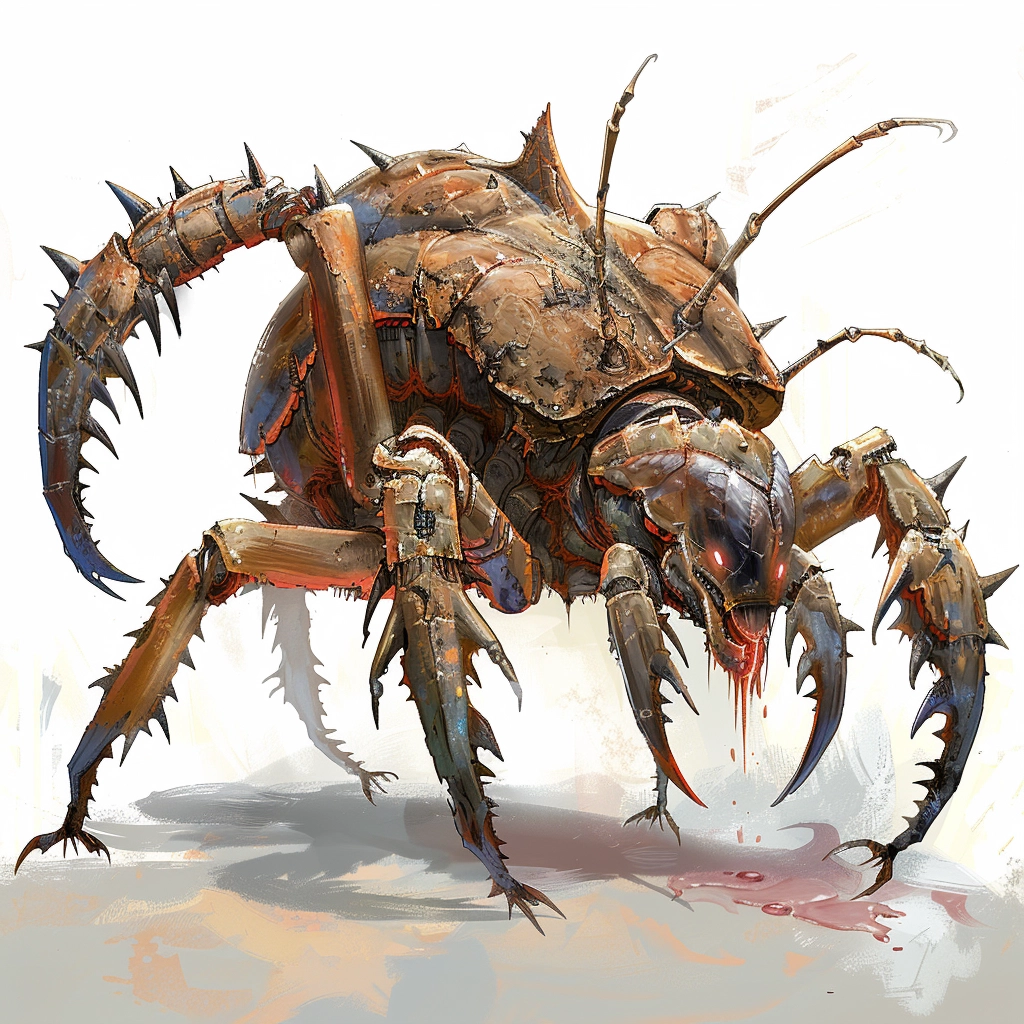
Silooths are monstrous beasts engineered by the Sith through sinister experiments, embodying the essence of Sith alchemy's power to corrupt and transform life. They are designed not only for physical dominance but also to strike terror into the hearts of enemies, serving as both weapons and symbols of Sith might. Their very presence on the battlefield is a manifestation of the dark side's ability to twist nature, creating living instruments of destruction and fear.
The Silooth is a towering insectoid creature, its body a horrific fusion of natural arthropod features and dark side mutations. Standing several meters tall, it boasts an exoskeleton that is nearly impenetrable, reflecting blaster shots and resisting lightsaber strikes. Its mandibles are massive and jagged, capable of spewing corrosive acid that can melt through armour and flesh alike. The creature's eyes, deep and glowing with malevolence, afford it excellent night vision, making it a formidable predator in the dark.
While originally engineered on planets steeped in the dark side, Silooths can adapt to and dominate a range of environments, from barren wastelands to dense jungles. Their ability to survive in hostile conditions makes them excellent siege creatures, capable of enduring long battles and harsh climates. They often lair in cavernous ruins or the depths of ancient Sith temples, where the dark side energy is strongest.
As creations of Sith alchemy, Silooths do not possess a culture or society in a traditional sense. They are solitary creatures, except when amassed for war by their Sith creators. Their existence is defined by their role as instruments of power and domination, living to serve the will of the Sith and to spread fear and death.
Silooths are not known to reproduce naturally. They are the result of meticulous and arcane Sith breeding programs, combining dark side energies with alchemical processes to spawn these terrifying beasts. The secrets of their creation are closely guarded, known only to the Sith alchemists who continue to refine and enhance their lethal attributes.
Inherently aggressive and territorial, Silooths display a level of brutality that is terrifying to behold. They attack without provocation, driven by an insatiable hunger for destruction. Their intelligence, though not high, is sufficient to execute complex commands and strategies in battle, making them effective at carrying out the Sith's orders. However, their fierce nature means they can sometimes be uncontrollable, turning on allies and enemies alike in their rage.
| STR | DEX | CON | INT | WIS | CHA |
|---|---|---|---|---|---|
| 22 (+6) | 8 (-1) | 17 (+3) | 2 (-4) | 8 (-1) | 13 (+1) |
Aggressive. As a bonus action, the silooth can move up to its speed toward a hostile creature it can see.
Bite. Melee Weapon Attack: +9 to hit, reach 5 ft., one target. Hit: 19 (2d12+6) kinetic damage plus 13 (2d12) acid damage. If the target is a Huge or smaller creature, it is grappled (escape DC 17). Until this grapple ends, the silooth can bite only the grappled creature and has advantage on attack rolls to do so.
Acid Spray (Recharge 6). The silooth spits acid in a 30-foot cone, provided that it has no creature grappled. Each creature in that area must make a DC 17 Dexterity saving throw, taking 32 (5d12) acid damage on a failed save, or half as much damage on a successful one.

Sith War Behemoths, the mammoth leviathans of the battlefield, are a testament to the Sith's mastery over nature and the dark side's perverse gift for war. These creatures were not merely animals; they were walking fortresses, a seamless blend of organic terror and armament, embodying the Sith philosophy of domination through strength.
The Sith War Behemoth is an imposing sight, standing at a colossal height of 12 to 15 meters and weighing approximately 10,000 kilograms. Their bodies are a stark display of evolutionary and alchemical design meant for war, covered in tough leathery skin, while their necks and backs are shielded by shaggy fur and a hard, protective shell. Their heads boast an array of weaponry in the form of long, curved tusks and an assortment of horns pointing skyward, giving them a formidable appearance that signals danger to any adversary.
These behemoths were originally native to the icy terrains of Khar Delba, where they lived as peaceful herd creatures. The Sith Lords, however, saw their potential for war, transporting many of them to various worlds, including harsh jungle environments where they underwent further transformations through Sith alchemy.
In their natural state, War Behemoths exhibited simple social behaviours, travelling in small groups and foraging widely for food. However, once integrated into the Sith armies, their behaviours were altered through selective breeding and alchemy, becoming an easily managed species. They were utilized as organic vehicles, bearing troops, and weapons, and leading the charge to demolish enemy fortifications.
Details of their natural reproductive processes are scarce, as the Sith's selective breeding programs significantly modified them. These behemoths became products of Sith genetic manipulation, selectively bred to enhance their size, strength, and obedience, making them suited for their roles in warfare.
The War Behemoths were naturally omnivorous, with a diet ranging from carrion to live prey. Despite not being highly territorial, they became hostile if threatened or attacked. Within Sith armies, their behaviour was meticulously controlled through standard command coding, allowing Sith troops to command these giants effectively in combat situations.
| STR | DEX | CON | INT | WIS | CHA |
|---|---|---|---|---|---|
| 22 (+6) | 9 (-1) | 18 (+4) | 2 (-4) | 10 (0) | 7 (-2) |
Battle Platform. The behemoth carries a mobile fort on its back. Up to four Medium creatures can ride in the fort without squeezing; a rider and three gunners. To make a melee attack against a target within 5 feet of the behemoth, they must use weapons with reach. Each gunner's seat has an attached weapon that can be fired once as if with a repeating blaster as an action. Creatures in the fort have three-quarters cover against attacks and effects from outside it. If the behemoth dies, creatures in the fort are placed in unoccupied spaces within 5 feet of the behemoth.
Sith-born. Dark forcecasters, Sith (species) and those who know the behemoth's command signals have advantage on Animal Handling checks against the behemoth.
Gore. Melee Weapon Attack: +9 to hit, reach 20ft., one target. Hit: 33 (6d8+6) kinetic damage.
Stomp. Melee Weapon Attack: +9 to hit, reach 20ft., one target. Hit: 28 (5d8+6) kinetic damage, and the target must succeed on a DC 15 Strength saving throw or be knocked prone.

Sith Warbirds, the dark avatars of the skies, are creatures steeped in the lore of ancient Sith conflicts. Their use as mounted assault avians paints a vivid picture of the battlefield - a tapestry of chaos and the raw power of nature, honed by the Sith's sinister influence into an instrument of war. They are the shadows that dive into the heart of the melee, agents of devastation as much as they are mounts.
Sith Warbirds are imposing beasts, each a massive, flightless bird hailing from the frigid peaks of Khar Delba. Towering at six meters in height and spanning ten meters from their beak to the tips of their tails, these creatures are a fearsome sight. Their wings have evolved into short, dual-clawed arms, more suited to the savagery of combat than the grace of flight. Their large, blunt beaks, perfect for devouring prey, coupled with thick hides capable of withstanding the embedding of hooks and spikes for domestication purposes, make them well-adapted to the rigours of war. Their plumage is a striking blend of yellow to yellowish-green, and their eyes, which can range from black to blue, add to their fierce visage.
Originally from the frozen mountains of Khar Delba within the Stygian Caldera, these predators adapted to the harsh, icy environment. Their home planet's unforgiving climate shaped them into hardy creatures, making them ideal for the Sith's use in the theatres of war that spanned many worlds.
In their natural state, Sith Warbirds are solitary predators, commanding the frozen mountainous territories of Khar Delba. However, their domestication by the Sith marked their entry into a culture of conquest and service. As part of the Sith military, these creatures became symbols of the empire's power, serving as mounts and as critical components in the strategy of warfare.
The specifics of Sith Warbird reproduction are not detailed in historical records, but it's likely that their breeding was tightly controlled by the Sith to produce creatures of war. Post-Sith conflicts, survivors bred on various worlds, suggesting a natural capacity for reproduction, with the potential for the Sith to have enhanced these traits for resilience and aggression.
Sith Warbirds are known for their bad temper and aggressive nature. They wield their colossal size to ram and trample their prey and utilize their beaks to gore enemies with brutal efficiency. In the service of the Sith, these warbirds displayed remarkable speed and maneuverability despite their size, making them excellent for both direct assaults and reconnaissance, their living presence allowing them to evade detection more easily than mechanical scouts.
| STR | DEX | CON | INT | WIS | CHA |
|---|---|---|---|---|---|
| 21 (+5) | 18 (+4) | 16 (+3) | 2 (-4) | 12 (+1) | 8 (-1) |
Barbed Hide. At the start of each of its turns, the war bird deals 5 (1d10) kinetic damage to any creature grappling it.
Battle Harness. The war bird comes equipped with a large harness. Up to three Medium creatures can ride in the harness without squeezing; a rider and two gunners. To make a melee attack against a target within 5 feet of the war bird, they must use weapons with reach. Each gunner's seat has an attached weapon that can be fired once as if with a blaster cannon as an action. These weapons do not need to be reloaded. Creatures in the harness have half cover against attacks and effects from outside it. If the warbird dies, creatures in the harness are placed in unoccupied spaces within 5 feet of the warbird.
Sith-born. Dark forcecasters and Sith (species) have advantage on Animal Handling checks against war birds.
Trampling Charge. If the war bird moves at least 20 feet straight toward a creature and then hits it with a talon attack on the same turn, that target must succeed on a DC 15 Strength saving throw or be knocked prone. If the target is prone, the war bird can make one beak attack against it as a bonus action.
Beak. Melee Weapon Attack: +7 to hit, reach 10ft., one target. Hit: 12 (2d6+5) kinetic damage.
Talon. Melee Weapon Attack: +7 to hit, reach 10ft., one target. Hit: 9 (1d8+5) kinetic damage.

The Droideka Sharpshooter, known alternatively as the sharpshooter droideka or sniper droid, is a specialized variant of the standard droideka or destroyer droid. Unlike its more common counterpart, which is typically equipped with twin blasters and deflector shields, the sharpshooter version features a single, powerful blaster rifle, emphasizing precision and range.
Physically, the Droideka Sharpshooter maintains the distinctive, rounded form of the standard droideka but is adapted to its sniping role. Its armored shell is designed to provide cover, especially when deployed in a stationary, firing position, compensating for the absence of deflector shields. This design allows it to focus on long-range engagements while maintaining a degree of protection.
The Droideka Sharpshooter was manufactured by the Colicoids of Colla IV, like the original droidekas. The Colicoids, known for their design of menacing and efficient droids, tailored the sharpshooter variant for specific tactical roles requiring long-distance firepower.
In terms of tactics, the Droideka Sharpshooter is deployed in scenarios where sniping and ranged combat are advantageous. It is used to target enemy forces from a distance, exploiting its high-powered blaster rifle to take out key targets or provide covering fire, thus complementing the more aggressive, front-line assault nature of the standard droidekas. This strategic deployment maximizes its effectiveness while minimizing its exposure to direct combat, where its lack of mobility compared to the standard droideka could be a liability.
| STR | DEX | CON | INT | WIS | CHA |
|---|---|---|---|---|---|
| 12 (+1) | 18 (+4) | 16 (+3) | 14 (+2) | 16 (+3) | 6 (-2) |
Circuitry. The droid has disadvantage on saving throws against effects that would deal ion or lightning damage.
Blast Shield. As a bonus action while in attack form, the sniper droideka can activate its blast shield. The droideka gains +3 AC when the blast shield is active. The shield has 80 hit points. Whenever the droideka takes damage, other than ion or lightning, the shield takes the damage instead. If this damage reduces the shield to 0 hit points, the droideka takes any remaining damage. The droideka can deactivate the shield with no action required. When deactivated the shield regenerates 10 hit points at the end of the droideka's turn. The shield cannot be activated when in ball form.
Keen Hearing and Sight. The Sniper Droideka has advantage on Wisdom (Perception) checks that rely on hearing or sight.
Multiattack. The droideka makes two weapon attacks
Heavy Blaster Cannon. Ranged Weapon Attack: +6 to hit, range 150/600, one target. Hit: 10 (1d12+4)
Ball Form. As a bonus action, the destroyer droid can transform into or out of ball form. While in ball form, the destroyer droid has increased speed, but it can not attack.

The Stone Guardian, also referred to in Legends as a Zardossa droid, is a droid model used primarily for discrete security tasks. These droids were designed with an exterior that mimicked stone, rock, or marble, allowing them to blend seamlessly into their surroundings as decorative statues or support pillars. This camouflage enabled them to be stationed in various locations without drawing attention, serving as hidden protectors or sentinels.
Physically, Stone Guardians are robust and imposing, with their armoured shells sculpted to resemble stone. This not only serves as effective camouflage but also provides them with a sturdy defence mechanism against potential attacks. They are typically large and semi-humanoid in shape, with the ability to activate and move when required, transforming from inert objects into dynamic combatants.
The manufacturers of these droids are not specifically mentioned, but they were widely used across the galaxy by various cultures and organizations who valued the blend of aesthetics and functionality. Their ability to serve as both ornamental and practical security solutions made them a popular choice.
Tactically, Stone Guardians are deployed in a dormant state, often mistaken for mere statues by the unsuspecting. Upon detection of a threat or activation through specific triggers, they spring to life, attacking intruders or defending their designated territories. Their primary function is to provide a sudden and unexpected line of defence, capitalizing on the element of surprise to neutralize threats effectively. The blend of stealth, durability, and combat capability makes them formidable guardians of the locations they are assigned to protect.
| STR | DEX | CON | INT | WIS | CHA |
|---|---|---|---|---|---|
| 22 (+6) | 8 (-1) | 20 (+5) | 6 (-2) | 11 (0) | 2 (-4) |
Circuitry. The Stone Guardian has disadvantage on saving throws against effects that would deal ion or lightning damage.
False Appearance. While the Stone Guardian remains motionless, it is indistinguishable from a normal stone statue.
Multiattack. The Stone Guardian makes two slam attacks.
Slam. Melee Weapon Attack: +10 to hit, Reach 5 ft., one target. Hit: 19(3d8+6) kinetic damage.
Tactical Advantage (Recharge 5-6). Until the end of its next turn, the Stone Guardian gains a +2 bonus to its AC, has advantage on Dexterity saving throws, and can use its slam attack as a bonus action.

Storm Beasts are the embodiment of Malachor V's harsh environment, creatures born from darkness and storms. They are feared by those who know of them, for their power is great, and their fury unmatched. Few dare to tread on Malachor V, and those who do often find themselves hunted by these relentless predators. Yet, for all their ferocity, Storm Beasts are a part of the planet's twisted ecosystem, a reminder of the dark side's corrupting influence on all it touches.
This creature is designed to present a formidable challenge to a party of adventurers, embodying the terrifying presence and raw power of the Storm Beast as depicted in Knights of the Old Republic. It should provide both a combat challenge and an opportunity for rich storytelling within your campaign.
Storm Beasts are towering creatures, standing several meters tall with thick, muscular limbs and a hide tough enough to withstand blaster fire. Their skin is dark, often appearing black or deep gray, with electric blue veins visible beneath, pulsating with energy. They have sharp, protruding spines along their backs, and their faces are dominated by a large, tooth-filled maw capable of biting through durasteel.
Storm Beasts are native to Malachor V, thriving in its turbulent, storm-wracked surface. They are adapted to live in the planet's severe electromagnetic storms, drawing energy from the lightning and electrical discharges that constantly ravage Malachor V.
Storm Beasts are solitary creatures, with no known social structure or culture. They are driven by instinct, territoriality, and the need to feed. Their intelligence is a matter of some debate, but they have shown the ability to understand complex situations and to be surprisingly cunning in battle.
Little is known about the reproduction of Storm Beasts, as no one has ever observed them mating or caring for young. It is speculated that they reproduce very infrequently, possibly laying eggs or undergoing a form of asexual reproduction.
Storm Beasts are apex predators, aggressive and territorial. They are drawn to sources of electrical energy, which they consume to sustain themselves. They are also known to be particularly sensitive to disturbances in the Force, often attacking force users with relentless aggression.
| STR | DEX | CON | INT | WIS | CHA |
|---|---|---|---|---|---|
| 22 (+6) | 14 (+2) | 17 (+3) | 3 (-4) | 12 (+1) | 6 (-2) |
Storm Empowered. Whenever the Storm Beast takes lightning damage, it takes no damage and instead regains a number of hit points equal to the lightning damage dealt.
Force Sensitivity. The Storm Beast has advantage on saving throws against force powers and against effects that deal force damage.
Multiattack. The Storm Beast makes two attacks: one with its bite and one with its claws.
Bite. Melee Weapon Attack: +10 to hit, reach 5 ft., one target. Hit: 23 (3d10 + 6) piercing damage.
Claw. Melee Weapon Attack: +10 to hit, reach 10 ft., one target. Hit: 20 (3d8 + 6) slashing damage.
Electrical Discharge (Recharge 5-6). The Storm Beast releases a burst of electrical energy in a 20-foot radius. Each creature in that area must make a DC 15 Dexterity saving throw, taking 22 (4d10) lightning damage on a failed save, or half as much damage on a successful one.

The Super Battle Droid Rocket Trooper is a variant of the B2 Super Battle Droid, designed for increased aerial mobility and firepower. These units are distinguished by their more substantial, shoulder-mounted jetpacks, allowing for rapid, controlled flight, superior to their B2-RP predecessors. This enhancement provides not only greater speed but also improved maneuverability in combat scenarios.
Physically, the Super Battle Droid Rocket Trooper retains the imposing, armoured design of standard Super Battle Droids, with the notable addition of larger jetpacks. These jetpacks are equipped with two powerful thrusters, significantly enhancing the droid's battlefield versatility and threat level.
Manufactured by the Techno Union, these droids served the Separatist Alliance during the latter stages of the Clone Wars. They were part of a continuous effort to improve upon the designs of earlier droid models, addressing weaknesses and optimizing performance for specific combat roles.
Tactically, Super Battle Droid Rocket Troopers were deployed to exploit their aerial capabilities, engaging in rapid assaults, flanking maneuvers, and providing support fire from vantage points inaccessible to ground units. Their ability to swiftly move across the battlefield and engage from elevated positions made them a valuable asset in the Separatist war effort, particularly in scenarios where mobility and firepower were crucial.
| STR | DEX | CON | INT | WIS | CHA |
|---|---|---|---|---|---|
| 18 (+4) | 19 (+4) | 15 (+2) | 14 (+2) | 16 (+3) | 10 (0) |
Circuitry. The droid has disadvantage on saving throws against effects that would deal ion or lightning damage.
Jetpack. Activating or deactivating the jetpack requires a bonus action and, while active, the Rocket Trooper has a flying speed of 30 feet. The jetpack lasts for a maximum of 10 minutes.
Multiattack. The Rocket Trooper makes two weapon attacks with its strike or wrist blasters
Strike. Melee Weapon Attack: +5 to hit, Reach 5 ft., one target. Hit: 5(1d4+2) kinetic damage.
Triple Wrist Blaster. Ranged Weapon Attack: +7 to hit, Range 60/240 ft., one target. Hit: 11 (2d6+4) energy damage
Blaster Volley. (Recharge 5-6). The Rocket Trooper sprays a 10-foot-cube area within normal range with shots. Each creature in the area must make a DC 15 Dexterity saving throw, taking normal weapon damage on a failed save.

The Super Tactical Droid, or ST-series military strategic analysis and tactics droid, is an advanced model of tactical droid used by the Confederacy of Independent Systems during the Clone Wars. These droids were designed to be superior commanders, capable of making independent strategic decisions on the battlefield.
Physically, Super Tactical Droids are taller and more robust than their predecessors, the T-series tactical droids. They feature a humanoid shape with a distinctly angular and armoured design, often in darker hues to signify their elite status. Their eyes are equipped with advanced sensors to analyze the battlefield effectively.
Manufactured by Baktoid Combat Automata, the Super Tactical Droids were created to address the limitations of earlier tactical droids, such as inflexibility and predictability. They are equipped with enhanced processors and algorithms to assess situations and devise complex strategies quickly.
In terms of tactics, Super Tactical Droids are deployed as field commanders and strategists, often overseeing entire operations. They are capable of commanding large groups of droids, making real-time decisions to adapt to the unfolding combat scenarios. Their strategic acumen allows them to orchestrate large-scale assaults, defensive maneuvers, and retreats, maximizing the efficiency and effectiveness of the Separatist forces. Their role is crucial in ensuring the coordination and execution of the Separatist military campaigns.
| STR | DEX | CON | INT | WIS | CHA |
|---|---|---|---|---|---|
| 16 (+3) | 17 (+3) | 17 (+3) | 21 (+5) | 16 (+3) | 15 (+2) |
Legendary Resistance (3/Day). If the tactical droid fails a saving throw, it can choose to succeed instead.
Master of the Droid. While within 30 feet of the tactical droid, any droid ally of the tactical droid makes saving throws with advantage, and that ally regains 1d6 hit points whenever it starts its turn there.
Circuitry. The tactical droid has disadvantage on saving throws against effects that would deal ion or lightning damage.
Tactical Technology. When the tactical droid casts a tech power that causes damage or that forces other creatures to make a saving throw, it can choose itself and any number of allies to be immune to the damage caused by the power and to succeed on the required saving throw.
Techcasting. The tactical droid is a 13th-level techcaster. Its techcasting ability is Intelligence (power save DC18, +10 to hit with tech attacks) and it has 57 tech points. The tactical droid knows the following tech powers:
Multiattack. The tactical droid makes three bash attacks or biopistol attacks.
Bash. Melee Weapon Attack: +8 to hit, reach 5ft., one target. Hit: 15 (2d8+3) kinetic damage. This attack scores a critical hit on a roll of 19 or 20.
Biopistol. Ranged Weapon Attack: +8 to hit, range 40/160 ft., one target. Hit: 7 (1d8+3) kinetic damage plus 14 (4d6) poison damage.
At-Will. The tactical droid casts an at-will tech power.
Bash. The tactical droid makes a bash attack.
Move. The tactical droid moves up to its speed without provoking opportunity attacks.
Construct Droid (Costs 3 Actions). Up to five junk droids appear in unoccupied spaces within 30 feet of the tactical droid and remain until destroyed. Droids summoned in this way roll initiative and act in the next available turn. The tactical droid can have up to five droids summoned by this ability at a time.

Deep within the murky waters of Absit's swamplands lies a creature as ancient as the planet itself. The Abysmal Leviathan, a name whispered in fear among the locals, has dwelled in these waters for millennia, its origins shrouded in mystery and dark legend. This colossal amphibian is a guardian of the depths, a creature so intertwined with the planet's life force that some believe it to be the spirit of Absit itself.
The Abysmal Leviathan resembles a gargantuan salamander, with slick, dark green skin that seems to absorb light rather than reflect it. Its eyes glow with a bioluminescent hue, piercing the darkness of its swampy home. The creature's body is adorned with ancient, rune-like markings that shimmer with a faint, mystical energy, suggesting a connection to the Force not fully understood. It possesses a set of powerful limbs ending in webbed claws, enabling it to navigate both the waters and the land surrounding its domain with terrifying grace and agility.
The Leviathan resides in the darkest, most remote parts of Absit's swamplands, preferring the densest, most impenetrable parts of the marsh where the Force feels strongest. It is said that the waters of its lair have healing properties, guarded fiercely by the creature.
The Abysmal Leviathan is a solitary creature, with no known society or culture. Legends suggest it was once worshipped as a deity by an ancient, now-extinct civilization on Absit, which believed it to be a protector of the planet and a harbinger of balance.
It is unknown how the Abysmal Leviathan reproduces, as no other creature of its kind has ever been seen. Some speculate that it is the last of its kind, while others believe it can create life from the very essence of the swamp itself.
The Leviathan is generally reclusive, avoiding contact with sentient beings unless provoked. It is fiercely territorial and will attack anything it perceives as a threat to its domain. Despite its fearsome demeanour, the Leviathan has been known to aid those it deems worthy, guiding lost travellers out of the swamps or healing them with the mystical waters of its lair.
| STR | DEX | CON | INT | WIS | CHA |
|---|---|---|---|---|---|
| 23 (+6) | 14 (+2) | 19 (+4) | 6 (-2) | 15 (+2) | 10 (0) |
Amphibious. The Leviathan can breathe air and water.
Swamp Camouflage. The Leviathan has advantage on Stealth checks made to hide in swampy terrain.
Force-sensitive Rune Markings. The Leviathan can innately cast Force powers without any tech casting ability, using Wisdom as its casting ability (spell save DC 15, +7 to hit with force attack spells). It has the following force powers prepared:
Multiattack. The Leviathan can use its Frightful Presence. It then makes three attacks: one with its bite and two with its claws.
Bite. Melee Weapon Attack: +11 to hit, reach 10 ft., one target. Hit: 26 (3d10 + 6) piercing damage.
Claw. Melee Weapon Attack: +11 to hit, reach 5 ft., one target. Hit: 18 (2d8 + 6) slashing damage.
Frightful Presence. Each creature of the Leviathan's choice within 120 feet of it and aware of it must succeed on a DC 15 Wisdom saving throw or be frightened for 1 minute. A creature can repeat the saving throw at the end of each of its turns, with disadvantage if the Leviathan is within line of sight, ending the effect on itself on a success.
Force Echo. When the Abysmal Leviathan takes damage from a creature within 60 feet of it that it can see, it can use its reaction to impose disadvantage on the next attack roll that creature makes before the end of the creature's next turn. This reaction represents the Leviathan's ability to momentarily disrupt the flow of the Force around its attacker, mirroring the disturbance caused by the attack itself. This ability not only reflects the creature's deep connection to the Force but also its defensive instincts, further embodying its role as a guardian of its swampland habitat.
Detect. The Leviathan makes a Wisdom (Perception) check.
Tail Swipe. The Leviathan makes a tail attack.
Tail Attack. Melee Weapon Attack: +11 to hit, reach 15 ft., one target. Hit: 22 (3d8 + 6) bludgeoning damage.

The Swampstone Creeper is a formidable creature native to the swamps of Zakuul, a planet known for its vast southern ocean and expansive swamps, including the infamous Endless Swamp. This large, amphibious creature has adapted perfectly to the semi-solid terrain and towering, overgrown trees of its habitat.
Its body, a blend of hardened moss and stone, allows it to camouflage seamlessly with the swampy environment. This natural armour is not just for protection; it also serves as a testament to the creature's unique connection to the Force, balanced between the light and dark sides, much like the planet itself.
The Creeper's eyes glow in the dark, a necessary adaptation for life in the shadowy swamps. These glowing eyes, coupled with its ability to move with surprising speed, make it a fearsome predator. It can lie in wait, almost indistinguishable from the surrounding landscape, before launching itself at its prey with powerful arms.
Despite its primitive appearance, the Swampstone Creeper exhibits a certain level of intelligence. It has learned to avoid the populated cities branching off from the Spire, and it keeps a safe distance from the resting place of the Eternal Throne. However, it has been known to come into conflict with the native Iknayid and even the adapted swamp rancors.
The Swampstone Creeper is a testament to the diverse and resilient life forms that inhabit Zakuul, a creature as mysterious and formidable as the planet itself.
| STR | DEX | CON | INT | WIS | CHA |
|---|---|---|---|---|---|
| 18 (+4) | 8 (-1) | 16 (+3) | 2 (-4) | 10 (0) | 6 (-2) |
Amphibious. The amphibious trait means that the Swampstone Creeper can breathe both air and water. This allows it to survive in both land and aquatic environments, making it a versatile predator in its swampy habitat. In game terms, this means it doesn't suffer penalties or need to make checks to operate in water, and it can't be drowned in the usual way.
Arm Strike. Melee Weapon Attack: +4 to hit, range 10ft., one creature. Hit: 14 (2d10+4) kinetic damage.
Surprise Leap. Ranged Attack: +4 to hit, range 15 ft., one target. Hit: 13 (3d6+4) kinetic damage.

The Sylorac, native to the mountainous world of Avidich, is a creature built for survival amidst the craggy peaks and harsh climate. With a stature rivalling a Bantha, the creature displays uncanny agility and sturdiness thanks to its lean, muscular build and four solid limbs.
The Sylorac's body is encased in an armour of thick, heavy scales - a defence mechanism evolved against the predatory threats in the formidable mountains of Avidich. These scales, reflecting an iridescent sheen under Avidich's unique atmospheric light, have a slight insulating property that protects the Sylorac from the often below-freezing temperatures.
At the end of its elongated body, a muscular tail provides critical balance while maneuvering treacherous mountain terrains and steep rock faces. Its dual horns, curved like the crescent moons of Avidich, serve as formidable weapons. Not only used in territorial disputes against fellow Syloracs, but also in defence against other native predators.
Sylorac's eyes, large and luminescent, are adapted to the planet's dark, long nights and its frequent, misty days, making it an exceptional nocturnal hunter. These eyes have a unique reflective property that adds to their uncanny ability to see in near-darkness.
Syloracs communicate through a series of low rumbling sounds, barely perceptible to most humanoids. These sounds, combined with subtle body language, allow them to understand basic emotions and intentions of sentient beings around them. They are predominantly solitary creatures, but during the harsh Avidich winters, they have been observed to form temporary social groups, sharing caves for warmth and protection.
The Chiss of Avidich has learned to respect the Syloracs, recognizing their role in the planet's ecosystem. Observations of the Sylorac's ability to locate and consume certain types of lichens, known for their medicinal properties, have even led to the discovery of new remedies by the Chiss.
A Sylorac sighting is a sign of good fortune among the Chiss settlers. These majestic, stoic creatures have become a symbol of resilience and adaptation, mirroring the survival spirit of the Chiss in the challenging landscape of Avidich.
| STR | DEX | CON | INT | WIS | CHA |
|---|---|---|---|---|---|
| 20 (+5) | 14 (+2) | 18 (+4) | 5 (-3) | 15 (+2) | 10 (0) |
Mountain Born. The Sylorac has advantage on Athletics checks made to climb, and it ignores difficult terrain caused by rocky or steep environments.
Sure-Footed. The Sylorac has advantage on Strength and Dexterity saving throws made against effects that would knock it prone.
Multiattack. The Sylorac makes two attacks: one with its bite and one with its horns.
Bite. Melee Weapon Attack: +9 to hit, reach 5 ft., one target. Hit: 14 (2d8 + 5) piercing damage.
Horns. Melee Weapon Attack: +9 to hit, reach 5 ft., one target. Hit: 16 (2d10 + 5) bludgeoning damage. If the target is a creature, it must succeed on a DC 16 Strength saving throw or be knocked prone.
Retaliatory Strike. If the Sylorac is hit by a melee attack, it can make one melee attack with its horns against the attacker as a reaction.

The T4 turret droid is a formidable automated weapon system designed by the Colicoid Creation Nest, known for its deployment during the pre-Clone Wars era. These droids are primarily used for defensive purposes, guarding important installations or individuals.
Physically, the T4 turret droid resembles a stationary gun emplacement with a robust, armoured chassis and multiple blaster cannons mounted on a rotating turret. This allows it to cover a wide area of fire, engaging multiple targets simultaneously or focusing its firepower on a single threat. Its design is highly durable, capable of withstanding considerable damage before being incapacitated.
Manufactured by the Colicoid Creation Nest, the same manufacturer as the Droideka, the T4 turret droid is built for longevity and reliability. Its primary function is to serve as a mobile defence platform, providing heavy firepower and fortification against enemy assaults.
In terms of tactics, the T4 turret droid is deployed in strategic locations to maximize its defensive capabilities. It is often used to protect vital assets, control key chokepoints, or provide supporting fire for allied forces. Its strength lies in its ability to deliver sustained blaster fire, making it a significant threat to approaching enemy forces and an excellent tool for area denial.
| STR | DEX | CON | INT | WIS | CHA |
|---|---|---|---|---|---|
| 17 (+3) | 7 (-2) | 13 (+1) | 18 (+4) | 12 (+1) | 8 (-1) |
Circuitry. The droid has disadvantage on saving throws against effects that would deal ion or lightning damage.
Targeting Systems. The T4 Turret Droid uses its Intelligence modifier for attack, damage, and initiative rolls.
Keen Hearing and Sight. The T4 has advantage on Wisdom (Perception) checks that rely on hearing or sight.
Multiattack. The Turret Droid makes two weapon attacks with its blaster cannons along with Grenade Launchers, if available.
Blaster Cannons. Ranged Weapon Attack: +5 to hit, Range 60/160 ft., one target. Hit: 15 (3d6+4) energy damage.
Grenade Launcher (3/Day). The T4 launches a grenade, at a point within 40 ft. Each creature within 10 feet must make a DC 14 Dexterity saving throw. A creature takes 7 (2d6) fire and 7 (2d6) kinetic damage on a failed save, or half as much as on a successful one.
Reactive Shield (2/Day). Until the start of its next turn, the T4 Turret Droid has a +5 bonus to AC. This includes the triggering attack.

Tachs are captivating, small creatures reminiscent of terrestrial monkeys but distinguished by their vivid blue fur and luminescent eyes. These creatures possess an innate agility and grace, utilizing their long, prehensile tails with remarkable skill to navigate the dense, vertiginous forests of Kashyyyk, their exclusive habitat. The shadowy forest floors and towering wroshyr trees provide not only sanctuary but a playground for these acrobatic beings, where they leap and swing from branch to branch with effortless ease.
Tach's society is deeply communal and characterized by a complex social structure that emphasizes group cohesion and mutual support. These creatures live in large family groups, forming tight-knit communities that communicate through an intricate language of chirps, screeches, and body movements. The rich tapestry of sounds that fill the air around Tach settlements is not mere noise but a sophisticated system of communication that conveys emotions, warnings, and social bonds. This complex social behaviour suggests a level of intelligence that, while not approaching sentience, indicates a profound connection to their environment and each other.
Reproduction among Tach is a yearly event, marked by an elaborate courtship ritual that involves both vocal and physical displays. During this period, the forest canopy becomes a vibrant stage for Tach as they compete to attract mates, showcasing their agility, strength, and vocal range. These displays serve not only to select the strongest and most agile partners but also to strengthen the social bonds within the group, reinforcing the communal fabric of Tach society.
The Tach's diet is primarily herbivorous, consisting of fruits, nuts, and small insects that are abundant within their arboreal home. This diet, while seemingly simple, is crucial for maintaining the delicate balance of Kashyyyk's ecosystem, with Tach playing a vital role in the dispersal of seeds and the control of insect populations.
Behaviorally, Tachs are diurnal creatures, embracing the light of day for foraging, socializing, and exploration. As night descends, they retreat to the safety of nests constructed high in the wroshyr trees, where they rest until dawn. Despite their peaceful nature, Tachs are not defenceless. When threatened, they can emit a surprisingly loud screech that disorients predators and alerts other Tachs to danger, demonstrating their keen instinct for survival.
| STR | DEX | CON | INT | WIS | CHA |
|---|---|---|---|---|---|
| 8 (-1) | 16 (+3) | 12 (+1) | 6 (-2) | 14 (+2) | 10 (0) |
Keen Sight. The Tach has advantage on Wisdom (Perception) checks that rely on sight.
Tree Dweller. The Tach has advantage on Dexterity (Acrobatics) checks made in forested terrain and can move through difficult terrain made of trees or foliage without extra movement.
Echolocation. The Tach can use echolocation to navigate and locate creatures within 60 feet. It can't use this trait while deafened.
Bite. Melee Weapon Attack: +5 to hit, reach 5 ft., one target. Hit: 7 (1d8 + 3) piercing damage.
Soothing Screech (Recharge 5-6). The Tach emits a soothing screech. Each ally within 30 feet of the Tach that can hear it gains advantage on their next attack roll, skill check, or saving throw before the end of the Tach's next turn.

The Takkaro Lizard, native to the lush, vibrant world of Takkaro, is a small but remarkably agile and adaptive creature. Known for their vividly coloured scales, which range from emerald greens to radiant blues, these lizards blend seamlessly into their tropical surroundings, evading predators with ease.
Takkaro Lizards measure around two feet in length, with slender bodies and long tails that aid in their balance. They possess four nimble legs that allow for quick movements and adept climbing. Their eyes are large and round, providing them with excellent vision to spot insects and small prey.
These lizards thrive in dense, humid jungle environments where foliage is plentiful. They are excellent climbers and spend a significant amount of time in the treetops, basking in the sun or hunting for food.
Takkaro Lizards are solitary creatures, with interactions largely limited to mating seasons. They are territorial, but their territories often overlap due to the high population density in their native habitats.
During mating season, Takkaro Lizards display vibrant colours and perform visual displays to attract mates. They lay clutches of eggs hidden in the underbrush or in tree hollows, which hatch into self-sufficient offspring.
These lizards are diurnal, active during the day and resting at night. They are primarily insectivorous but will occasionally consume small fruits. Takkaro Lizards have a unique ability to change the hue of their scales to better camouflage with their surroundings, making them elusive to both predators and observers.
| STR | DEX | CON | INT | WIS | CHA |
|---|---|---|---|---|---|
| 8 (-1) | 16 (+3) | 12 (+1) | 2 (-4) | 12 (+1) | 6 (-2) |
Camouflage. The Takkaro Lizard has advantage on Dexterity (Stealth) checks made to hide in forested or jungle environments.
Wall Crawler. The Takkaro Lizard can climb difficult surfaces, including upside down on ceilings, without needing to make an ability check.
Bite. Melee Weapon Attack: +5 to hit, reach 5 ft., one target. Hit: 6 (1d6 + 3) piercing damage.

Tauntauns are resilient and hardy creatures native to the icy planet of Hoth. They have been domesticated by the Rebel Alliance to serve as patrol mounts in the harsh, frozen terrain. These creatures are known for their ability to withstand extremely low temperatures, making them invaluable to those trying to survive in cold environments.
A tauntaun stands about eight feet tall at the shoulder on its hind legs, with a thick, bluish-gray hide that helps insulate it against the cold. It has a long, reptilian tail, two large horns curling from the sides of its head, and a face that bears a close resemblance to that of a terrestrial lizard. Its body is supported by strong, muscular legs adapted for swift movement across snowy landscapes.
Tauntauns are native to the icy wastelands of Hoth, thriving in areas that would be uninhabitable for most other species. They are adept at navigating the treacherous terrain, from icy plains to snow-covered mountains.
While tauntauns do not have a society or culture in the human sense, they do exhibit social behaviours, living in herds for protection against natural predators like the wampa. These herds are typically led by a dominant male.
Tauntauns are egg-layers, with females laying a clutch of eggs in a warm, sheltered location. The eggs are fiercely protected by both parents until they hatch, at which point the young are quickly taught to fend for themselves.
Tauntauns are known for their stubborn yet loyal nature when domesticated. In the wild, they are cautious creatures, always alert for signs of predators. They communicate with each other using a series of grunts and bleats, especially during mating season or when warning the herd of danger.
| STR | DEX | CON | INT | WIS | CHA |
|---|---|---|---|---|---|
| 16 (+3) | 13 (+1) | 16 (+3) | 2 (-4) | 12 (+1) | 6 (-2) |
Keen Smell. The tauntaun has advantage on Wisdom (Perception) checks that rely on smell.
Sure-Footed. The tauntaun has advantage on Strength and Dexterity saving throws made against effects that would knock it prone.
Bite. Melee Weapon Attack: +5 to hit, reach 5 ft., one target. Hit: (2d6 + 3) piercing damage.
Stomp. Melee Weapon Attack: +5 to hit, reach 5 ft., one prone creature. Hit: (2d8 + 3) bludgeoning damage.

Emerging from the darkest corners of Sith legends, the Terentatek is a creature of nightmares, a testament to the corrupting power of the dark side. These monstrous beings are feared across the galaxy, not just for their formidable size and strength but for their insidious diet: the blood of Force sensitives. They are predators born from the dark side, often found lurking in ancient Sith temples and tombs, places where the dark side of the Force seethes.
Physically, Terentateks are behemoths, standing as grotesque parodies of Rancors but distinguished by a series of menacing spines along their backs and distinctive flap or tusk-like protrusions extending from their mouths. Their hands are equipped with four deadly claws, and their tusks are laced with a potent venom, making them particularly lethal. The hide of a Terentatek is a marvel of dark-side mutation; it is not only incredibly tough but also seemingly impervious to the Force, providing them with a natural defence against Force-powered attacks.
The origins of these dark-side creatures are shrouded in mystery and Sith alchemy. Legend has it that Terentateks were once Rancors, twisted and reshaped by the dark side through Sith experimentation, designed to hunt and exterminate Jedi. Their life cycles are deeply intertwined with the ebb and flow of the dark side across the galaxy; they slip into long periods of hibernation during times when the dark side wanes, only to reawaken with its resurgence.
Solitary by nature, Terentateks are known as "Jedi Killers" for their predisposition to hunt those strong in the Force. Their emergence is often seen as an ill omen, signifying a rise in the dark side's power. Despite their fearsome reputation, little is known about their societal structures or cultures, as their lives are dedicated solely to the hunt and consumption of Force-sensitive beings.
Details on Terentatek reproduction are scarce, perhaps mercifully so. It is unknown how these creatures multiply, whether through the dark side's will alone or through more natural means. Their behaviours, however, are well-documented by those unfortunate enough to encounter them. Terentateks are relentless and brutal hunters, using their natural resistances to close in on their prey and their venomous tusks and claws to incapacitate or kill. They are creatures of the dark side, through and through, embodying its malevolence in every aspect of their being.
| STR | DEX | CON | INT | WIS | CHA |
|---|---|---|---|---|---|
| 17 (+3) | 12 (+1) | 18 (+4) | 8 (-1) | 11 (0) | 3 (-4) |
Force Resistance. Advantage on saving throws against Force powers and resistance to damage from Force powers.
Sith-born. Dark forcecasters and Sith (species) have advantage on Animal Handling checks on Terentatek.
Multiattack. Makes three attacks: one with its tusks and two with its claws.
Tusks. Melee Weapon Attack: +6 to hit, reach 5 ft., one creature. Hit: 22 (5d8+3) kinetic damage. When a creature is hit by the Terentatek's tusks or claws, it must succeed on a DC 15 Constitution saving throw or become poisoned. While poisoned in this way, the creature takes 2 (1d4) toxin damage per turn​​.
Claws. Melee Weapon Attack: +6 to hit, reach 5 ft., one creature. Hit: 18 (5d6+3) kinetic damage. When a creature is hit by the Terentatek's tusks or claws, it must succeed on a DC 15 Constitution saving throw or become poisoned. While poisoned in this way, the creature takes 2 (1d4) toxin damage per turn​​.
Rock. Ranged Weapon Attack: +3 to hit, range 30/70 ft., one creature. Hit: 15 (4d6+3) kinetic damage.

Terentateks, known among the Jedi as "Jedi Killers," are the stuff of nightmares, conjured from the darkest depths of Sith alchemy. These creatures are a grim reminder of the malevolence that the dark side can bestow upon nature, transforming beasts into apex predators with a thirst for the lifeblood of the Force-sensitive.
The terentatek is a formidable predator, roughly one-quarter the size of a bull Rancor but no less terrifying. With an array of spines erupting from its back and tusk-like projections framing its mouth, this beast exudes danger. Its massive, venomous claws and tusks stand ready to rend and tear with deadly efficiency. Their formidable hides resist not just physical harm but also the manipulation of the Force, making them a dire threat to even the most skilled Force-users.
These abominations were said to dwell in caves and tombs imbued with the dark side, often guarding the unhallowed grounds of ancient Sith Lords like Naga Sadow. Their presence in such places is a testament to their role as sentinels of the dark, a living defence against any who would dare disturb the slumber of their sinister masters.
Terentateks are solitary hunters, and their society is limited to the cruel hierarchy of predator and prey. Culturally, they are a symbol of the Sith's twisted creations, often used in dark rituals or as tests for aspiring Sith warriors to prove their mettle.
Little is known about how terentateks reproduce, as they are likely not a naturally occurring species. It's probable that their numbers were sustained through Sith breeding programs and alchemical practices, designed to ensure their presence in the galaxy as a dark side was prevalent.
A terentatek's bad temper is legendary, and they are known to attack with ferocity anything they perceive as a threat. They use their sheer bulk to overpower foes, crushing and goring with tusks and claws alike. During times when the dark side wanes, these creatures enter a state of hibernation, emerging only when the dark side surges once again.
| STR | DEX | CON | INT | WIS | CHA |
|---|---|---|---|---|---|
| 18 (+4) | 13 (+1) | 18 (+4) | 3 (-4) | 8 (-1) | 11 (0) |
Disruptive. When a creature is forced to make a Constitution saving throw to maintain concentration due to taking damage from the terentatek, the DC for the check equals 10 or the full damage is taken, whichever number is higher, instead of only half.
Force Resistance. The terentatek has advantage on saving throws against force powers.
Sith-born. Dark forcecasters and Sith (species) have advantage on Animal Handling checks on terentateks.
Multiattack. The terentatek makes three attacks, once with its tusks and twice with its claws.
Tusks. Melee Weapon Attack: +8 to hit, reach 5 ft., one creature. Hit: 26 (5d8+4) kinetic damage plus 2 (1d4) poison damage. The creature must then succeed on a Constitution saving throw (DC 16) or become poisoned for 1 minute.
Claws. Melee Weapon Attack: +8 to hit, reach 5 ft., one creature. Hit: 21 (5d6+4) kinetic damage plus 2 (1d4) poison damage. The creature must then succeed on a Constitution saving throw (DC 16) or become poisoned for 1 minute.
Rock. Ranged Weapon Attack: +8 to hit, range 30/120 ft., one creature. Hit: 18 (4d6+4) kinetic damage.

The Terentatek Mauler is a whispered legend among even the bravest Jedi, a creature so fierce that it's considered the zenith of dark-side alchemy's perversion. These behemoths are the Sith's ultimate guardians, stalking the corridors of ancient temples and tombs, a testament to the lengths the Sith will go to protect their secrets.
The Terentatek Mauler is an evolution of terror, a monstrosity towering above its kin. It dwarfs the standard Terentatek, with an even thicker hide impervious to the Force, and spines that are longer and sharper, like the jagged blades of a vibrosword. Its tusks, dripping with potent venom, are larger and curved like the scythes of death itself. Each of the Mauler's claws could rend durasteel, and its eyes burn with an unholy light that chills the soul. The Mauler is not just a creature; it's a walking cataclysm, a force of nature that has been twisted into an instrument of destruction.
Terentatek Maulers would be found only in the most sacred and darkened recesses of the Sith realms. They are the ultimate sentinels, stationed to guard the most treasured and forbidden knowledge, often deep within the caverns and temples pulsating with dark side energy.
As solitary apex predators enhanced by Sith alchemy, Terentatek Maulers have no society or culture to speak of. Their purpose is singular and ingrained: to destroy anything that carries the light of the Force within it. They are solitary by necessity, as even other dark creatures give them a wide berth.
It is likely that Maulers are not bred but created, perhaps from the largest and most vicious of Terentateks, augmented and amplified through Sith rituals and alchemy to reach their monstrous size and power.
The Mauler embodies relentless aggression and is driven by an insatiable hunger for Force-sensitive blood. They are creatures of pure destruction, capable of enduring an onslaught of attacks while delivering devastating blows with their tusks and claws. Unlike their lesser kin, Maulers may be even more resistant to Jedi powers, turning battles with them into gruelling tests of physical might and endurance.
| STR | DEX | CON | INT | WIS | CHA |
|---|---|---|---|---|---|
| 18 (+4) | 13 (+1) | 18 (+4) | 3 (-4) | 8 (-1) | 11 (0) |
Disruptive. When a creature is forced to make a Constitution saving throw to maintain concentration due to taking damage from the terentatek, the DC for the check equals 10 or the full damage is taken, whichever number is higher, instead of only half.
Improved Force Resistance. The terentatek has advantage on saving throws against force powers, and any creature that makes a force attack against the leviathan has disadvantage on the attack roll.
Regeneration. The terentatek regenerates 10 hit points at the start of its turn. If the terentatek takes necrotic or lightning damage, this trait doesn't function at the start of the terentatek's next turn. The terentatek dies only if it starts its turn with 0 hit points and doesn't regenerate.
Sith-born. Dark forcecasters and Sith (species) have advantage on Animal Handling checks on terentateks.
Multiattack. The terentatek makes three attacks, once with its tusks and twice with its claws.
Tusks. Melee Weapon Attack: +9 to hit, reach 5 ft., one creature. Hit: 26 (5d8+4) kinetic damage plus 7 (2d6) poison damage. The creature must then succeed on a Constitution saving throw (DC 17) or become poisoned for 1 minute.
Claws. Melee Weapon Attack: +9 to hit, reach 5 ft., one creature. Hit: 21 (5d6+4) kinetic damage plus 7 (2d6) poison damage. The creature must then succeed on a Constitution saving throw (DC 17) or become poisoned for 1 minute.
Rock. Ranged Weapon Attack: +9 to hit, range 30/120 ft., one creature. Hit: 18 (4d6+4) kinetic damage.
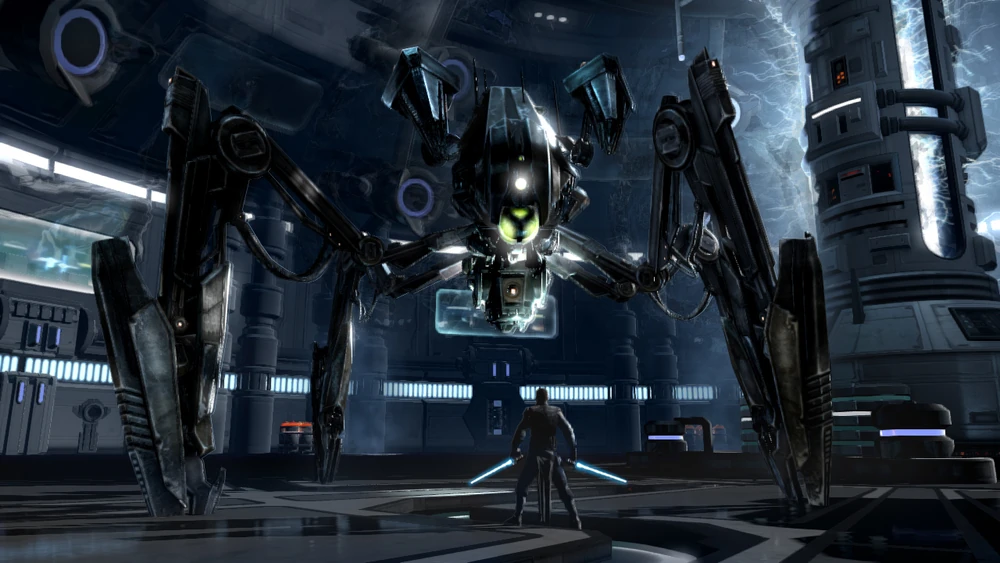
The Terror Walker, as featured in "Star Wars: The Force Unleashed II," is a formidable droid design used by the Galactic Empire, specifically designed for heavy combat situations and to instill fear in its opponents.
Physically, the Terror Walker is an imposing droid with a large, robust body supported by multiple legs, which gives it a spider-like appearance. Its design allows for stability and mobility across various terrains, while its armoured exterior provides significant protection against enemy attacks. The droid is equipped with heavy weaponry, including blaster cannons and missile launchers, making it a deadly adversary on the battlefield.
The manufacturer of the Terror Walker is not explicitly mentioned, but it is a product of Imperial engineering, designed to suppress and eliminate large groups of enemies with its overwhelming firepower and durability.
In terms of tactics, the Terror Walker is deployed in scenarios where the Empire needs to exert control and demonstrate its power. Its role is to break through enemy lines, destroy fortifications, and eliminate large numbers of enemy combatants. The sheer size and firepower of the Terror Walker make it a central element in Imperial assault strategies, often used to crush resistance and dominate battlefields with its intimidating presence and lethal capabilities.
| STR | DEX | CON | INT | WIS | CHA |
|---|---|---|---|---|---|
| 18 (+4) | 15 (+2) | 21 (+5) | 15 (+2) | 20 (+5) | 14 (+2) |
Legendary Resistance (3/Day). If the Terror Walker fails a saving throw, it can choose to succeed instead.
Circuitry. The droid has disadvantage on saving throws against effects that would deal ion or lightning damage.
Keen Hearing and Sight. The Terror Walker has advantage on Wisdom (Perception) checks that rely on hearing or sight.
Siege Monster. The Terror Walker deals double damage to objects and structures.
Frightful Presence. Each creature of the droid's choice that is within 120 feet of the droid and aware of it must succeed on a DC-18 Wisdom saving throw or become frightened for 1 minute. A creature can repeat the saving throw at the end of each of its turns, ending the effect on itself on a success. If a creature's saving throw is successful or the effect ends for it, the creature is immune to the droid's Frightful Presence for the next 24 hours.
Multiattack. The Terror Walker makes four weapon attacks
Cutting Laser. Ranged Weapon Attack. +8 to hit, 60/120 ft., one target. Hit: 30 (2d10+6) energy damage.
Slam. Melee Weapon Attack: +5 to hit, reach 10 ft., one target. Hit: 13 (3d8+6) kinetic damage.
Missile Launcher (3/Day). Ranged Weapon Attack: +8 to hit, range 120 ft., one target. Hit: 14 (6d8+6) kinetic damage, and each creature within 5 feet must make a DC 18 Dexterity saving throw, taking 16 (3d10) kinetic damage on a failed save, or half on a successful save.
Combined Laser (Recharge 5-6). The Terror Walker emits a Combined Laser in a line 100 feet long and 5 feet wide. Each creature within the area must make a DC-18 Dexterity saving throw. On a failed save, a creature takes 17 (5d10+6) energy damage and is pushed 15 feet away. On a success, the creature takes half as much damage and is not pushed.
Deflector Shield. The Terror Walker adds 5 to its AC against one attack that would hit it. To do so, the droid must see the attacker.
Cutting Laser. The Terror Walker makes one Cutting Laser attack.
Detect. The Terror Walker makes a Wisdom (Perception) check.
Rapid Reconstruction (Costs 2 actions). The droid regains 15 hit points.

The Tibidee is a majestic creature known for its harmonious presence in the skies of various planets. Seldom seen by the galaxy's denizens, these creatures float gracefully, riding air currents with their expansive wings. Tibidee communicates through a series of melodic sounds, creating a symphony that resonates through the air.
Tibidee possess large, bird-like bodies covered in soft feathers ranging from deep blues to vibrant purples. They have elongated beaks and wide, expressive eyes. Their most striking feature is their massive wingspan, capable of carrying them great distances without the need for frequent flaps.
These creatures are found in a variety of environments but prefer the open skies of planets with vast natural landscapes. They nest in high, unreachable places, away from predators and disturbances.
Tibidee are solitary creatures but occasionally gather in small flocks for migration or during mating season. They do not have a complex society or culture but are known to exhibit protective behaviours towards their young and nesting sites.
Tibidee mate for life and lay eggs in secluded nests. Both parents share the responsibility of incubating the eggs and raising the young. The chicks are taught to fly at an early age, quickly becoming independent.
Tibidee are generally passive, avoiding conflict whenever possible. They feed on small animals and occasionally fruits, hunting from the sky with precise dives. Their flight patterns are a beautiful sight, often described as a dance among the clouds.
| STR | DEX | CON | INT | WIS | CHA |
|---|---|---|---|---|---|
| 16 (+3) | 14 (+2) | 17 (+3) | 2 (-4) | 12 (+1) | 7 (-2) |
Keen Sight. The Tibidee has advantage on Wisdom (Perception) checks that rely on sight.
Pack Tactics. The Tibidee has advantage on an attack roll against a creature if at least one of the Tibidee's allies is within 5 feet of the creature and the ally isn't incapacitated.
Bite. Melee Weapon Attack: +5 to hit, reach 5 ft., one target. Hit: 10 (2d6 + 3) piercing damage.
Grab and Drop. The Tibidee tries to grab a Medium or smaller target with its talons. The target must succeed on a DC 13 Strength saving throw or be grabbed. While grabbed, the target is restrained, and the Tibidee can fly at half its speed. At any point, the Tibidee can drop the target, dealing 1d6 bludgeoning damage for every 10 feet the target was dropped, up to a maximum of 6d6 damage.

Ugnaughts are diminutive, porcine humanoids known for their distinct visual characteristics and societal customs. They are characterized by varying shades of pink skin, white hair, and black and red eyes. Physically, Ugnaughts are notable for their small stature, standing at an average height of about 3 feet 1 inch and weighing around 40 pounds.
In terms of their sociocultural characteristics, Ugnaughts hail from the homeworld Gentes and have their own language, Ugnaught. Their society is governed by councils of elected officers, and they live according to their “blood profession,†a trade passed down from parents to children. Interestingly, they practice a form of ritual combat known as a blood duel when the number of individuals in a given profession exceeds the need. These duels, which can be fatal, determine who inherits the right to a profession. Despite this practice, Ugnaughts are generally peaceful and have a rich culture. They are often considered meek and have been subjected to enslavement in some instances. A notable cultural aspect is their form of greeting; it is advised to bow silently to an Ugnaught and wait for a guttural purring as a sign of a positive response. The use of the common galactic greeting “yaa-yaah†is regarded as an insult among Ugnaughts.
Ugnaughts possess certain abilities that distinguish them from other species. They are skilled in crafting, with the choice of proficiency in specific crafting tools. Additionally, they have a unique affinity for technology, being capable of understanding and using tech powers to a certain extent.
| STR | DEX | CON | INT | WIS | CHA |
|---|---|---|---|---|---|
| 12 (+1) | 14 (+2) | 12 (+1) | 8 (-1) | 10 (0) | 10 (0) |
Heavy Pistol. Ranged Weapon Attack: +4, range 40/160 ft, one target. Hit 6 (1d8+2) energy damage.
Tusks. Melee Weapon Attack: +3, range 5 ft, one target. Hit 4 (1d6+1)

The V2-series commando droid is a variant of the BX-series commando droids, designed with advanced combat capabilities and specialized for high-risk infiltration and assault missions. These droids are part of the tactical units employed by the Confederacy of Independent Systems during the Clone Wars.
The V2-series droid features a sleek, humanoid design optimized for stealth and agility. It has a more menacing appearance compared to the standard battle droids, with enhanced armour plating for increased durability. Its appearance is similar to the BX series but with notable upgrades in armament and sensor technology, making it more deadly and efficient on the battlefield.
Manufactured by Baktoid Combat Automata, the V2 series was created as a response to the need for more specialized and effective droids capable of executing complex and high-stakes operations behind enemy lines.
The V2-series commando droid excels in covert operations, including sabotage, assassination, and intelligence gathering. Its programming includes advanced combat strategies, making it capable of independent decision-making and adaptation to changing combat conditions. The V2-series is often deployed in small, specialized squads for missions that require discretion and precision, capitalizing on its stealth capabilities to approach targets undetected before striking with lethal efficiency.
| STR | DEX | CON | INT | WIS | CHA |
|---|---|---|---|---|---|
| 14 (+2) | 15 (+2) | 14 (+2) | 16 (+3) | 12 (+1) | 10 (0) |
Circuitry. The droid has disadvantage on saving throws against effects that would deal ion or lightning damage.
Mimicry. The V2-Series can mimic simple sounds it has heard, such as a person whispering, a baby crying, or an animal chattering. A creature that hears the sounds can tell they are imitations with a successful DC-15 Wisdom (Insight) check.
Droid Synergy. Once per turn, the V2-Series can deal an extra 3 (1d6) damage to a creature it hits with a weapon attack if that creature is within 5 feet of an ally of the commando droid that isn't incapacitated.
Close Quarters Shooter. Other creatures provoke an opportunity attack when they move within 15 feet of the V2-Series, and it can use its blaster weapons when making opportunity attacks.
Multiattack. The V2-Series makes three weapon attacks
Blaster Carbine. Ranged Weapon Attack: +5 to hit, range 60/240 ft., one target. Hit: 6 (1d6+6) energy damage.
Hidden Blade. Melee Weapon Attack: +10 to hit, reach 5 ft., one target. Hit: 8 (1d4+6) kinetic damage.

The Baralou Verdant Strider is a captivating creature native to the warm, wet world of Baralou, a planet almost entirely covered by oceans and dotted with chains of small islands. This creature is a testament to the planet’s rich biodiversity, embodying the unique adaptations required to survive in such a dynamic environment.
Resembling a large, quadrupedal insect, the Verdant Strider is equipped with long, slender legs that allow it to navigate the complex terrain of Baralou’s islands and even wade through shallow waters during high tides. Its vibrant green, leaf-like wings serve a dual purpose: they enable the creature to glide from tree to tree across the islands, and their coloration provides excellent camouflage among the dense foliage of Baralou’s poisonous plants.
The Verdant Strider feeds on the sap of these plants, extracted using its sharp, needle-like proboscis. This unique diet has led to the creature developing a resistance to the plant toxins, an adaptation that protects it from most predators.
| STR | DEX | CON | INT | WIS | CHA |
|---|---|---|---|---|---|
| 12 (+1) | 16 (+3) | 14 (+2) | 6 (-2) | 12 (+1) | 10 (0) |
Proboscis Stab. Melee Attack: +3 to hit, range 5ft., one creature. Hit: 6 (1d6+3) kinetic damage.
Wing Buffet. The Verdant Strider flaps its wings forcefully, sending a gust of wind your way (within 10 ft.). Make a Dexterity saving throw (DC 13). If you fail, you’re knocked prone, taking 5 (1d4+3) kinetic damage. A successful save avoids these effects.

The Vulptex, or crystal foxes, are mysterious and elusive creatures native to the mineral-rich world of Crait. With bodies covered in crystalline bristles that shimmer in the light, these creatures are a breathtaking sight against the stark, white landscape of their salt-covered home.
A Vulptex stands about 2 feet tall at the shoulder, with a slender, fox-like body covered in thousands of sparkling crystal spines rather than fur. These crystals range in colour from translucent white to light blues and pinks, reflecting the mineral composition of their environment. Their pointed ears and narrow muzzles contribute to their keen sensory abilities, while their lithe form allows them swift movement across the treacherous terrain of their habitat.
Vulptices are native to the planet Crait, where they inhabit the vast, unending plains of salt and the intricate networks of caves beneath the surface. These caves, rich in minerals and bathed in subterranean darkness, are where the Vulptex truly thrives, away from predators and the harsh conditions of the surface.
Vulptices are not known to have a complex society or culture. They live in packs, showing communal instincts, particularly in hunting and evading threats. Their behaviours suggest a deep connection to their environment, moving with the seasons and changes in the terrain.
Little is known about the Vulptex's reproduction, but it is believed they give birth to live young, with litters consisting of two to three kits. These offspring are born without the crystal spines, which develop within the first few months of life.
Vulptices are primarily nocturnal, venturing out at night to hunt for food and water. They are omnivorous, feeding on small creatures and the mineral-rich vegetation unique to Crait. When threatened, a pack of Vulptex can use their crystal camouflage to blend into the icy surroundings, making them nearly invisible to predators.
| STR | DEX | CON | INT | WIS | CHA |
|---|---|---|---|---|---|
| 8 (-1) | 15 (+2) | 12 (+1) | 3 (-4) | 12 (+1) | 6 (-2) |
Crystal Camouflage. The Vulptex has advantage on Dexterity (Stealth) checks made to hide in icy or crystalline environments.
Pack Tactics. The Vulptex has advantage on an attack roll against a creature if at least one of the Vulptex's allies is within 5 feet of the creature and the ally isn't incapacitated.
Bite. Melee Weapon Attack: +4 to hit, reach 5 ft., one target. Hit: 5 (1d6 + 2) piercing damage.

Deep within the ice caves and unforgiving snowy landscapes of Hoth, the Wampa reigns as a silent phantom of the tundra. To the sparse settlers and scouts who dare venture into these icy wastelands, the Wampa is a legend made flesh - a reminder of the raw, untamed nature that governs the planet. Tales whispered in the glow of campfires speak of the Wampa's prowess, a creature both feared and respected, a solitary hunter whose very presence embodies the merciless beauty of its icy realm.
Standing nearly 3 meters tall, the Wampa is a towering figure of strength and primal ferocity. Its body, covered in a thick coat of white fur, blends seamlessly into the snowdrifts and icy formations of its habitat, making it an unseen spectre until it chooses to strike. The muscular arms end in deadly claws, capable of carving through ice and flesh with equal ease. The creature's face, a stark contrast to the softness of its fur, features piercing yellow eyes - windows to a soul driven by survival - and a gaping maw filled with razor-sharp teeth, perfectly evolved for its carnivorous diet.
The Wampa is uniquely adapted to the frozen wilderness of Hoth, thriving where few other creatures can. Its domain encompasses the sprawling ice fields and the labyrinthine caves that pierce the planet's crust, environments that offer both shelter and hunting grounds. Within these icy confines, the Wampa is both ghost and guardian, moving with a silence that belies its size, an apex predator in an ecosystem defined by cold and scarcity.
Wampas exhibit no known societal structures, living and hunting alone. Their interactions are primarily territorial, marked by fierce battles over hunting grounds when their paths cross. Despite this solitary existence, there is a certain majesty to their lone dominion over Hoth's icy expanses, a testament to their adaptation and survival in one of the galaxy's most unforgiving environments.
Details of the Wampa's reproductive cycle are shrouded in mystery, obscured by the inhospitable climes they inhabit. It is believed that Wampas are solitary even in their earliest moments, with young Wampas venturing into the icy wilderness shortly after birth to claim their dominion. The nurturing period, if it exists, is brief, instilling in each new generation the fierce independence necessary for survival.
Wampas are master hunters, employing stealth and power in equal measure. They use the blizzards and ice storms of Hoth to their advantage, stalking prey with an eerie silence before launching swift, devastating attacks. Their diet is opportunistic, consisting of anything they can overpower, including the tauntauns native to Hoth and unwary explorers. Despite their ferocious hunting methods, Wampas are not wanton killers, striking out of necessity rather than malice, a reflection of the harsh world they inhabit.
| STR | DEX | CON | INT | WIS | CHA |
|---|---|---|---|---|---|
| 18 (+4) | 13 (+1) | 17 (+3) | 2 (-4) | 12 (+1) | 7 (-2) |
Keen Smell. The Wampa has advantage on Wisdom (Perception) checks that rely on smell.
Snow Camouflage. The Wampa has advantage on Dexterity (Stealth) checks made to hide in snowy terrain.
Multiattack. The Wampa makes two attacks: one with its bite and one with its claws.
Bite. Melee Weapon Attack: +6 to hit, reach 5 ft., one target. Hit: 10 (1d12 + 4) piercing damage.
Claw. Melee Weapon Attack: +6 to hit, reach 5 ft., one target. Hit: 12 (2d6 + 4) slashing damage.

War Wyrms are the embodiment of the devastation wrought by the dark side, twisted by Sith alchemy into colossal engines of destruction. These behemoths slither through the underworld, emerging without warning to sow chaos, their presence a herald of the Sith's might and an omen of the darkness that lies beneath.
War Wyrms are gargantuan creatures of pure aberration, with thick, scaly hides that serve as natural armour against even the most potent weapons. With strength that can shatter fortresses and a form so massive it can tunnel through solid rock, these creatures bear immense jaws capable of swallowing creatures whole and a tail that can send enemies sprawling with a mere flick. They move with a grace that belies their size, their bodies rippling with muscle beneath their dark, energy-resistant scales.
These creatures are at home in the deep, dark places of the world, where the Sith have left their mark. War Wyrms burrow through the very bedrock, creating vast networks of tunnels with their tunneler ability, their paths often leading to Sith strongholds or places steeped in dark side energy.
War Wyrms have no society or culture; they are living weapons created by the Sith for a singular purpose: to serve as powerful tools of war. They understand commands in Sith, a testament to their creators' intention for them to be instruments of their will.
It is unclear how War Wyrms reproduce if they do at all. As Sithspawn, it's probable that they are not bred naturally but are rather the product of Sith alchemy and dark side rituals, spawned and shaped to fulfill their role as behemoths of battle.
These creatures are engines of chaos in combat, using their multi-attack to devastating effect, biting and lashing with their tails. Their gargantuan strength makes them siege monsters, capable of levelling structures and defences with ease. In the presence of their Sith masters or dark forcecasters, they are relatively easier to handle, exhibiting a strange kinship with those steeped in the dark side.
| STR | DEX | CON | INT | WIS | CHA |
|---|---|---|---|---|---|
| 24 (+7) | 16 (+3) | 18 (+4) | 1 (-5) | 10 (0) | 8 (-1) |
Tunneller. The wyrm can burrow through solid rock at half its burrow speed and leaves a 10-foot-diameter tunnel in its wake.
Legendary resistance (3/day). If the wyrm fails a saving throw, it can choose to succeed instead.
Gargantuan Strength. The wyrm's melee weapon attacks are considered enhanced.
Siege Monster. The wyrm deals double damage to objects and structures.
Sith-born. Dark forcecasters and Sith (species) have advantage on Animal Handling checks against war wyrms.
Multiattack. The wyrm makes two attacks: one with its bite and one with its tail.
Bite. Melee Weapon Attack: +13 to hit, reach 10 ft., one target. Hit: 20 (3d8+7) kinetic damage. If the target is a Large or smaller creature, it must succeed on a DC 17 Dexterity saving throw or be swallowed by the wyrm. A swallowed creature is blinded and restrained, it has total cover against attacks and other effects outside the wyrm, and it takes 21 (6d6) acid damage at the start of each of the wyrm's turns. If the wyrm takes 30 damage or more on a single turn from a creature inside it, the wyrm must succeed on a DC 20 Constitution saving throw at the end of that turn or regurgitate all swallowed creatures, which fall prone in a space within 10 feet of the wyrm. If the wyrm dies, a swallowed creature is no longer restrained by it and can escape from the corpse by using 20 feet of movement, exiting prone.
Tail. Melee Weapon Attack: +13 to hit, reach 10 ft., one target. Hit: 17 (3d6+7) kinetic damage. If the target is a creature, it must succeed on a DC 19 Strength saving throw or be knocked prone.
Cloud of Dust. The wyrm lashes out and scatters a dusty wake. Each creature within 10 feet of the wyrm, including around a corner, must succeed on a DC 15 Constitution saving throw or be blinded until the end of the wyrm's next turn. A creature that succeeds on the saving throw is immune to this effect until the end of the wyrm's next turn.
Double Tail (Costs 2 Actions). The wyrm makes two-tail attacks.
Move. The wyrm moves up to its speed.

Warden Droids represent a formidable presence in Imperial-controlled prisons. Physically, these droids are imposing figures, designed to be taller and bulkier than the average human to instil a sense of authority and control. Their frames are typically made of durasteel, giving them a dark, metallic appearance that complements their function. The design includes reinforced joints and a robust structure, enabling them to withstand physical confrontations and riot-like situations.
The head of a Warden Droid is often minimalist, equipped with sensory equipment necessary for identifying and tracking prisoners. This includes advanced visual and auditory sensors, capable of infrared and night vision, allowing them to operate effectively in various lighting conditions. Their arms are versatile, equipped with inbuilt stun batons or energy-based restraints, enabling them to subdue prisoners without causing permanent harm.
Behaviourally, Warden Droids are programmed with advanced combat algorithms, specializing in nonlethal tactics. They are adept in melee combat, using their physical prowess and built-in weaponry to overpower and subdue intruders. These droids are also equipped with programming that allows them to make tactical decisions quickly, efficiently coordinating with other security measures within the prison.
In a detention setting, Warden Droids are relentless. They rush towards any unauthorized entity with intimidating speed and precision, their primary objective being to stun and immobilize. They are designed to work in groups, often forming an impenetrable wall of defence around high-risk areas. Despite their focus on nonlethal methods, their presence alone is often enough to deter potential escape attempts or unauthorized entries.
Overall, Warden Droids are a critical component of the Imperial prison system, embodying the Empire's approach to control and order. Their physical design and behavioural programming make them ideal for maintaining security in high-risk environments, ensuring that prisoners remain contained and intruders are swiftly dealt with.
| STR | DEX | CON | INT | WIS | CHA |
|---|---|---|---|---|---|
| 14 (+2) | 13 (+1) | 10 (0) | 10 (0) | 11 (0) | 7 (-2) |
Stun claws. The warden droid may make a second claw attack as a bonus action.
Stun claws. Melee Weapon Attack: +5 to hit, reach 5 ft., one target. Hit 5 (1d6+2) subdual damage.

Womp rats, indigenous to the arid and harsh landscapes of Tatooine, have carved out a notorious reputation among the settlers and denizens of this desert planet. These creatures, while often dismissed as mere vermin, hold a peculiar place in the local lore and daily life, serving both as a pest and a challenge for those seeking to prove their marksmanship. The act of targeting womp rats, creatures agile and elusive, has evolved from a necessity to a sport, with tales of feats such as those achieved by Luke Skywalker - striking womp rats from a moving speeder—becoming a benchmark of skill and bravado among the youth of Tatooine.
Womp rats are formidable in size for rodent-like creatures, often growing to more than two meters in length. Their appearance is marked by a set of distinct, sharp teeth and coarse, matted fur that varies in shade from dusty browns to sandy beiges, allowing them to blend seamlessly into the desert backdrop. Despite their ungainly size, they move with surprising agility, aided by powerful hind legs and a long, balancing tail. Their eyes, small and dark, gleamed with a cunning intelligence, hinting at a keen survival instinct honed by life in one of the galaxy's most unforgiving environments.
The natural habitat of the womp rat spans the vast, sun-scorched deserts of Tatooine. These creatures are adept at surviving in extreme conditions, from the blistering daytime heat to the frigid nights. They construct intricate burrow systems beneath the desert's surface, which serve as homes, nurseries for their young, and sanctuaries from predators. These burrows, often hidden beneath rock formations or within the dunes, are central to the womp rat's survival strategy, offering protection from the elements and a base from which to launch their nocturnal forays.
Womp rats are not social creatures in the way sentient species are. They do not form structured communities or have complex social hierarchies. However, their interactions, particularly in the context of hunting and defending territory, reveal a level of cooperation and communal living driven by instinct. Womp rats occasionally gather in loose, temporary groups for specific purposes - such as overwhelming a particularly tough prey or scavenging in large numbers - before disbanding. These gatherings are pragmatic, driven by necessity rather than any sense of social bond.
The reproductive habits of womp rats contribute significantly to their status as a pervasive species on Tatooine. Females are capable of birthing multiple litters each year, with each litter consisting of several pups. This rapid reproduction rate, combined with a lack of natural predators in many areas of Tatooine, allows womp rat populations to grow quickly, often leading to conflicts with human settlers over territory and resources.
Womp rats are primarily nocturnal, venturing out of their burrows under the cover of night to feed and explore. They are opportunistic feeders, consuming a varied diet that can include plant matter, insects, small animals, and carrion. This diet flexibility is a key factor in their ability to thrive in such a harsh environment. Womp rats are known for their aggressiveness, particularly when cornered or when their nests are threatened. They will not hesitate to use their sharp teeth in defence or to assert dominance within their territory. Despite their often negative perception among Tatooine's human population, womp rats play a crucial role in the ecosystem, acting as both predator and prey within their desert food chain.
| STR | DEX | CON | INT | WIS | CHA |
|---|---|---|---|---|---|
| 7 (-2) | 15 (+2) | 11 (0) | 2 (-4) | 12 (+1) | 5 (-3) |
Keen Smell. The womp rat has advantage on Wisdom (Perception) checks that rely on smell.
Pack Tactics. The womp rat has advantage on an attack roll against a creature if at least one of the womp rat's allies is within 5 feet of the creature and the ally isn't incapacitated.
Bite. Melee Weapon Attack: +4 to hit, reach 5 ft., one target. Hit: 5 (1d6 + 2) piercing damage.

Wraids are formidable predators that roam the deserts of Tatooine and other arid worlds. Their hulking, reptilian forms and distinctive horned heads make them a fearsome sight. Solitary but sometimes found in small packs, they leverage their strength and natural armour to dominate the desert ecosystem.
Covered in thick, sandy-coloured scales, Wraids possess a muscular build, powerful legs for quick bursts of speed, and sharp horns and teeth for combat and hunting. Their pinkish-red coloration and powerful front legs allow for long, bounding strides, and they have large claws on their feet for digging and combat.
Native to desert planets like Tatooine, Korriban, and Tython, Wraids reside in rocky outcrops or caves, emerging during cooler temperatures to hunt.
Wraids display a basic level of social organization when hunting in packs, suggesting rudimentary social behaviour. They have no discernible culture, acting on instinct and survival needs.
Details on Wraid reproduction are scarce. It is speculated that they lay eggs in secluded nests, with the young being self-sufficient from birth.
Wraids are aggressive and territorial, attacking perceived threats or potential prey with little provocation. They are known to not harm passersby unless provoked, but their ferocious appearance and short temper make them popular quarry for sport hunters. Hunting Wraids became a significant activity in settlements like Anchorhead on Tatooine, with hunting lodges and sales of Wraid skull plates becoming a marketable trade​​.
The skull plates of Wraids are rumoured to have medicinal uses, creating a specific market for them. This aspect has contributed to the development of a hunting culture around these creatures, blending the lines between ecological impact and economic significance on frontier worlds.
| STR | DEX | CON | INT | WIS | CHA |
|---|---|---|---|---|---|
| 17 (+3) | 12 (+1) | 17 (+3) | 2 (-4) | 12 (+1) | 6 (-2) |
Pack Tactics. The Wraid has advantage on an attack roll against a creature if at least one of the Wraid's allies is within 5 feet of the creature and the ally isn't incapacitated.
Powerful Build. The Wraid counts as one size larger when determining its carrying capacity and the weight it can push, drag, or lift.
Multiattack. The Wraid makes two attacks: one with its bite and one with its tail.
Bite. Melee Weapon Attack: +5 to hit, reach 5 ft., one target. Hit: 10 (2d6 + 3) piercing damage.
Tail Swipe. Melee Weapon Attack: +5 to hit, reach 10 ft., one target. Hit: 12 (2d8 + 3) bludgeoning damage. If the target is a creature, it must succeed on a DC 13 Strength saving throw or be knocked prone.